
Chevening journey that moulds way more than an academic achievement; it moulds the way we envision being leaders and mentors.
This postgraduate year was full of supportive networks, collaborative learning, and global views that served to enhance my leadership insights. Upon graduating from my Chevening Scholarship, I knew the need to pay this spirit forward through the mentorship of people who have stood where, at one point in life, I did.
Following are five of the key lessons on mentorship and growth that I learned after postgraduate study.
Your international experience is one that deserves to be shared across the world.
It was studying abroad that brought me for the first time into a new academic framework, culture, and way of thinking. Only much later did I realize how valuable such experiences are when shared.
I started giving informal sessions to potential scholars and early-career professionals on unpacking what I learned abroad and translating that knowledge into local contexts.
This way, mentorship allows a kind of multiplication of impact: many building on the blocks laid by one.
Storytelling can be a means of instilling confidence. Most talented people usually doubt whether they are eligible to apply for various scholarships and leadership positions. That is why telling one's story is important to others, all the way from successes to times when there has been uncertainty. When people listen to a story about someone with the same fears who, nevertheless, succeeded, reframes what's possible for them. Storytelling turns teaching into an enabling practice-a pedagogy showing that confidence is not an innate characteristic but an acquired one. Where the way is not clear is where guidance matters most. Success in postgraduate applications, interviews, and academic transitions requires clear guidance.
Personal experience of the Chevening application process has taught me that the best support I can give is very clear, step-to-step guidance. This stems from fine-tuning the applicant's personal statement, getting ready for the interview, and understanding what awaits within the international academic environment.
Many times, all someone needs is that right piece of advice at the right time to move them forward. Inclusive mentorship builds strong leaders. Among the key things I took from my postgraduate experience was the important realization that diversity indeed empowers any learning environment. Further, this gets translated into my mentoring because I welcome people coming from different backgrounds, disciplines, and lived experiences.
Moreover, I encourage peer-to-peer circles wherein mentees learn from one another. Inclusive mentorship does not only expand opportunities, but it also creates leaders who understand and value diversity. Success after postgraduate study is not to end with securing a degree but is a sustained process through lifelong mentorship. For this reason, I build long-term relationships with previous mentees, celebrating successes and advising as their careers progress. Through this, the values of Chevening are reflected in ongoing leadership, service, and community engagement. Mentorship is not a moment; it's a commitment. These five lessons taught me a simple fact: true postgraduate success is not measured by personal achievements alone but by the doors we open for others. By sharing our experiences, building confidence, and committing to inclusive, long-term mentorship, we enrich the global Chevening community, giving rise to a new generation of leaders.
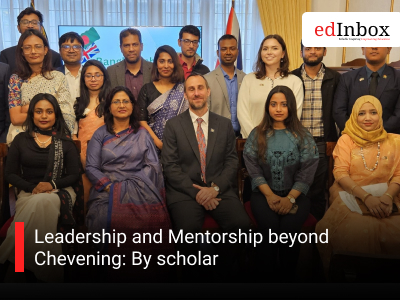
Leadership and Mentorship beyond Chevening: By scholar
Typography
- Smaller Small Medium Big Bigger
- Default Helvetica Segoe Georgia Times
- Reading Mode