
India's premier engineering institutions have stepped up faculty recruitment, filling more than 3,500 positions across the Indian Institutes of Technology (IITs) between September 2022 and May 2026.
The number marks a significant recruitment push after years of concern over faculty shortages.
But one crucial question remains unanswered: Are IITs now meeting the faculty-to-student ratio required to support their rapidly expanding student population?
A recent response from the Ministry of Education in the Lok Sabha provides details of the recruitment drive but does not disclose the current faculty-student ratio for individual IITs. It also does not provide institute-wise data showing sanctioned, filled and vacant faculty positions over the past five years.
That leaves the scale of the remaining faculty shortage difficult to assess.
IITs Fill Over 3,500 Faculty Vacancies Since 2022
The Ministry of Education told Parliament that all Central Higher Educational Institutions were advised in September 2022 to undertake faculty recruitment in “mission mode” to address vacancies.
Following the directive, IITs filled more than 3,500 faculty posts between September 2022 and May 2026.
However, the ministry stressed that faculty recruitment cannot be treated as a one-time exercise.
Faculty vacancies continue to emerge because of retirements and resignations. At the same time, IITs are expanding student intake, launching new academic programmes and increasing their teaching and research activities.
As a result, IITs continue to issue recruitment advertisements throughout the year.
Around 460 Visiting Faculty Members Working Across IITs
Permanent faculty recruitment is not the only way IITs are addressing their teaching requirements.
According to the ministry's parliamentary response, around 460 visiting faculty members are currently engaged in teaching and other academic activities across the IIT system.
The institutes also rely on:
- Guest faculty
- Adjunct faculty
- Professors of Practice
- Other academic appointments
These arrangements allow IITs to bring specialised expertise from industry, research organisations and other universities into their classrooms.
However, visiting and adjunct appointments are not equivalent to building a permanent faculty base.
For an institution that combines teaching with intensive research, a stable pool of permanent faculty remains important for long-term academic planning, student mentoring and research supervision.
What Did the Lok Sabha Question Ask?
The issue was raised by Congress MP Shashi Tharoor, who sought detailed information on faculty recruitment and staffing across the IIT system.
Among other things, the parliamentary questions sought to know:
- Whether the government or IIT Council has prescribed a faculty-to-student ratio
- The actual faculty-student ratio at each IIT
- The number of permanent and visiting faculty members over the past five years
- The sanctioned, filled and vacant faculty positions at individual IITs
- Measures to attract IIT alumni with PhDs into permanent faculty positions
- Steps to convert long-serving visiting or ad-hoc faculty members into permanent positions
The latest response, however, did not provide the detailed institute-wise figures sought.
IITs Have a 1:10 Faculty-Student Norm
The issue becomes more significant because IITs have a stated benchmark for faculty requirements.
An earlier Lok Sabha response in August 2025 stated that faculty posts in IITs are sanctioned on the basis of a 1:10 faculty-to-student ratio.
In simple terms, the norm envisages approximately one faculty member for every 10 students.
The government has also described faculty sanctioning as a dynamic and continuous process, with requirements reviewed according to the needs of individual IITs.
But the latest parliamentary response does not establish whether individual institutes are currently meeting that benchmark.
And that distinction is important.
Filling 3,500 vacancies may appear to represent a major improvement. But the number of appointments alone cannot determine whether the faculty shortage has been resolved.
The actual ratio depends on both the number of faculty members in position and the number of students enrolled.
IIT Faculty Shortage Has Been a Long-Standing Issue
The latest recruitment figures need to be viewed against a much longer history of faculty shortages in the IIT system.
In 2016, reports highlighted around 2,600 vacant faculty positions across IITs. At the time, the student-teacher ratio was reported to be approximately 15:1, higher than the desirable 10:1 benchmark.
The challenge became more complicated as the IIT system expanded.
Student intake increased, new programmes were introduced and the institutions expanded their postgraduate and doctoral education and research activities.
By August 2022, a parliamentary response placed the number of vacant teaching posts across the 23 IITs at 4,596.
The mission-mode recruitment programme launched soon afterwards was intended to tackle this substantial backlog.
IIT Council Considered Counting PhD Scholars
The faculty shortage had previously prompted the IIT Council to consider an unconventional approach to calculating the student-teacher ratio.
A proposal accepted by the council suggested that five PhD scholars could be counted as equivalent to one faculty member for the purpose of calculating the ratio.
The argument was that doctoral scholars also contribute to undergraduate teaching and other academic activities.
With approximately 26,000 PhD scholars in the IIT system at the time, the proposal could potentially have added nearly 5,000 faculty-equivalent positions to the calculation.
While the move was intended to address the gap between the existing ratio and the 1:10 benchmark, it also highlighted the difficulty IITs faced in recruiting sufficient permanent faculty.
Counting doctoral scholars, however, is different from increasing the number of permanent professors responsible for teaching, research supervision and institutional responsibilities.
IITs Expand Recruitment Beyond Traditional Channels
The Ministry of Education has indicated that the IIT Council has discussed several strategies to strengthen faculty recruitment.
These include:
- Rolling faculty recruitment
- Special recruitment drives
- Recruitment of foreign faculty
- Hiring eligible Overseas Citizen of India (OCI) cardholders
- Institutional performance reviews
- Regular monitoring of faculty recruitment
The measures reflect the growing competition for highly qualified academics.
IITs are competing not only with other Indian institutions but also with universities and research organisations around the world for faculty with strong academic and research credentials.
Is the IIT Faculty Shortage Really Over?
The recruitment of more than 3,500 faculty members since September 2022 is undoubtedly significant.
But recruitment numbers alone cannot answer whether IITs now have enough teachers.
The missing piece is current, institute-wise data.
Without knowing the number of students and faculty at each IIT — along with sanctioned, filled and vacant posts — it is difficult to determine whether the institutions are meeting the 1:10 benchmark.
The question is particularly important as IITs continue to increase student intake, introduce new programmes and expand research.
For students, faculty strength affects much more than classroom teaching. It can influence access to mentors, laboratory work, research opportunities, project supervision and overall academic interaction.
The next step, therefore, is not simply to count how many vacancies have been filled.
It is to ask whether the faculty strength has kept pace with the growth of the IIT student population.
Until detailed institute-wise figures are made available, the answer remains unclear.
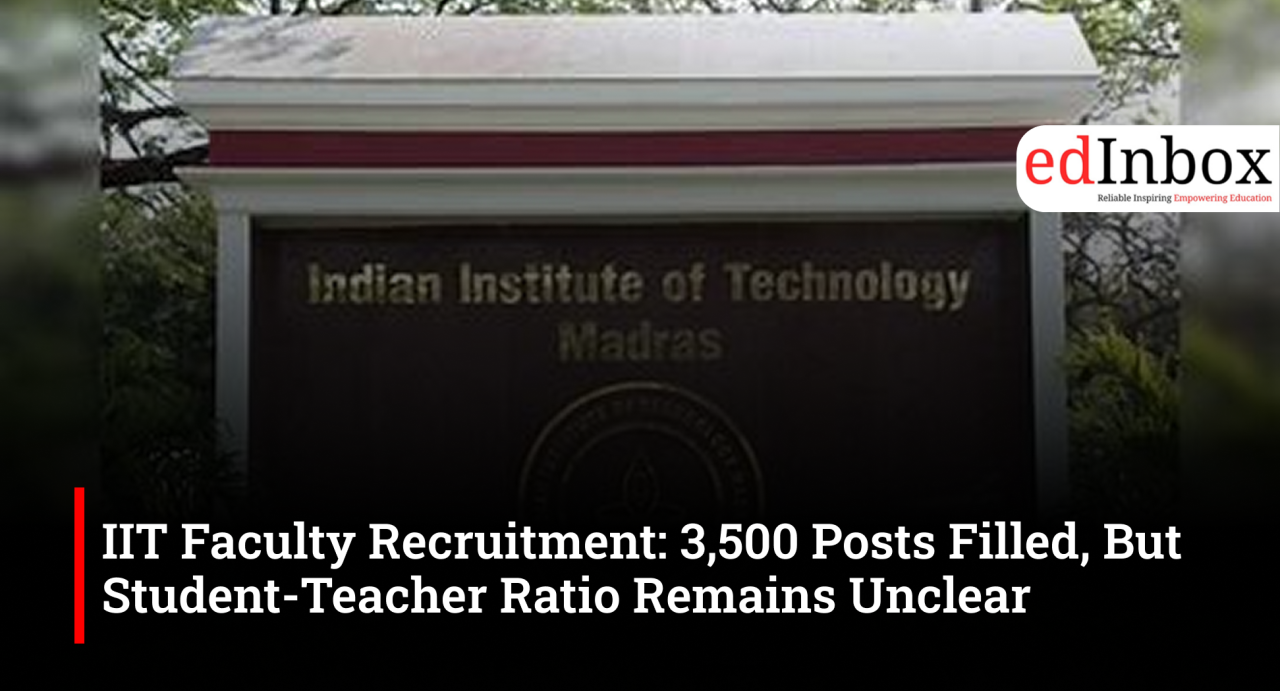
IIT Faculty Recruitment: 3,500 Posts Filled, But Student-Teacher Ratio Remains Unclear
Typography
- Smaller Small Medium Big Bigger
- Default Helvetica Segoe Georgia Times
- Reading Mode