Delhi CM Rekha Gupta vows to strengthen school education system with modern facilities and digital infrastructure
 Edinbox
 Blog
Edinbox
Edinbox Blog
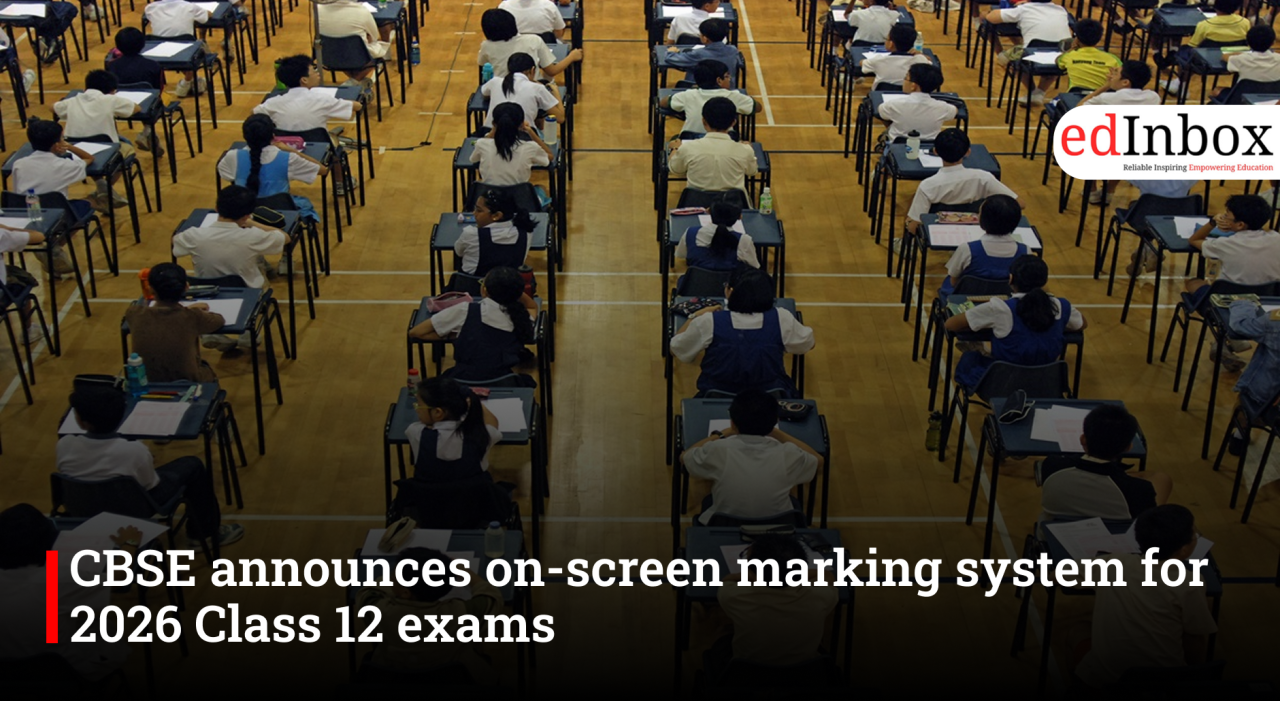
The Central Board of Secondary Education, CBSE, will introduce an On, Screen Marking, OSM system, for the live marking of answer books of Class 12 students that will be implemented starting the board exams 2026. The board exams will begin on 17th February.
In a circular issued to the principals of all the affiliated schools on 9th February, CBSE announced that the move was undertaken to intensify the effectiveness, openness, and precision of the assessment process.
The board clarified that as per the new system Class 12 answer sheets would be marked through digital mode while marking of answer books of Class 10 would remain physical in 2026.
CBSE Examination Controller Sanyam Bhardwaj pointed out that the OSM system would be totally eliminating the error of totalling, lessening the staff intervention through an automated coordination step, and allowing faster evaluations with wider teacher involvements. He added that the teachers would be able to carry out the evaluations from their respective schools which would definitely save a lot of time and transportation costs.
The board also said that post-result verification of marks would no longer be required, reducing manpower needs, while enabling teachers from all CBSE-affiliated schools, including those overseas, to participate in the evaluation process.Bhardwaj explained that the move was a green tech reform.
In order to make the change hassle, free, CBSE has instructed schools to upgrade their infrastructure to be computer labs with public static IPs, Windows OS 8 or higher systems with at least 4 GB RAM, updated web browsers, Adobe Reader, good internet connection (at least 2 Mbps), and uninterrupted power supply.
CBSE will be there for schools with training sessions, several dry runs, tutorial videos, and a helpline for solving problems. Teachers with Online Affiliated School Information System (OASIS) IDs will be allowed to access and familiarise themselves with the platform.
The board conducts Class 10 and 12 examinations annually in India and in 26 countries, catering to nearly 46 lakh students.
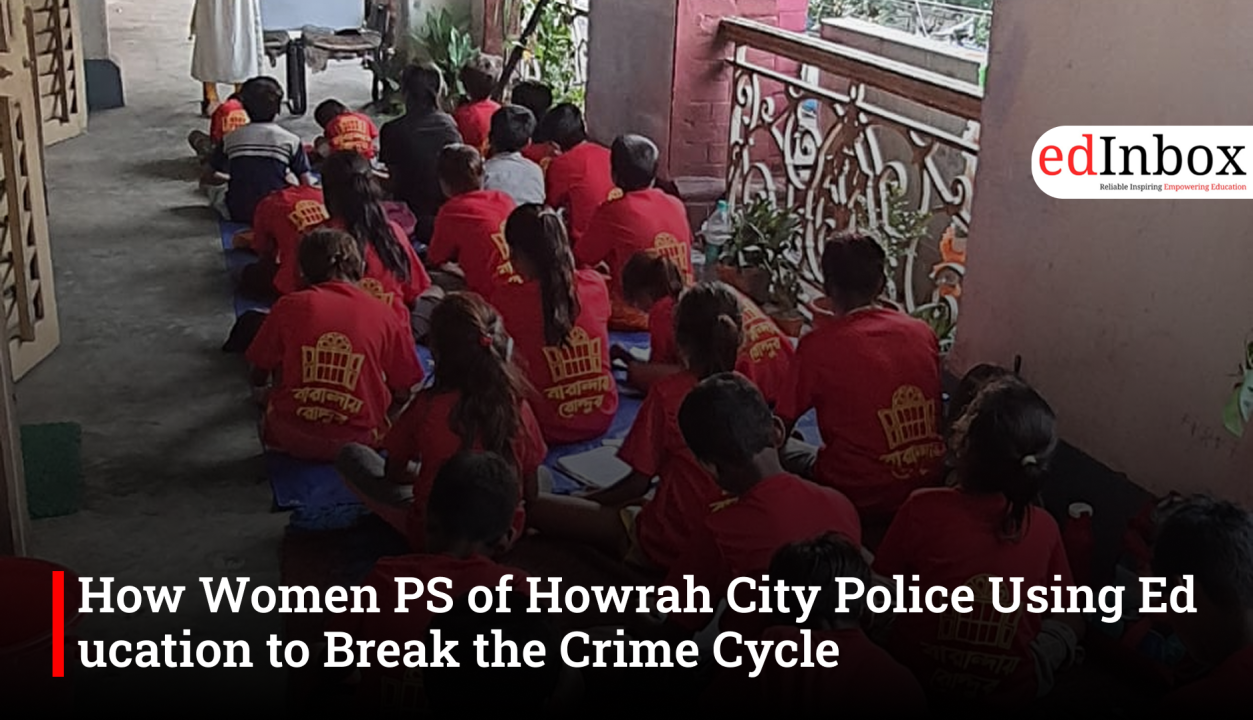
Every afternoon, sunlight spills across the balcony of the Women’s Police Station in Howrah. By 4 pm, it is no longer a corridor of authority but a classroom, lined with notebooks, chalk dust, and children who once slept on railway platforms. For them, this balcony is not just a place of learning. It is where the Indian Constitution finally found them.
The initiative, called “Barandaye Roddur” (Sunshine on the Balcony), began in March 2024 with 25 children. Today, it reaches 71 first-generation learners, many of whom had fallen out of the education system during the COVID-19 pandemic. Run by the Women’s Police Station under Howrah City Police, the programme is an unusual but powerful assertion of a basic human right: every child’s right to education.
According to UNICEF, India has nearly 6 million out-of-school children, with urban poverty, migration, and pandemic disruptions pushing thousands permanently out of classrooms. Data from ASER 2023 shows that learning loss among children from low-income households has been the sharpest, particularly in reading and basic numeracy. These gaps are not academic failures; they are right failures.
The children at Barandaye Roddur used to be ragpickers, platform dwellers, slum residents and among those most likely to be left behind. Many had attended primary school before COVID-19 shut classrooms and cut mid-day meals. As families slipped deeper into poverty, education became expendable. By the time schools reopened, children had aged out, lost routine, or been absorbed into survival labour.
“Once a child remains out of school for two or three years, the system quietly gives up on them,” says Inspector-in-Charge Kakali Ghosh Kundu, who leads the programme. “We refused to.”
The idea was simple but radical: if children could not return to school, the school would come to them—even if that meant a police station verandah. What began as informal teaching has now evolved into a structured, rights-based intervention. Trained teachers are appointed and paid, learning outcomes are reviewed regularly, and logistics—from books to meals—are institutionally supported.
“We are not running a charity class,” said Howrah Police Commissioner Akash Magharia. “This is an investment in crime prevention through education. When the state fails to educate a child, it later pays through the criminal justice system.”
The police identify vulnerable children during patrols near railway stations, ghats, and informal settlements—areas identified by child rights groups as high-risk zones for trafficking, child labour, and substance abuse. Instead of criminalising survival behaviours, officers intervene with trust, routine, and learning.
The results are measurable. All enrolled children are now formally admitted to government schools, a critical step toward restoring their constitutional rights under the Right of Children to Free and Compulsory Education Act, 2009. NGOs, local institutions, and alumni from government schools and St. Xavier’s College, Kolkata, support the transition as mentors and resource persons.
Education here extends beyond textbooks. Children receive regular health check-ups, hot meals, and access to yoga, dance, and vocational exposure. In 2026, several students performed at the Kolkata International Book Fair,once invisible children now visible on a public stage.
Globally, rights experts argue that education is the strongest long-term crime prevention tool. UNESCO estimates that every additional year of schooling reduces the likelihood of youth involvement in violent crime by nearly 20 per cent. Barandaye Roddur operationalizes that insight at ground level.
In a city still recovering from pandemic-induced inequality, this sunlit balcony offers a quiet lesson in governance: human rights do not need grand buildings,only political will, institutional accountability, and the courage to see children not as future offenders, but as rights-bearing citizens.
As chalk scrapes against the blackboard and children repeat the alphabet in unison, the message is unmistakable. This is not policing softened by compassion. This is the State fulfilling its most fundamental promise,one child, one lesson, one reclaimed future at a time.
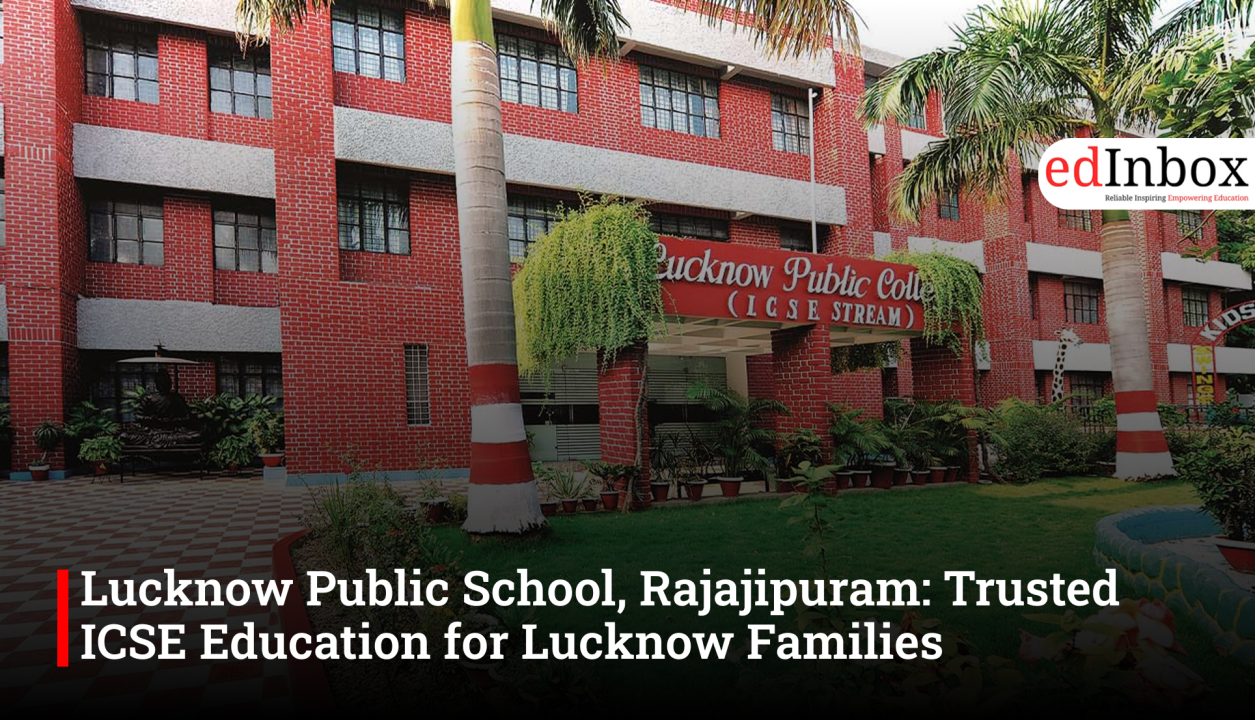
Lucknow Public School, located in Rajajipuram, provides parents with a consistent option for quality ICSE education from Playgroup to Class 12. The school has built a reputation over 28 years of good academic performance and balanced child development. LPS, founded by Dr. S.P. Singh, Member of Parliament, has focused on moral values and practical skills, making the children responsible citizens of the present day world.
The vision of Dr. S.P. Singh is based upon the concept of Pestalozzi of education as an expression of the natural, natural, harmonious growth of natural forces. At LPS A-Block, education extends beyond books to generate interest, innovation, and civic duty. The school has a student population of more than 4000 and 134 committed mentors, whose learning is based on competency, which is in line with the National Education Policy of India. It is situated in A-70, Karbala Road, Block A, Rajajipuram, Lucknow (UP 226017) as part of a chain of nine LPS branches in Uttar Pradesh.
Lucknow Public School provides consistent top performance. Arfeen Fatima scored 98.6% in Class 10 ICSE, and Aditya Sahani secured 2nd rank in India with 99.5% in Class 12 ISC. Students also organized the ASISC Zonal Basketball Tournament for the UP and UK zones and won national inter-school competitions. The school's alumni include IPS Amit Pal Singh and Rohit Verma, Civil Judge Shubham Tripathi, and Delhi University Assistant Professor Dr. Monika Gupta.
ICSE/ISC curriculum from Play/Pre-Primary to Class 12 (Science, Commerce, Humanities, Biotechnology in ISC).
|
Class |
Annual Fees |
|
Play to UKG |
₹53,400 |
|
I to V |
₹61,200 |
|
VI to VIII |
₹68,000 |
|
IX & X |
₹78,900 |
|
IX & X (Computer) |
₹88,500 |
|
XI & XII |
₹92,700 |
|
XI & XII (Computer) |
₹1,03,500 |
Admission requires only simple documents such as a birth certificate in Pre-Primary and Class 1 or Transfer Certificate of the previous school in higher classes. The Principal is the decision-maker on admission.
The application forms can be requested at the school office by parents or they can be downloaded at ablock.lpsc.co.in and submitted along with the necessary documents to be reviewed by the Principal and approved. The new students are required to enrol on this particular day otherwise the seat can be cancelled. Parent-Teacher Meetings, a school app to keep them updated on their child, and daily diary check make the families at par with the progress of their child.
The school has contemporary infrastructure such as two swimming pools, basketball, badminton, and tennis courts, science/math/computer labs, music room, kids' park, cafeteria, and mini auditorium. Evaluations include worksheets, class tests, half-yearly exams in September/October, annual exams in February/March, and MCQ tests to develop logical reasoning. Clubs include debating, math reasoning, ICT, communication, innovation, yoga, dance, music, painting, and creative writing. The student-run "News Accord" channel showcases activities on a monthly basis.
The Principal and Vice Principal work towards developing "future-ready" youth, along with Managing Director Sushil Kumar, Senior Director Asha Singh, Director Academics & Innovation Neha Singh, and Director Planning & International Affairs Harshit Singh. Administrative Head Mrs. Kanti Singh (former MLC) ensures smooth school functioning. Experienced teachers emphasize practical learning and 21st-century skills.
LPS A-Block targets Rajajipuram families that value established ICSE performance, sports centres, and alumni achievements in the civil services and academic fields. The friendly atmosphere around the Karbala Road, including modern amenities such as a school app, news channel, cashless charges, and a favourable community, makes it an ideal option.
Find another one in case you want CBSE curriculum, boarding, or fees less than 50,000 per year. The 80 percent attendance requirement lacking any medical waiver to promotion can be incompatible with some families.
Lucknow Public School, Rajajipuram offers a balance of academic excellence and genuine concern for students' development. With sound performance and family-friendly facilities, it serves as a community hub for Lucknow parents.Visit the campus for more information and one-on-one experience before choosing it for your child.
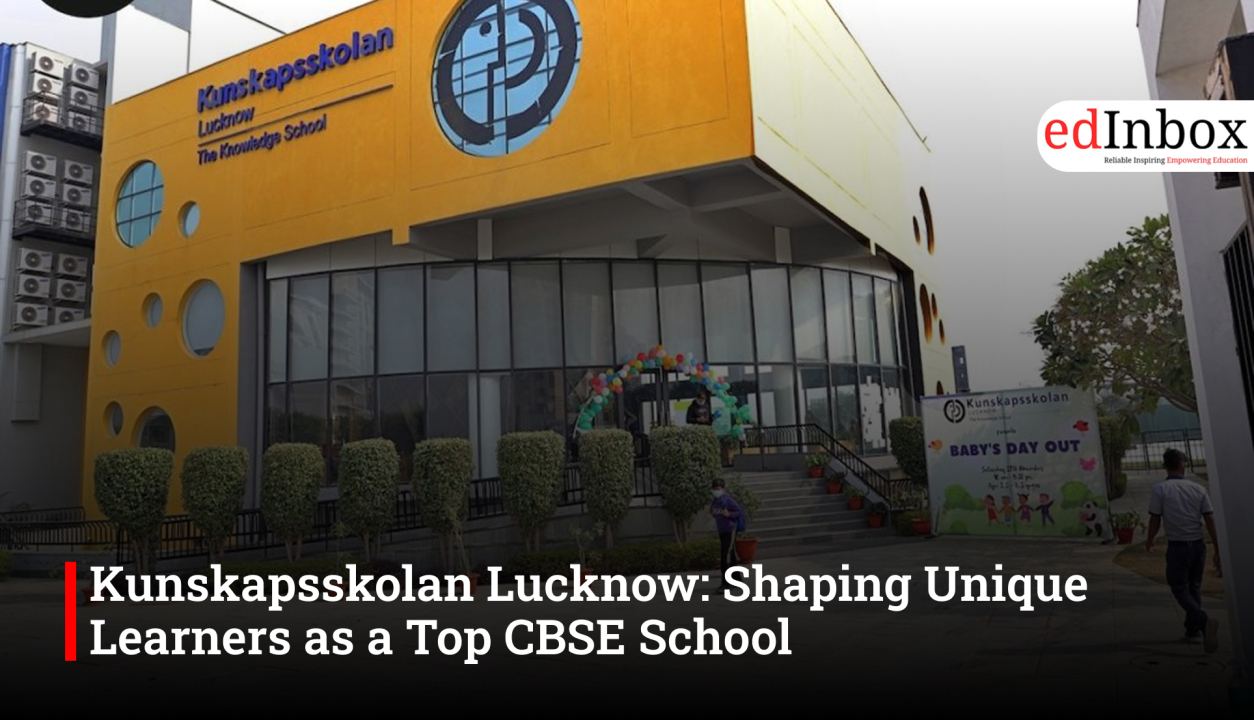
Looking for Best CBSE School in Lucknow where your child learns at his own pace? Kunskapsskolan Lucknow is a unique combination of the Swedish KED programme and CBSE curriculum. Established in 2016, this co-ed day school from Pre-Nursery to Class 12 helps every student to shine individually.
Kunskapsskolan Lucknow is run by Kunskapsskolan Smart Services Private Limited (KSSPL), a joint venture between Kunskapsskolan Education Sweden AB and Gyandarshan Eduventures Private Limited. Located on Sector-A, Pocket-1, Behind Medanta Awadh Hospital, Ansal Sushant Golf City, Shaheed Path, Lucknow-226030, it has an area of 16596 sqm.
The school is based on the innovative KED Programme from Sweden (started 1999), which is about personalised learning. Each child develops at his/her own pace, and develops skills such as collaboration and global awareness. Contact: +91 9591748899 or
Kunskapsskolan Lucknow is among the best CBSE schools in Lucknow because of this student-centred approach. Part of India's KED network with 4 schools (Gurgaon x2, Lucknow, Bengaluru) serving 3000+ students. Globally, Kunskapsskolan Sweden educates 13,000+ in 36 schools. Known for high academic results, parent satisfaction, and teacher quality via continuous improvement.
Kunskapsskolan Lucknow combines the innovative Swedish KED Programme with the best curricula to cater to each learner. The KED model provides personalised learning in the form of clear goal-setting and one-on-one coaching where students are responsible for their own progress and develop lifelong skills.
For CBSE students, the school is following a secured way from Pre-Nursery to Class 12, as per the needs of India but creating future-ready minds. Science, Commerce, and Arts streams help kids prepare for the board exams and much more.
The Cambridge curriculum gives flexibility to fulfil personal and cultural needs to unleash the potential of each child as a keen learner. It just fits in perfectly with the school's joyful, explorative atmosphere.
Kunskapsskolan also offers the IB Middle Years Programme (MYP) from the age of 11-16. This relates classroom lessons to real life increasing success with studies and careers.
Additional activities such as adventure camps, workshops, exhibitions and community activities stimulate creativity and global connections. All curriculums are collaboration-based, real-world skills and holistic growth, which makes the learning fun and effective.
Standard CBSE age limits: e.g., Nursery (2.5+ years). Admissions open Toddlers to Grade 11 (except 10/12). No strict cutoffs; based on interaction and aptitude test.
Modern 16,596 Sqm campus with IT labs, Music/Dance rooms, Sports Facilities, Transport. Focus on extracurriculars, collaboration across the globe. "A Day at Kunskapsskolan" contains: personalised goals, team projects, real-world skills. Vibrant Student Council, holidays posted on the web.
Qualified teachers who are trained in KED Programme focus on mastery-based learning. Low student-teacher ratio (~30:1).
Ideal for parents who are looking for personalised CBSE education in Lucknow. Suits ambitious students wanting global skills, flexible pacing and streams such as Science/Commerce. Great for your child to thrive in co-operative, technological environments near Sushant Golf City.
May not suit if you are into rigid traditional teaching/boarding. Avoid if high fees (~₹2.5-3.8L/year) are a strain on your budget, or if you are looking for Grades 10/12 seats. Not for those who are far away from Shaheed Path..
Kunskapsskolan Lucknow is your top pick for CBSE schooling in Lucknow with Swedish innovation. Empower your child for life, apply now at ked.edu.in/lucknow/ and let their true potential be polished at the best international school in Lucknow.
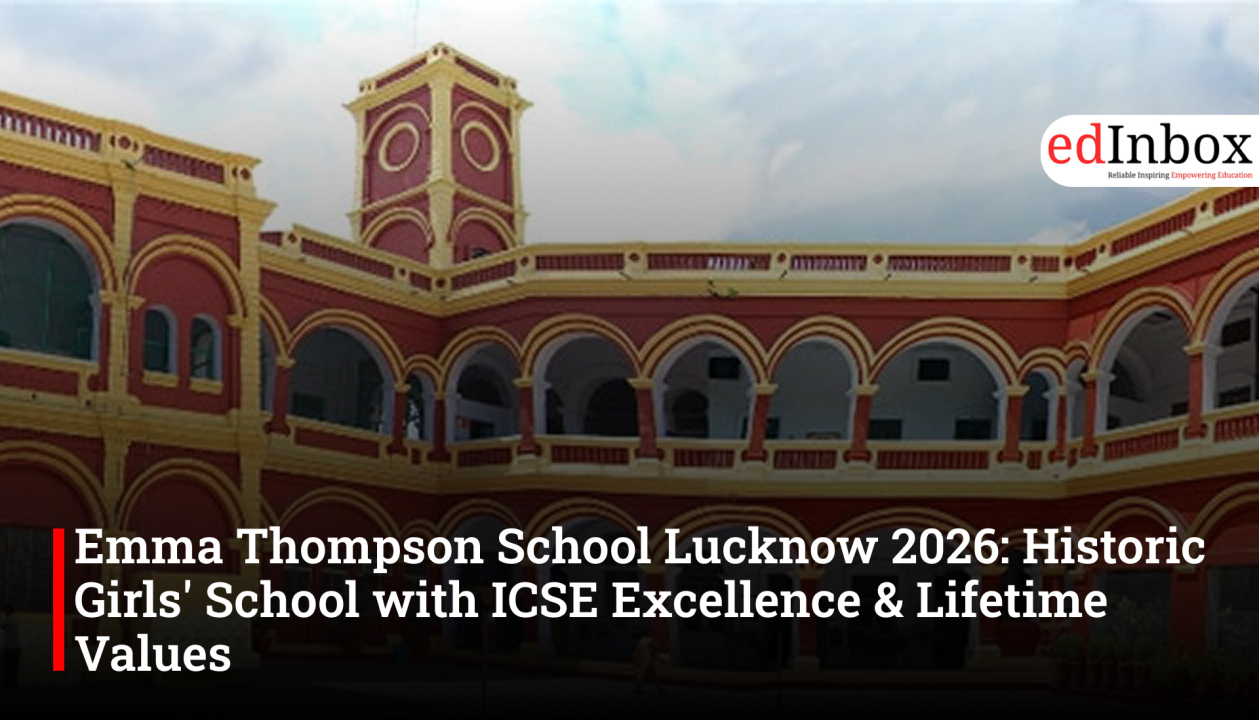
Worried about finding the best ICSE girls school near Lalbagh Lucknow for 2026 admissions? Parents consistently choose Emma Thompson School, named after Lalbagh Girls College's legendary Manager Ms. Emma Thompson. With roots tracing back to Isabella Thoburn's 1871 missionary vision, this premier day-cum-boarding girls school (Prep-Class 12) delivers CISCE-accredited ICSE (permanent recognition 2002) and ISC across Humanities, Commerce, and Science streams. In this article, you’ll find all crucial information about
Named after Ms. Emma Thompson, eminent Manager of Lalbagh Girls College, the school was opened on July 17, 1979 with Bishop J.R. Lance as chairman. Starting with six students in Nazirabad, it was developed from a Normal School to a high class institution for girls. Co-ed till Class V, turns into girls-only from Class VI and provides Humanities, Commerce and Science streams to ISC Class XII. The motto, "When you educate a woman, you educate a whole family," is what drives its mission.
Emma Thompson School was affiliated with CISCE since 1987, permanent class X (2002) and ISC Class XII (2004) permission. First ISC batch (16 girls, 1989), 84 ISC students (2004), and Science stream addition (2009). Recognized at state/national levels for sports excellence (Cricket, Basketball, Volleyball, Taekwondo), the school has a high quality standard in both academics and extracurriculars.
Emma Thompson School offers a strong ICSE curriculum from Preparatory to Class X, gaining permanent affiliation to the CISCE in 2002, followed by ISC Class XI - XII in Humanities, Commerce and Science streams (introduced 2004, Science added 2009). The academic framework focuses on self-directed learning under teacher guidance, as it frees young minds from rote ignorance towards enlightenment with supervised study hours and progress tracking with tutors. Moral and value education has the advantage of fitting in easily with professional training, creating life-long commitment to ethics in the workplace while evolving with today's issues in society. First ISC batch success (16 girls, 1989) and 84-student ISC cohort (2004) bear witness to the success of this curriculum.
Open to girls (co-ed Prep - Class V). Admissions are based on availability, previous academics (higher classes) and transfer certificates. Boarding requires parental consent and conformance to hostel regulations. Siblings and church families priority according to tradition.
Visit www.emmathompsonschool.com for application forms and deadlines. The process involves form submission, interaction/assessment, document verification, and payment of fees. Parents have to sign general rules, no expensive jewelry, stringent leave policies, restricted parental visits (twice monthly max). Regular meetings are scheduled with Hostel Warden for boarding queries
Smart classrooms with interactive white boards, Wi-Fi network, well-equipped playgrounds (all ages) and sports facilities (Cricket, Basketball, Volleyball, Table Tennis, Athletics, Taekwondo). Hostel has qualified doctor/nurse, infirmary, yoga/meditation, mini library, monthly outings, birthday celebrations and supervised study hours. Night assemblies consist of prayers.
Leadership is about "education of the future"-dynamic, values-driven teaching about the future with a combination of moral education and professional training. Principal and editor promote ethical commitment as well as academic rigor. Trained Physical Training Instructors conduct sports programs. Tutor system ensures that boarders are under personalized welfare and academic tutelage
Ideal for Lucknow parents looking for ICSE accredited board girls education (Class VI+) with boardings, good moral values, sports excellence and professional ethics training. Perfect for you if you value historic legacy (1871 beginnings), structured discipline, and family upliftment philosophy over co-ed flexibility.
Avoid looking for co-ed beyond Class V, CBSE curriculum, liberal hostel policies, or heavy arts over sports/structured academics. Not suitable for parents who want casual discipline and/or frequent access to parents.
Are you clear on Emma Thompson School's 2026 Admissions? Visit www.emmathompsonschool.com or call the Admission office. Lucknow's 150+ year legacy awaits your daughter at this values driven ICSE school.