
At dawn in a wheat field outside Moga, Punjab, farmer Gurmeet Singh bends down and rubs the soil between his fingers. It looks healthy enough, but he knows better. “The soil is tired,” he says quietly. “Every year we add more urea, and every year the crop demands more. It’s like an addiction.”
For farmers like Gurmeet, India’s battle against climate change is not fought in conference halls or policy documents. It plays out season after season, in rising input costs, weakening soils, and crops that seem increasingly vulnerable to heat and erratic rains.
A recent study published in the prestigious scientific journal Nature has opened a door that agricultural scientists have been knocking on for decades. The research suggests that a microscopic tweak , changing just two amino acids in a plant protein, could allow cereal crops like wheat, rice, and maize to tap into atmospheric nitrogen on their own. If realised in the field, this breakthrough could sharply reduce India’s dependence on urea fertilisers, a cornerstone of modern agriculture and one of the country’s most persistent climate and fiscal burdens.
“This is fundamentally a question of how plants respond to microbial cues,” the researchers write. “The answer hangs on a small molecular switch that decides whether a plant mounts an immune response or establishes a symbiosis.”
At stake is nothing less than a rethink of how food is grown in a warming world.
The Nitrogen Divide
For more than a century, modern agriculture has relied on industrial nitrogen fertilisers to feed crops. The Haber–Bosch process used to manufacture urea made it possible to feed billions, but at a steep environmental cost. Urea production alone consumes roughly two percent of global energy and releases vast quantities of carbon dioxide. Once applied to fields, excess nitrogen leaches into groundwater or escapes into the air as nitrous oxide, a greenhouse gas 277 times more potent than carbon dioxide.
India sits at the heart of this dilemma. It is among the world’s largest consumers of urea, spending tens of thousands of crores annually on fertiliser subsidies. Official data and IPCC assessments show particularly intense usage in Punjab, Haryana, and western Uttar Pradesh, where rice–wheat cropping systems dominate.
Yet nature offers a quieter alternative one that only some plants have mastered.
Legumes such as lentils, peas, and soybeans host specialised bacteria called rhizobia inside nodules in their roots. These microbes “fix” nitrogen directly from the atmosphere, converting it into a form plants can use. Cereals, despite being global staples, lack this ability. When bacteria approach their roots, cereals respond not with cooperation, but with hostility.
The Haber-Bosch Process
- The Haber-Bosch process, developed by Fritz Haber and later industrialized by Carl Bosch, provided a solution to this problem by creating an artificial method for nitrogen fixation.
- The process involves combining nitrogen (N2) and hydrogen (H2) under high pressure (around 200 atmospheres) and temperatures of about 400-500°C, in the presence of a catalyst, to produce ammonia.
- Ammonia produced through this process is a critical ingredient in synthetic fertilizers, which are used to enrich soil and promote plant growth.
- The availability of ammonia-based fertilizers has enabled the world’s agricultural productivity to grow exponentially, contributing to a sevenfold increase in the global food supply during the 20th century.
Gatekeepers at the Root
The key difference lies in receptor proteins embedded in plant root cells molecular gatekeepers that decide whether an approaching microbe is friend or foe.
In legumes, a receptor protein called NFR1 plays a remarkable role. It suppresses immune alarms, allowing symbiotic bacteria to colonise the roots and begin nitrogen fixation. Cereals, however, carry receptors such as CERK6 or RLK4 that do the opposite. They interpret bacterial signals as threats and trigger immune defences.
The Nature study reveals that this difference may hinge on something extraordinarily small.
By swapping just two amino acids in a critical region of the cereal receptor ,known as the “symbiosis determinant” , scientists were able to flip the plant’s response. “The immune system is not switched off,” the researchers note, “but rewired to discriminate between pathological and beneficial microorganisms, such as nitrogen-fixing bacteria.”
In barley, this modification led to the formation of root nodules strikingly similar to those seen in legumes. The plant’s behaviour towards bacteria changed, the researchers observed, “from hostile to symbiotic” , a functional reawakening of an ancient biological pathway lost over millions of years of evolution.
Why This Matters for India
For climate scientists and agricultural economists alike, the implications are profound.
“Urea production alone accounts for enormous energy consumption and carbon emissions,” explains Zaitsev, one of the researchers. “And once fertilizer is applied, nitrous oxide emissions follow.”
If cereals could fix even a fraction of their nitrogen needs, the ripple effects would be immense. Agricultural scientists estimate that India could save up to ₹40,000 crore annually on fertiliser subsidies. According to projections cited by the Indian Council of Agricultural Research (ICAR), nitrous oxide emissions from agriculture could fall by nearly one-third.
But the benefits would not be limited to climate metrics or government budgets.
“Regions experiencing urea-laden groundwater, such as Punjab, would see immediate relief,” notes an ICAR official. Years of excessive fertilizer use have contaminated soils and aquifers, contributing to declining soil health and public health risks. In climate-vulnerable regions like Bundelkhand or the floodplains of Bihar, reduced dependence on fertilisers, often applied erratically due to monsoon variability, could stabilise yields and input costs.
From Lab Bench to Field Furrow
Despite the excitement, scientists caution against premature celebration. What works in controlled laboratory conditions must still survive the complexity of real fields , pests, droughts, soil diversity, and farmer practices.
“Translating this discovery to wheat, rice, and maize will require careful field trials, regulatory clarity, and public trust,” the researchers acknowledge.
In India, that last element may be the most delicate. Gene editing, even when it does not involve transgenic modification, remains politically sensitive. Public debates around genetically modified crops have been shaped by decades of distrust, activism, and uneven communication.
Yet agricultural experts argue that the stakes have changed.
“This is not about boosting yields at any cost,” says one senior agricultural scientist. “It’s about reducing chemical dependence, lowering emissions, and giving farmers resilience in a climate-stressed future.”
A Different Kind of Green Revolution
India’s first Green Revolution transformed fields through fertilisers, irrigation, and high-yield seeds , but it also left behind ecological scars that farmers are now paying for. The discovery described in Nature hints at a second transformation, one that works with biology rather than overwhelming it.
“Sometimes climate solutions are not about scaling up,” one researcher reflects, “but about switching on.”
India’s first Green Revolution transformed agriculture through fertilisers, irrigation, and high-yield seeds but it also left scars that farmers now live with. The discovery described in Nature hints at a different kind of transformation, one that works with biology rather than overpowering it.
Back in Moga, Gurmeet looks across his field as the winter sun rises. “If the plant can learn to take care of itself,” he says, “maybe the soil can heal too.”
For now, the change exists only at the molecular level — two amino acids, invisible to the eye. But beneath India’s most familiar crops, a quiet possibility is taking root: that the future of low-carbon farming may already be written into the plants themselves, waiting to be switched back on.
Whether this discovery ultimately reshapes Indian agriculture will depend on how science, policy, and society respond. But for now, beneath the surface of the country’s most familiar crops, a quiet revolution is stirring , one that suggests the future of low-carbon farming may already be written into the plants themselves.
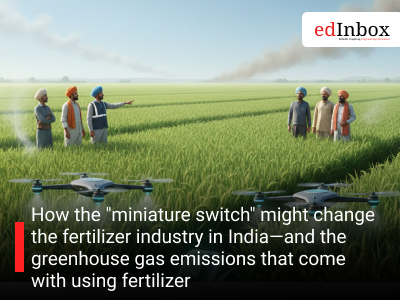
How the "miniature switch" might change the fertilizer industry in India—and the greenhouse gas emissions that come with using fertilizer
Typography
- Smaller Small Medium Big Bigger
- Default Helvetica Segoe Georgia Times
- Reading Mode