
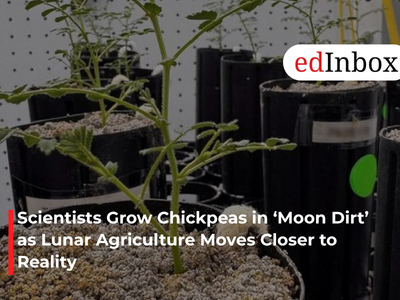
People might think that lunar hummus is something from a movie, but it is indeed doable. The soil that was used by Texas A&M scientists for growing chickpeas was largely composed of simulated lunar regolith; this was their way of demonstrating how crops could be raised on the moon. It is a very good basis for keeping humans in space for a long time.
To grow chickpeas, the researchers relied on "Myles", a variety of chickpea which was put in soil that combined lunar simulant and vermicompost, i.e. worm's excrement which provides the necessary nutrients. Seeds were dusted with fungi that help plants grab key minerals. Plus, it blocks toxic metals like aluminum. The soil mix came from Space Resource Technologies and matches Apollo-era regolith NASA collected decades ago.
"Chickpeas are high in protein and must-have nutrients. Making them strong candidates for space crop production," said Jessica Atkin, a doctoral candidate and NASA fellow at Texas A&M's Department of soil and crop Sciences, who led the study published on March 5, 2026, in Scientific Reports. Sara Oliveira Santos, a postdoctoral researcher at the university of texas Institute for geophysics, added, "We need to grow food locally on the moon or mars - transporting everything from Earth isn't workable."
And plants grown in lunar soil could generate oxygen and help sustain microbial life that supports human habitats, based on jyothi Basapathi Raghavendra of northumbria University, lead author of a related study on martian soil simulants.
Lunar regolith is crushed rock and dust, often sharp, glass-like. It forms over billions of years from meteorite hits. Though it has some nutrients, it's inorganic and doesn't support plants. Previous work showed compost helps, but this study looked at microbes working with plants. The fungi colonized chickpea roots even in 100% regolith simulant, holding particles together so the soil acts more like Earth soil. Probably, that helps reduce stress on plants. A single seed germinating in a sealed chamber would be a good sign.
They haven't tasted the moon-grown chickpeas yet. Testing for metal buildup is underway because lunar soil holds high levels of iron - helpful - and aluminum, possibly harmful. Safety and nutrition results are expected later this year. More or less, researchers expect these findings to inform future farming efforts on the moon.
The team kept spirits high in the lab with a lighthearted touch: lunar-themed songs like Bad Moon Rising played while the chickpeas grew, and a picture of chickpeas on the moon was hung on the wall. “Kind of silly, but something to aim for,” Ms. Atkin said.
“This is a small but crucial first step toward lunar agriculture,” Oliveira Santos concluded. “We have demonstrated it is feasible, and we are moving in the right direction.
Scientists Grow Chickpeas in ‘Moon Dirt’ as Lunar Agriculture Moves Closer to Reality
Typography
- Smaller Small Medium Big Bigger
- Default Helvetica Segoe Georgia Times
- Reading Mode