
The Supreme Court has directed the Assam government to stop the appointment or absorption of teachers in schools and colleges on the basis of the provincialisation scheme till further orders.
While hearing a PIL, a bench of Chief Justice Surya Kant, Justice Joymalya Bagchi and Justice V Mohana was informed by senior advocate Ranjit Kumar, appearing for the petitioners Rajesh Chauhan and Madhab Mukunda Pujari, about the details of the submissions made by them. Notices were issued to the Centre, the Assam government and senior officials of the education departments of Assam.
The PIL questioned the constitutional validity of the provincialisation of teachers and personnel of venture educational institutions in Assam. As per the provincialisation scheme, the state bears part of the liabilities of eligible venture educational institutions, including payment of salary, gratuity, pension, and leave encashment as per the rules applicable to government employees.
Challenge to recruitment process
The petitioners argued that as per the provincialisation scheme, the recruitment process of teachers and employees of venture educational institutions was not through a fair, just, and transparent selection process.
The petitioners’ counsel submitted that such recruitment not only violates Articles 14 and 16 of the Constitution but also the Right of Children to Free and Compulsory Education Act, 2009, and the National Council for Teacher Education Act, 1993.
The plea questioned the validity of the Assam Education (Provincialisation of Services of Teachers and Re-organisation of Educational Institutions) Act, 2017. This law, as contended by the petitioners, allows the provincialisation of even those personnel who do not meet the eligibility criteria as stipulated by various statutes, rules, and regulations governing teacher eligibility.
Besides, the petitioners’ counsel said that under the aegis of the Assam Education (Provincialisation of Services of Teachers and Re-organisation of Educational Institutions) Act, 2017, even tutors can be provincialised. They argued that people not meeting eligibility criteria should not be allowed to teach in government or government-aided educational institutions.
Supreme Court puts appointments on hold
The Supreme Court issued an interim order directing that no teacher should be appointed or absorbed under any law till further orders. The plea also questioned the validity of the statutory framework in so far as it relates to the Right of Children to Free and Compulsory Education Act, 2009, the National Council for Teacher Education Act, 1993, the University Grants Commission Act, 1956, and other rules and regulations.
The petitioners have sought a review of teachers and employees already provincialised under the Assam Venture Educational Institutions (Provincialisation of Services) Act, 2011, and the Assam Education (Provincialisation of Services of Teachers and Re-organisation of Educational Institutions) Act, 2017. They want a scrutiny of whether these personnel meet eligibility criteria as stipulated by statutes and rules.
The petitioners have also moved for a direction to the government that no teacher shall be appointed through the provincialisation scheme unless they meet the eligibility criteria as stipulated by law. They have sought a direction for adopting a fair, just, transparent, and merit-based system of teacher recruitment as provided under the Constitution and various statutes.
The Supreme Court’s interim order is likely to have a bearing on Assam’s teacher recruitment and provincialisation policy as the PIL is being heard.
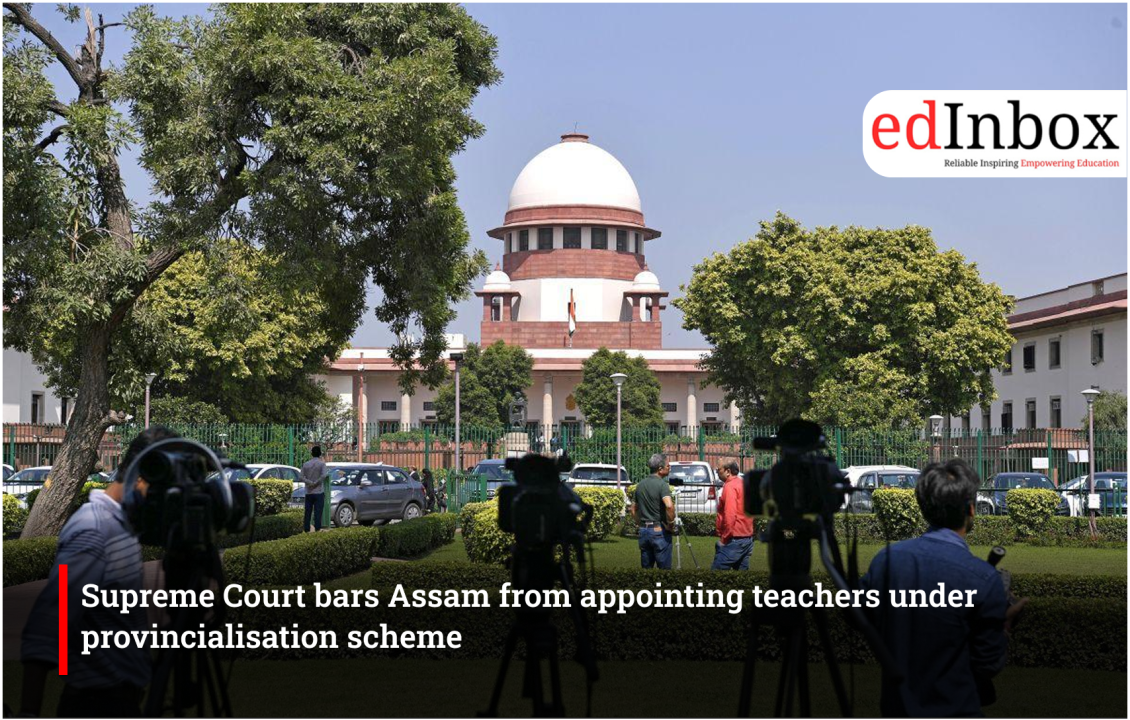
Supreme Court bars Assam from appointing teachers under provincialisation scheme
Typography
- Smaller Small Medium Big Bigger
- Default Helvetica Segoe Georgia Times
- Reading Mode