
In a significant development on education rights, the Supreme Court of India has issued notices to the Centre, all States, and Union Territories on a Public Interest Litigation (PIL) seeking effective implementation of the Right of Children to Free and Compulsory Education Act 2009.
A Bench comprising Chief Justice Surya Kant and Justice Joymalya Bagchi took cognisance of the plea filed by petitioner Haripriya Patel, who has urged the court to ensure that the Right to Education (RTE) mandate is uniformly enforced across the country.
The RTE Act guarantees free and compulsory education for children aged 6 to 14 years, making it a fundamental obligation for governments at both central and state levels. However, the PIL argues that its implementation remains inconsistent across regions, affecting access and quality of schooling.
During the hearing, the Chief Justice observed, “We are issuing notices. We would like to examine the issue,” indicating that the court intends to closely scrutinise the matter before proceeding further.
In addition to the RTE Act, the petitioner has also sought directions for the implementation of the National Education Policy 2020 across all States and Union Territories. The plea highlights the need for a cohesive national approach to education reforms, especially in ensuring equitable access and standardisation.
The case brings renewed attention to gaps in India’s school education system, particularly in areas such as infrastructure, teacher availability, and policy execution. While the RTE Act has significantly expanded enrolment over the years, concerns remain regarding its on-ground enforcement.
With notices now issued, responses from governments are expected to shed light on the current status of implementation and the challenges faced in delivering universal elementary education.
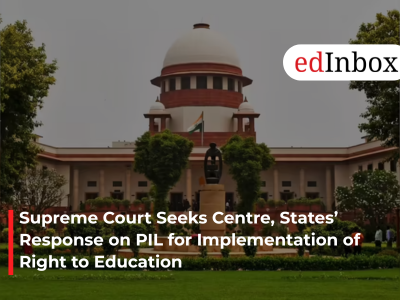
Supreme Court Seeks Centre, States’ Response on PIL for Implementation of Right to Education
Typography
- Smaller Small Medium Big Bigger
- Default Helvetica Segoe Georgia Times
- Reading Mode