
The Supreme Court on Thursday observed that police can use pellet guns only in exceptional circumstances, while seeking a response from the Centre on the standard operating procedure (SOP) and rules governing their deployment during protests. The remarks came during the hearing of a petition challenging the use of metallic pellet guns against protesters at Delhi's Jantar Mantar.
A Bench comprising Chief Justice of India Surya Kant and Justice Joymalya Bagchi issued notice to the Union government, asking it to place on record the rules and SOP regulating the use of pellet guns by police forces.
Supreme Court seeks clarity on police use of pellet guns
Appearing for the petitioners, senior advocate Vrinda Grover argued that the police had fired kinetic metallic projectiles, not rubber or plastic pellets, during the protests. She contended that metallic pellets were recovered from the bodies of protesters, raising serious concerns about the proportionality of force used.
Grover told the court that the nature of the crowd should determine the level of force employed and questioned the deployment of metallic pellets when the protesters were not a violent mob.
Responding to the submissions, Justice Bagchi noted that existing police rules permit the use of pellet guns only in "exceptional circumstances" as part of a graded response to crowd control. However, he clarified that the petitioners would need to demonstrate whether the use of metallic pellets violated the existing legal framework.
Metallic pellets under legal scrutiny
The petitioners clarified that they were not challenging the use of pellet guns in general, but specifically objecting to the deployment of metallic pellets, which they argued pose a significantly higher risk of serious injury compared to rubber or plastic alternatives.
Grover urged the Centre and the Delhi Police to produce any standing orders authorising the use of metallic pellets. She submitted that no publicly known Delhi Police directive permits such deployment and expressed hope that the government would not endorse firing metallic pellets at students or peaceful protesters.
The court indicated that it was willing to examine the legality of pellet gun use in the specific incident while assessing whether it complied with the principles of proportionality and graded force.
CJI suggests judicial guidelines for pellet gun use
Chief Justice Surya Kant suggested that the petition could seek broader judicial guidelines regulating the use of pellet guns rather than focusing solely on the individual incident.
"In light of the alleged excessive use, your prayer should be that the court lays down a protocol regarding the use," the CJI observed. Grover agreed, reiterating that the concern related specifically to metallic pellets.
During the hearing, Justice Bagchi also referred to an outdated police regulation previously struck down by the Calcutta High Court that had directed officers to fire bullets at the chest to conserve ammunition. Solicitor General Tushar Mehta remarked that the rule appeared to be from the colonial era, with Justice Bagchi noting that it had already been invalidated.
Court backs peaceful protests but acknowledges graded force
The Bench emphasised that peaceful protests deserve protection and that police should follow a non-violent approach while managing demonstrations. At the same time, Justice Bagchi observed that graded force may sometimes be necessary, depending on the circumstances confronting law enforcement personnel.
The Supreme Court has now sought the Centre's response and directed the government to place on record the SOP and rules governing the use of pellet guns, a move that could shape future judicial guidelines on crowd-control measures and police use of force during public protests.
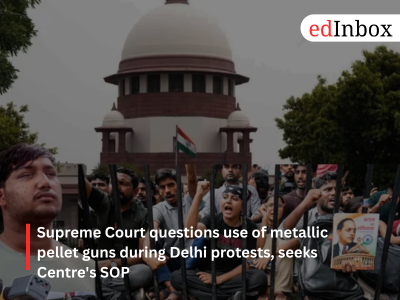
Supreme Court questions use of metallic pellet guns during Delhi protests, seeks Centre's SOP
Typography
- Smaller Small Medium Big Bigger
- Default Helvetica Segoe Georgia Times
- Reading Mode