
A section of graduating students at the National Academy of Legal Studies and Research (NALSAR), Hyderabad, has urged the university administration to reconsider its decision to invite Chief Justice of India Surya Kant as the chief guest for the 2026 convocation.
Students from the 2025-26 graduating batch have written to the Vice-Chancellor, Registrar, faculty members and other university officials, expressing concerns over the invitation and referring to recent judicial developments and remarks attributed to the CJI.
The students cited the ongoing controversy surrounding the NEET-related protests, remarks concerning demonstrations at Jantar Mantar and the controversy over Justice Surya Kant's reported reference to some young people as "cockroaches".
In their letter, the students said the invitation "does not sit right" with them, arguing that the CJI's reported remarks and recent developments have raised concerns about his approach towards students and young people.
"From referring to the youth as ‘cockroaches’ to making insensitive statements about not having time to watch videos of police brutality, the CJI has shown apathy towards students like us," the students wrote.
They further argued that inviting the CJI to the university to confer degrees would conflict with values they associate with constitutional accountability and academic freedom.
NALSAR Students Seek Reconsideration of Invitation
The graduating students have urged the university administration to reconsider the proposed invitation and said the issue should not be viewed as a concern raised by only one batch.
"We request the University Administration to reconsider its proposal to extend the invitation to the Hon’ble CJI, and hope that the University treat this as a shared concern across the graduating cohorts rather than one raised by a single batch," the letter stated.
The development has brought the debate surrounding Justice Surya Kant's remarks and the wider youth protests back into focus in an academic setting.
How Did the 'Cockroach' Controversy Begin?
The controversy surrounding the "cockroach" remark originated during a Supreme Court hearing in May concerning alleged fake law degrees and individuals entering the legal profession without proper qualifications.
Remarks made during the proceedings were subsequently circulated widely on social media. Some interpreted them as a reference to unemployed or young Indians, triggering criticism and giving rise to the satirical political initiative known as the Cockroach Janta Party, or CJP.
Justice Surya Kant later clarified that his remarks had been misconstrued. He said the reference was directed at people allegedly using fake or bogus degrees to enter professions such as law and journalism, rather than unemployed youth as a whole.
Cockroach Janta Party and Gen Z Protests
The Cockroach Janta Party was subsequently launched by Boston University student and political communications strategist Abhijeet Dipke.
Initially emerging as an online satirical response, the initiative later developed into a youth-led campaign using the cockroach as a symbol of resilience. Its supporters raised issues including unemployment, examination-related concerns and governance through social media campaigns and protests.
The group later participated in demonstrations, including protests at Delhi's Jantar Mantar, and became associated with the wider 2026 Gen Z protests.
The youth-led protests brought issues including examination irregularities, unemployment and police action against demonstrators into public focus. The use of the cockroach symbol became a prominent feature of the movement.
The NALSAR students' letter has now brought the controversy into the university environment, with students questioning whether Justice Surya Kant should preside over their convocation.
Justice Surya Kant became the Chief Justice of India on November 24, 2025, after serving as a Supreme Court judge since May 2019. He is scheduled to retire on February 9, 2027.
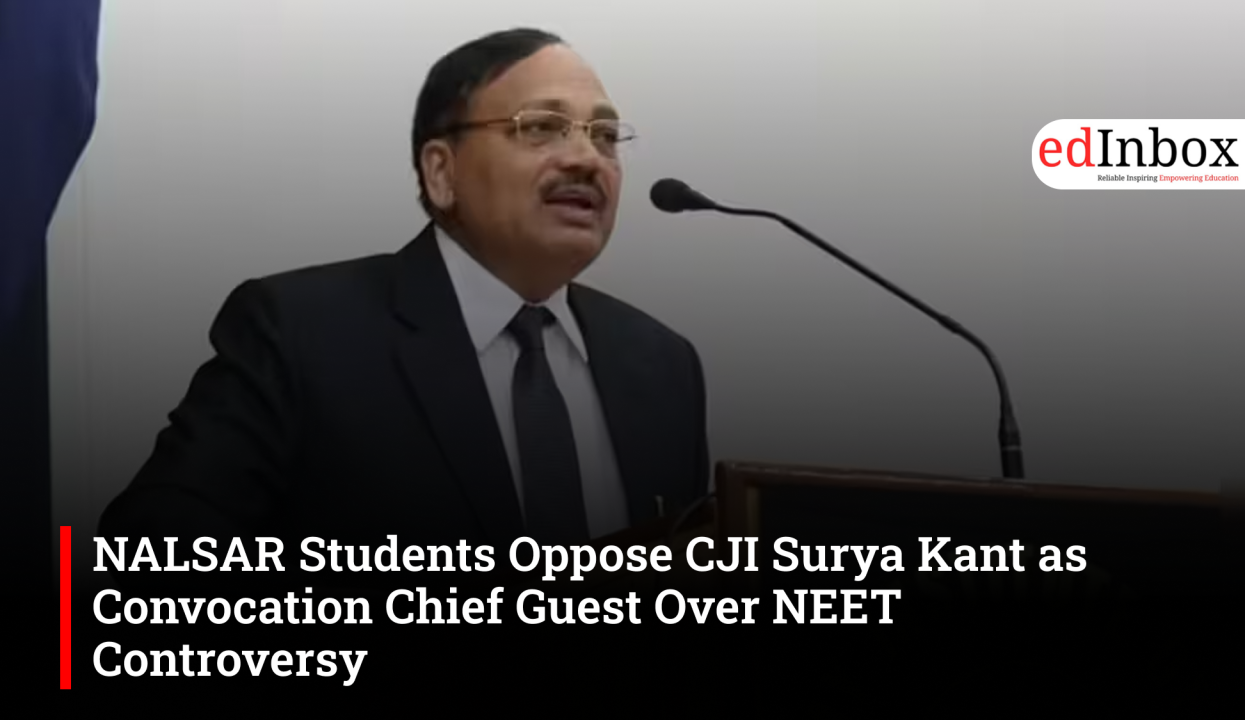
NALSAR Students Oppose CJI Surya Kant as Convocation Chief Guest Over NEET Controversy
Typography
- Smaller Small Medium Big Bigger
- Default Helvetica Segoe Georgia Times
- Reading Mode