
The controversy over student opposition to Chief Justice of India (CJI) Surya Kant’s appearance at a law school convocation has now spread from Hyderabad to Bengaluru, with students and alumni of the National Law School of India University (NLSIU) expressing solidarity with their counterparts at NALSAR University of Law.
The NLSIU students have questioned the proposed participation of both CJI Surya Kant and Bar Council of India (BCI) Chairman Manan Kumar Mishra at their upcoming convocation, arguing that the episode raises wider concerns about freedom of expression, student dissent and the power of professional institutions over the careers of law graduates.
ALSO READ: BCI Reverses NALSAR Ban, Says Majority of 2026 Graduates Innocent in CJI Convocation Row
In a statement dated August 15, a group of 165 members of NLSIU’s graduating class, which comprises 409 current students and 128 alumni, expressed “unconditional solidarity” with the students of NALSAR.
The group said the issue was not simply about who attends a convocation, but about whether students at premier law schools can disagree with powerful public institutions without fearing consequences for their professional careers.
Why Are NLSIU Students Supporting NALSAR Students?
The NLSIU students criticised the BCI’s response to the NALSAR controversy, particularly its initial decision to prevent the 2026 graduating batch from enrolling with state bar councils.
The students argued that expressing disagreement with a public figure or institution should not result in professional consequences.
They called on the BCI to issue an unconditional apology to the NALSAR student and faculty community, alleging that the council’s actions infringed upon students’ freedom of speech and expression.
The NLSIU group has also raised questions about the use of official BCI letterhead in connection with the controversial directive issued by BCI Chairman Manan Kumar Mishra.
ALSO READ: Bombay High Court Allows ILS Law Students to Appear for Exams Despite Attendance Shortfall
What Happened At NALSAR?
The controversy began at NALSAR University of Law, Hyderabad, after students from the 2026 graduating batch objected to the proposed invitation of CJI Surya Kant as the chief guest at their convocation.
The students’ objections came after remarks made by the CJI during proceedings concerning allegations of police excesses during protests in Delhi. During the proceedings, he was quoted as saying, “Don't waste our time.”
Justice Surya Kant later clarified that he had not refused to hear the petition and had instead asked that it be filed in the appropriate manner.
The student protest subsequently triggered an unprecedented response from the BCI.
On August 13, the BCI directed state bar councils not to enrol graduates of NALSAR’s 2026 batch until further orders. The directive was widely criticised as a punitive response to student dissent.
The order stated that law students who showed insufficient respect for the country’s highest judicial office could not be expected to become responsible advocates, teachers or judges.
BCI Withdraws NALSAR Enrolment Directive
The BCI’s decision triggered significant backlash within the legal and academic community.
Mishra subsequently clarified that the action was not intended to punish the entire graduating batch and acknowledged that the “vast majority” of students were innocent and should not suffer because of the alleged actions of a few.
The BCI later withdrew the directive in full.
Mishra also apologised to law students, saying their dignity, independence of thought and legitimate concerns should be respected.
The Supreme Court also criticised the BCI’s intervention. CJI Surya Kant said the matter was “between me and the students”, indicating that disagreement between students and the Chief Justice should not have been converted into an issue concerning professional enrolment.
ALSO READ: BCI Reverses NALSAR Ban, Says Majority of 2026 Graduates Innocent in CJI Convocation Row
Why Is NLSIU Now Questioning CJI Surya Kant’s Presence?
Against this backdrop, NLSIU students and alumni have extended their support to the NALSAR community while raising questions about the proposed participation of both CJI Surya Kant and BCI Chairman Manan Kumar Mishra at their own convocation.
The NLSIU statement argues that the dispute has implications beyond a single university or convocation. According to the students, the central question is whether law students can exercise freedom of speech and express dissent without facing institutional retaliation.
The students have also questioned whether the BCI chairman has the authority to take decisions of such significance unilaterally and sought greater clarity regarding the procedure followed in issuing the NALSAR directive.
More than 700 NLSIU students and alumni have reportedly raised concerns about the BCI’s role and the authority exercised by its chairman.
NLSIU Has Institutional Links With CJI, BCI
The development is significant because NLSIU has a long-standing institutional relationship with both the office of the Chief Justice of India and the BCI.
The university’s governing bodies include the CJI and BCI chairman. At NLSIU’s 2025 convocation, Justice Surya Kant, who was not yet the CJI at the time, presided over the ceremony, while Manan Kumar Mishra delivered the welcome address.
The latest student statement therefore comes within an established institutional relationship between the university and the two offices.
However, the NALSAR controversy appears to have changed the context surrounding their proposed participation in the upcoming ceremony.
What Happens Next?
Although the BCI has withdrawn its controversial NALSAR directive and its chairman has apologised, the issue continues to generate debate across India’s premier law schools.
The NLSIU students’ statement has shifted the conversation from one university to a broader discussion about student dissent, freedom of expression, institutional accountability and the professional consequences of disagreement.
The controversy also places renewed attention on the relationship between law students, universities, the BCI and the judiciary. For students preparing to enter the legal profession, the question of whether academic dissent can be separated from professional enrolment has become central to the debate.
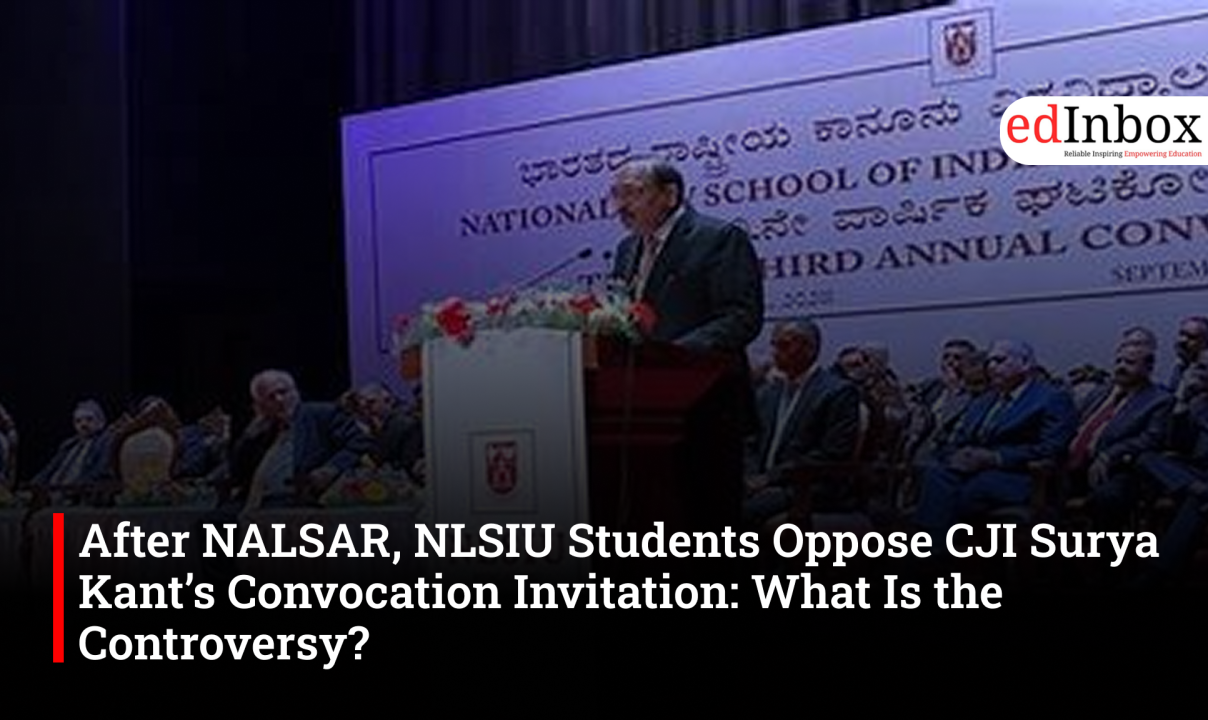
After NALSAR, NLSIU Students Oppose CJI Surya Kant’s Convocation Invitation: What Is the Controversy?
Typography
- Smaller Small Medium Big Bigger
- Default Helvetica Segoe Georgia Times
- Reading Mode