
In a significant shift aimed at expanding access to technical education, new academic provisions will now allow students with a four-year BSc degree to pursue MTech programmes, even without qualifying for the Graduate Aptitude Test in Engineering. The move, set to be implemented from the 2026–27 academic session, is expected to benefit a large pool of students who were previously excluded due to rigid eligibility norms.
Traditionally, admission to MTech programmes in India has been closely tied to engineering backgrounds and mandatory GATE scores. However, with the introduction of more flexible pathways, institutions are now recognising diverse academic backgrounds, particularly those with strong foundations in science. This reform reflects a broader push to align higher education with evolving interdisciplinary demands, especially in emerging technology sectors.
As part of this transition, a new programme titled MTech in Quantum Information Technology has been introduced under the Department of Applied Sciences at a leading institute. The course will offer 25 seats and aims to equip students with specialised knowledge in quantum computing, communication, and related advanced technologies—fields that are rapidly gaining global prominence.
One of the most notable aspects of this programme is the relaxed admission criteria. While candidates with valid GATE scores will continue to receive preference, the examination is no longer mandatory. Students without GATE qualification can still apply and will be considered for admission if seats remain unfilled. In such cases, selection will be based on an institute-level screening test followed by a personal interview, offering a second chance to candidates who either did not appear for GATE or could not clear it.
Eligibility criteria for the course have also been broadened. Applicants must have studied Physics and Mathematics at the 10+2 level. In terms of undergraduate qualifications, candidates with degrees such as BTech, BE, BSc, MSc, or integrated BS-MS programmes are all eligible to apply. This inclusive approach is expected to attract students from varied academic streams, particularly those interested in transitioning into high-end research and technology domains.
Education experts believe that this policy shift could significantly reshape postgraduate technical education in India. By allowing science graduates to directly access MTech programmes, institutions are fostering a more interdisciplinary learning environment—one that blends theoretical science with applied engineering skills.
Beyond academics, the programme also promises strong industry exposure. Students will have opportunities to participate in internships, live projects, and hands-on training aligned with current industry needs. This practical focus is expected to enhance employability and prepare graduates for careers in cutting-edge sectors such as quantum computing, data science, and advanced research.
The development signals a progressive step toward making higher education more inclusive, flexible, and future-ready. For thousands of science graduates across the country, it opens a new pathway to specialised technical careers that were previously out of reach.
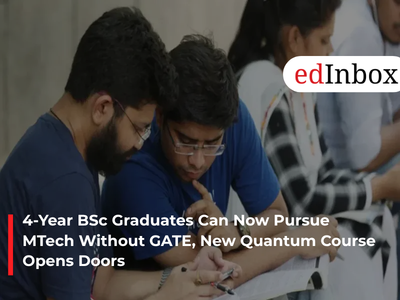
4-Year BSc Graduates Can Now Pursue MTech Without GATE, New Quantum Course Opens Doors
Typography
- Smaller Small Medium Big Bigger
- Default Helvetica Segoe Georgia Times
- Reading Mode