
The Indian Institute of Technology Gandhinagar (IIT-Gn) is strengthening industry-academia collaboration through its External Exposure Activity (EEA), a semester-long elective that enables students to gain hands-on experience in leading technology companies and research institutions while earning academic credits.
This year, 18 undergraduate students participated in the programme, working on cutting-edge projects across software engineering, embedded systems, fintech, and advanced research.
Students Apply Classroom Learning to Industry
Among the participants, Bhoumik Patidar, a BTech Computer Science student, completed his EEA at Qualcomm, where he developed an open-source ELF (Executable and Linkable Format) linker—a core software tool that combines compiled code and libraries into a single executable program.
Reflecting on the experience, Patidar said that working on a production-grade open-source project significantly enhanced his problem-solving abilities and allowed him to contribute to foundational software used by modern computing systems.
Meanwhile, Tejas Zunjare, a BTech Electrical Engineering student, interned at HapiHygi Innovation, where he worked on embedded systems and electronic circuit design for hygiene automation products.
According to Zunjare, the internship provided valuable practical exposure by demonstrating how theoretical concepts learned in classrooms can be translated into real-world engineering solutions.
A Unique Academic-Industry Initiative
The External Exposure Activity is designed for students during their seventh semester, allowing them to spend an entire semester working in industry or research environments without delaying graduation.
According to Bhaskar Datta, the programme enables students to gain meaningful professional experience while continuing to meet their academic requirements.
Students earn 16 academic credits through the elective and work under the joint supervision of faculty members and industry mentors. Any remaining degree requirements can be completed during the final semester.
Datta noted that the initiative has witnessed growing student interest, with participants contributing not only to core technology projects but also exploring interdisciplinary domains such as fintech.
Industry and Research Partners
As part of the programme, students have collaborated with several leading organisations, including:
- Qualcomm
- Solar Defence and Aerospace Limited
- Tower Research Capital
- Samsung Research and Development Institute
- Oracle
- California Institute of Technology
- Indian Institute of Science
Significance
The semester-long industry exposure programme reflects the growing emphasis on experiential learning in engineering education. By integrating academic coursework with real-world industry projects, IIT Gandhinagar is equipping students with practical skills, industry readiness, collaborative research experience, and exposure to emerging technologies, thereby enhancing their employability and innovation capabilities before graduation.
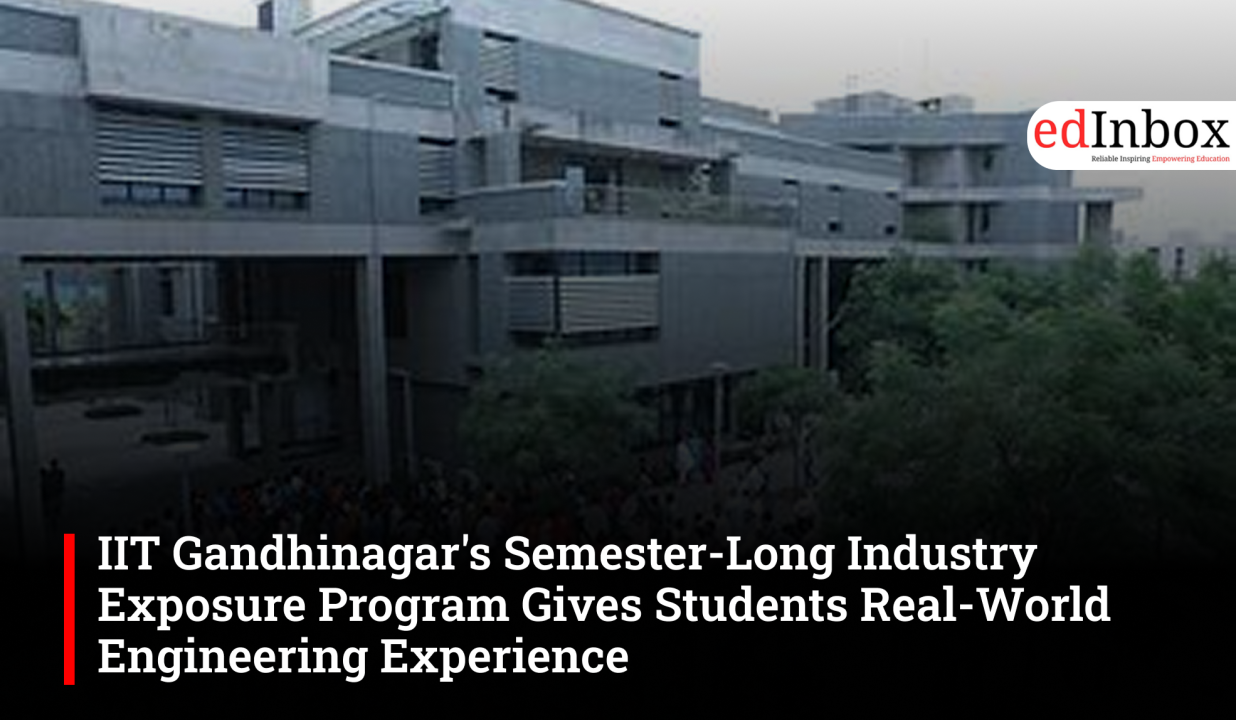
IIT Gandhinagar's Semester-Long Industry Exposure Program Gives Students Real-World Engineering Experience
Typography
- Smaller Small Medium Big Bigger
- Default Helvetica Segoe Georgia Times
- Reading Mode