
As board examinations begin across the country, mental health professionals are witnessing a sharp rise in stress and anxiety among students. Pune-based child psychiatrist Dr Bhooshan Shukla says the pressure during the board exam season is so intense that it significantly alters clinical patterns.
Q: What should be the role of parents in helping their children's mental health during board exams?
Dr Shukla: A lot of this depends on what relationship they have built up to this point.
If you have a relationship where you are a partner of your child in the studies, then you already have a plan of how the two of you are going to prepare and how the last days before the exams are going to be.
If your job has mainly been of, say, a supervisor, then that is what you continue to do. But by supervisor, I mean that your child has actually listened to you for the last one year. So there is a plan which you supervise, and the child has agreed that you will be their supervisor and they actually let you do that, and that has happened through the year.
The third version, which I believe is true for almost 80% of the families, is where parents’ get involved every now and then and try to motivate their children in some way or the other to study, and the children are largely either ignoring the parents or getting into conflict with them. If this has been your relationship for the past entire year, then right now is the time to actually step back and let the child do their thing.
Because you have tried your thing for an entire year or 2 years and it hasn't exactly gone according to your plans. So at least at this point of time you need to step back.
Q: What should be the role of teachers, schools, and tuition teachers at this time?
Dr Shukla: To tell you very honestly, schools and teachers have been doing the same thing over and over for years. They are unlikely to take advice from a child psychiatrist or any mental health professionals. Their typical stand is that we have been doing this every year, we have turned out champions. We know what we are doing.
Tuition teachers never get alerted. When do the schools get active? When either one of the children kills themselves, or at least says that they are going to end their life. That is when everybody suddenly wakes up and starts looking for a mental health expert.
The thing is that the stress bursting mechanism or the resilience has to be built over a period of time. Constantly giving threatening messages to children and telling them that they are going to go to hell if they don't behave, that doesn't really generate that environment.
So in this last month, I think the simple job the teachers and even parents have is quite similar, is to encourage the children. Say “Yes you can do it. Go ahead, you will be fine”.
Q: What can the students themselves do to keep their mental health safe?
Dr Shukla: It's very contrarian advice to what their teachers and their parents are going to tell them. But I give this advice from two standpoints: one as a mental health doctor and second as someone who has consistently aced these exams.
- You must sleep for 7 to 8 hours everyday. Sleep is absolutely golden.
- You have to have 45 minutes to one hour of exercise or play every day, even on the evening before the exam. That's the greatest stress buster you can ever have. You physically sweat it out and you are fine.
- If you are into some kind of performing art like music, dancing, whatever, you need to do that every day. Something that uses totally different circuits of your brain than what you use for studying.
- You have to eat less. You don't have to starve yourself but stay off sugars, stay away from chocolate. Have multiple but small meals instead of those big chunky meals twice in the day. That keeps you sharp.
- Hydration is very important. People forget to drink water. I might sound like a grandmother but it boils down to these small things.
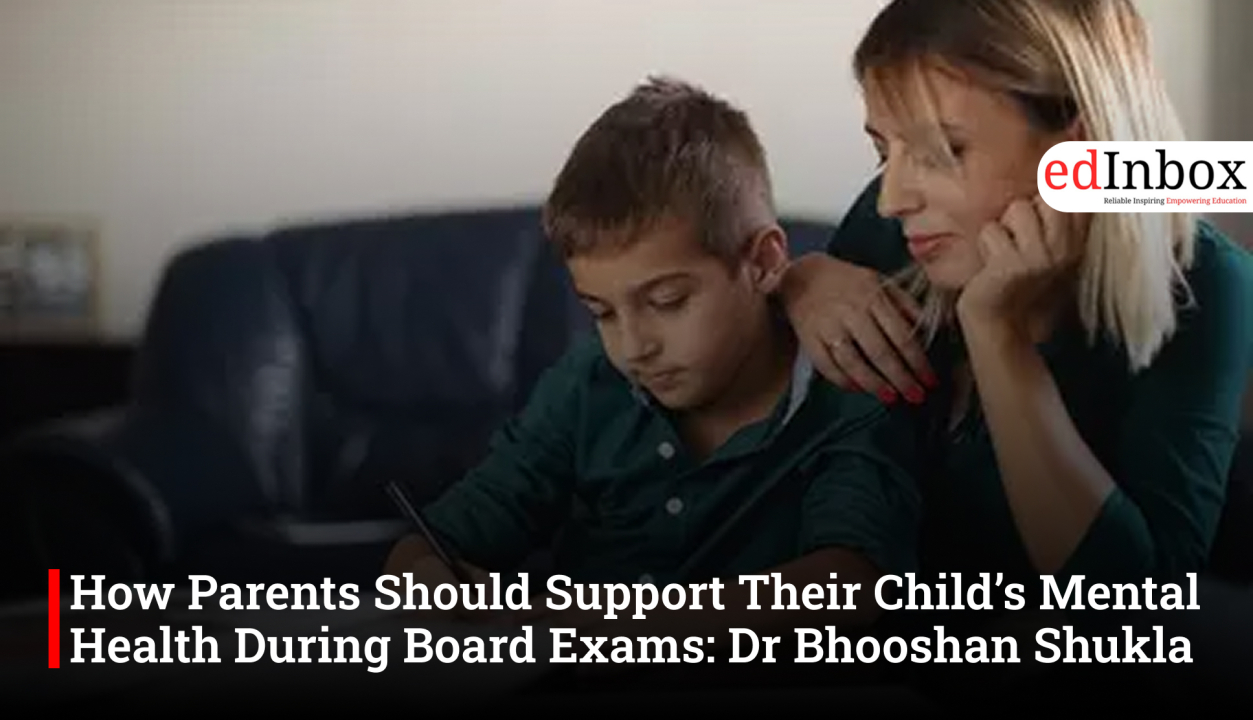
How Parents Should Support Their Child’s Mental Health During Board Exams: Dr Bhooshan Shukla
Typography
- Smaller Small Medium Big Bigger
- Default Helvetica Segoe Georgia Times
- Reading Mode