
On a hot afternoon, 16-year-old Riya Kumari stands outside her school with a cloth bag full of reusable pads. "Didi, hum log plastic waale pad phenkna bandh kar diye hain," she tells a huddle of younger girls, explaining how switching to reusable kits helped her family cut both cost and shame. Riya is one of nearly 40 students in Dhatkidih who now conduct weekly awareness circles-a quiet revolution led not by seasoned activists, but by teenagers determined to keep their village menstrual-waste-free for two uninterrupted years.
The movement took root under the guidance of Tarun Kumar — widely known as the Padman of Jharkhand. But the baton has unmistakably passed to the youth. “I only started the conversation. The students made it a habit,” Kumar laughs, watching a group of boys from Class 10 explain biodegradable waste to villagers at the weekly haat.
For years, Dhatkidih struggled like so many rural pockets of Jharkhand: there is little awareness, scant access to hygienic menstrual products, and unsafe methods of disposal make women burn or bury their pads secretly. That changed when Kumar introduced a simple three-step model: awareness, access, and sustainability.
He distributed free sanitary pads in 120 villages, then switched to reusable menstrual kits and distributed those to more than 5,000 women. The results were almost immediate: homes reduced monthly expenditure, menstrual hygiene improved, and waste production dipped dramatically.
But it was the students who brought about the turning point.
“My mother used to hide her pads in a tin,” says Class 9 student Sunita. “Now she uses the reusable one I taught her about.” Health workers say they have witnessed a clear decline in infections due to poor menstrual hygiene. Panchayat members proudly refer to Dhatkidih as the model for sustainable menstruation, bringing it up during block meetings.s
Students' involvement has also inspired nearby schools across Kolhan, with similar youth-led clubs coming up in them. Teachers say the movement has erased awkwardness and encouraged boys to participate in menstrual-health sessions — a rare sight in many Indian villages. In fact, Dhatkidih's story is singularly unremarkable: no grants, no large-scale campaigns; just one man starting a conversation and some young people turning it into a community habit. As that spreads across Jharkhand, one is left with this powerful question: If a handful of schoolchildren can eliminate pad waste in one village, imagine what millions of India's students could do together.
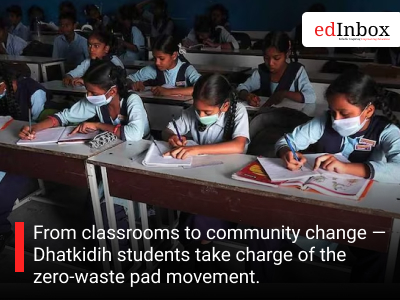
From classrooms to community change — Dhatkidih students take charge of the zero-waste pad movement.
Typography
- Smaller Small Medium Big Bigger
- Default Helvetica Segoe Georgia Times
- Reading Mode