
Every morning begins with invisible labor.
A spoonful of palm oil in processed food, a cup of coffee, a bite of banana, a piece of chocolate made from cocoa—these are not just commodities. They are the outcome of a global system built on land, climate, and above all, labor. And today, that labor is quietly disappearing.
For over a century, tropical plantation economies have operated on a model inherited from colonial rule—export-driven, labor-intensive, and dependent on a workforce that was abundant, inexpensive, and largely invisible. Independence redrew political borders, but not the architecture of production. The fields remained the same. So did the expectations from those who worked for them.
But something has shifted.
Across Southeast Asia, West Africa, and Latin America, plantations are no longer struggling with yield alone—they are struggling with relevance. The question is no longer how to grow more, but who will choose to grow at all.
An Economy Built on Extraction, Now Facing Exhaustion
The numbers tell a stark story. In Malaysia, migrant workers now account for nearly 70–80% of the palm oil workforce, a dependency so deep that when borders closed during the pandemic, production faltered almost immediately. In Indonesia, where foreign labor is less dominant, the system relies heavily on internal migration—yet even here, younger generations are stepping away.
Globally, smallholders contribute around 40% of Indonesia’s palm oil output, yet remain locked out of certification systems meant to define “sustainability,” unable to bear the costs of compliance. What emerges is a paradox: those closest to the land are the furthest from the benefits of reform.
The plantation, once a site of economic certainty, is now a place young people actively avoid—seen as physically punishing, socially undervalued, and economically limiting.
The Human Cost Beneath Green Labels
During the last twenty years or so, sustainability has been the chief discourse of global agriculture. Certification schemes such as the Roundtable on Sustainable Palm Oil (RSPO) have changed the way supply chains are inspected and promoted. We can measure, track and even put a price on changes in forest cover, carbon footprints and product traceability.
However labor which is at the very core of these systems, is still mostly ignored.
In fact, women are the ones standing at the most vulnerable points of this economy. They do informal jobs mostly, get very little pay and are not given social security benefits, at the same time, they also do the unpaid household work which is most of the time not recognized. On the other hand, men still have to do the physically heavy work, often in conditions that have hardly changed for decades.
This does not only lead to inequality but also to exhaustion on a large scale - systemic, across generations, fatigue.
A Crisis of Aspiration
At its core, this is not simply a labor shortage. It is a crisis of aspiration. Rural youth are not rejecting agriculture out of indifference, but out of awareness. They are choosing mobility over stagnation, dignity over endurance. In doing so, they are exposing the limits of a system that has failed to evolve with them.
As the Food and Agriculture Organization has repeatedly emphasized, rural employment is no longer a peripheral concern—it is central to the sustainability of agricultural systems. Without workers, there is no harvest. Without dignity, there are no workers.
Beyond Yield: Rethinking What Sustainability Means
If the first face of sustainability was environmental, then the next one has to be human. It is about bringing plantations back as communities where human beings can live, grow and work rather than as places where only natural resources are extracted. It is also about introducing the use of mechanisms that keep the workers physically healthy as well as timely and fair payment of wages, comprehensive training that empower rather than keep the workers in a helpless cycle situation, etc.
Programs, such as the TALENT, supported by international development agencies, change this by concentrating effort on skills, pathways, and the appeal of farming over time. However, such efforts are scattered and tardy to overcome the magnitude of the challenge.
The Question That Remains
The question that remains is whether it is common to describe the future of tropical agriculture in terms of climate resilience/yield optimization or supply chain transparency. These are very important. Nonetheless, they alone cannot contribute to the development of tropical agriculture.
In fact, every indicator carries a hidden question that is rarely posed, and even less frequently answered: who will remain? Just as a detailed and good map requires a lot of features besides the economic aspects in order to identify social and political aspects of the 'who will stay' question, if we do not understand who will stay, the future of tropical plantations will be a mystery. It is not land production but the shrinking number of people who will want to belong to it that is being questioned.
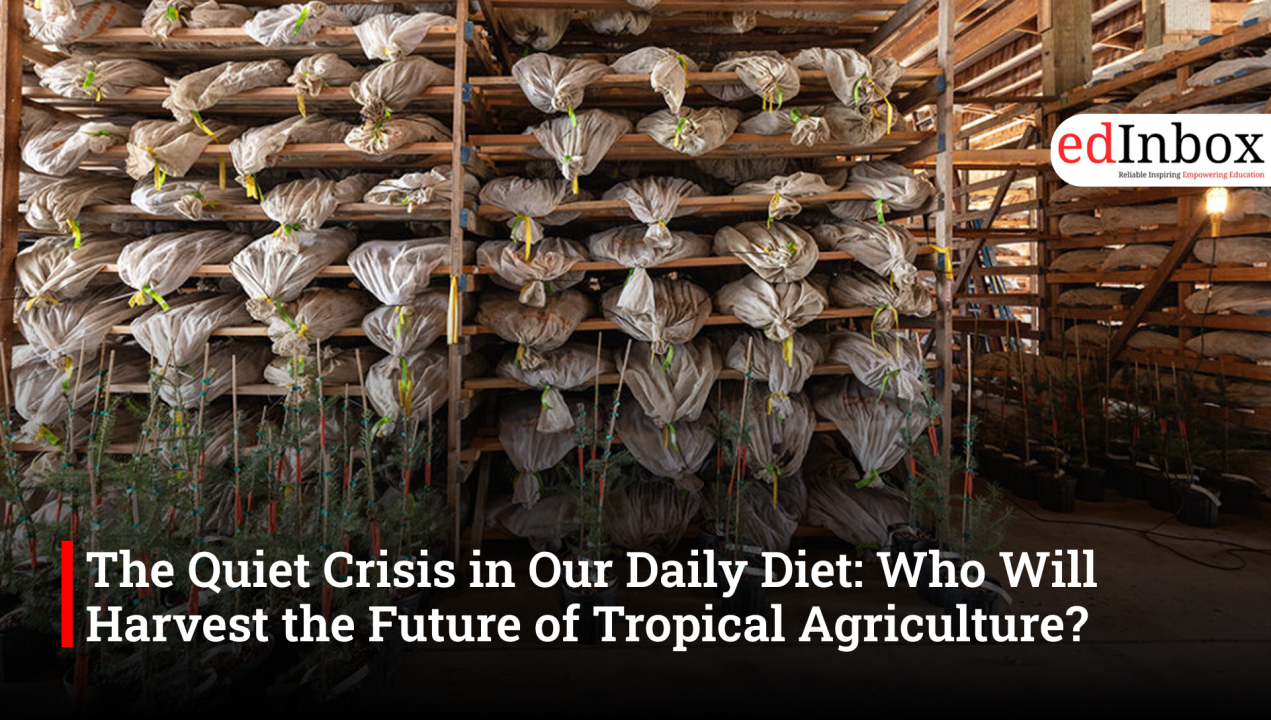
The Quiet Crisis in Our Daily Diet: Who Will Harvest the Future of Tropical Agriculture?
Typography
- Smaller Small Medium Big Bigger
- Default Helvetica Segoe Georgia Times
- Reading Mode