
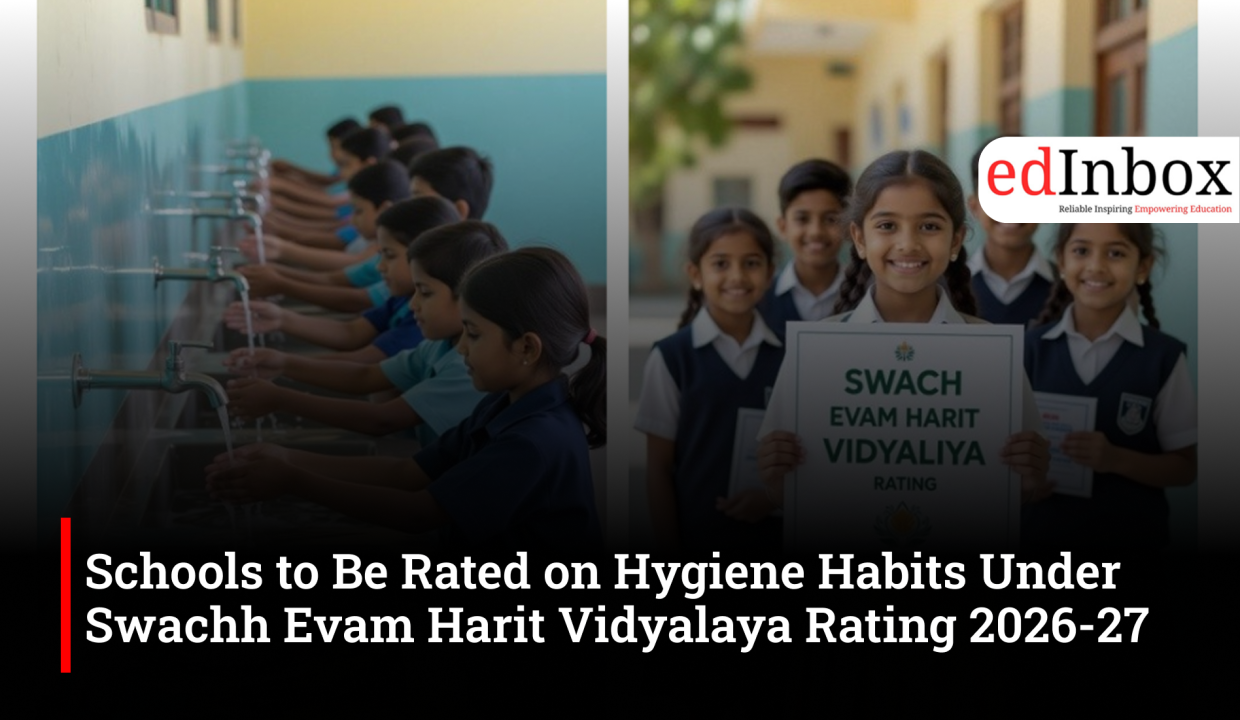
Schools across India will now be assessed not only on infrastructure and academic facilities but also on their everyday hygiene and sustainability practices under the Swachh Evam Harit Vidyalaya Rating (SHVR) 2026-27.
The initiative, launched by the Ministry of Education, requires government-aided and private recognised schools to conduct a detailed self-assessment covering facilities, their maintenance and how effectively students use them.
The assessment focuses on six key areas: water, sanitation, hand hygiene, operation and maintenance, behaviour change, and environmental activities linked to Mission LiFE.
From Facilities to Actual Usage
According to a circular issued by the education department on August 11, the programme aims to shift the focus from simply “having facilities” to how well those facilities are used and maintained.
For example, schools with functional toilets will also be assessed on cleanliness, accessibility and student usage. Similarly, handwashing stations will be evaluated based on the availability of soap, regular usage and students’ awareness of hand hygiene.
The exercise places particular emphasis on behavioural change, with the objective of encouraging children to adopt cleanliness and environmentally sustainable practices as part of their daily routines.
“This is not just an infrastructure audit; it is about building a culture of cleanliness and sustainability among children,” the circular stated.
SHVR 2026-27 Assessment Timeline
The assessment process will be conducted online. Schools are required to register using their UDISE code and complete a structured survey covering facilities and practices on campus.
Schools must upload relevant data and photographs as part of the self-assessment between August 1 and September 30, 2026.
District-level evaluation for the Certificate of Merit is scheduled to be completed by the end of October. State and Union Territory-level nominations will follow in the first week of December, while national-level nominations are expected by the second week of December.
National-level cross-validation will begin in the second week of December 2026 and continue until the second week of February 2027.
Physical Verification Possible
The government has also included mechanisms to verify the information submitted by schools. District-level committees headed by district magistrates may conduct physical inspections.
Government officials and sector experts involved in the evaluation will use a standard checklist and mobile application to validate school submissions.
To qualify for a district-level Certificate of Merit, schools must score at least 51% in each assessment category. Top-performing schools will then progress to subsequent levels of recognition.
At the national level, 200 recognised schools will be selected. Their principals will receive an opportunity to participate in experiential and educational learning tours to selected destinations.
The SHVR initiative therefore places hygiene, sustainability and behavioural practices alongside physical infrastructure, making everyday school habits an important part of how schools are assessed under the 2026-27 rating exercise.
Schools to Be Rated on Hygiene Habits Under Swachh Evam Harit Vidyalaya Rating 2026-27
Typography
- Smaller Small Medium Big Bigger
- Default Helvetica Segoe Georgia Times
- Reading Mode