The advanced and futuristic school campus of 2035 will be recognized as an example of sustainability in every respect, that is, its buildings, staff work, and the lives of its community members will be perfectly in harmony with the natural world. It will exploit renewable energy sources for all its day to day running, get rid of wastes by means of the most up to, date recycled cycles, and promote healthy living among its inhabitants.

Universities and colleges have been grappling with ecological issues over the years; thus, it is only natural that they should set the trend for the rest of the world. These institutions will certainly be compelled to initiate such a thorough change that apart from becoming super, efficient, they will be so deeply ingrained with the principles and practices of sustainable ecological health that they will be able to sustain them over the long haul.

Harnessing clean energy for resilient infrastructure

Clean energy sources will serve as the foundation for future campuses. Rooftops and open spaces will be occupied by solar PV arrays to provide energy for classrooms, laboratories, and residential units, while wind turbine technology will provide complementary energy through site-specific use of wind gusts; and biomass technologies will feed organic waste back into biomass systems, thus completing energy cycles on-campus.

Curriculum will be central in such campuses. Renewable energy and green technology courses can cover solar cell basics, from module construction to grid-connected systems. Students will model 10 kW solar PV plants in tools like MATLAB and study how performance changes with different insolation levels. Wind energy units will look at turbine generators, site selection, and how to calculate power output, while biomass classes will examine anaerobic digestion in digesters such as KVIC models, producing gas from waste. These hands-on components will equip graduates to design systems capable of 100% renewable supply, helping reduce climate instability.

Energy storage advances, such as lithium-ion batteries scaled for microgrids will ensure uninterrupted supply. Campuses will use smart grids to enhance their electrical distribution systems and reduce electrical losses by 20 to 30 per cent. The result will be lower greenhouse gas emissions and increased resilience against grid failures during severe weather events.

Implementing zero waste through circular systems

On zero-waste campuses, trash will be treated as a valuable resource. While a combination of solid waste management practices, such as source segregation, composting, and recycling will divert 95% from landfill disposal, advanced facilities will make building materials from plastic waste, while organic waste can create energy and fertiliser through effective anaerobic digestion.

Environmental science curricula will provide foundational knowledge. Modules on pollution control will examine solid waste causes, effects, and strategies, including marine and thermal pollution impacts. Through conducting audits of their own campuses, students will learn about the dangers of noise and radiation and how to apply those lessons to the real world. Students in the biodiversity conservation unit will examine loss of habitat through case studies of deforestation and urbanization to develop waste management policies that protect local habitats.

Water conservation will complement this. Harvesting rainwater will enable aquifer recharge. Greywater treatment will enable recycling of greywater for irrigation purposes. Education in watershed management will include principles of hydrology, soil erosion control, and check dams. Practical projects will investigate poor drainage characteristics of soils and recommend amendments to improve permeability and decrease runoff. Campus education will create closed-loop systems, thereby minimizing campuses’ negative environmental impacts.

Regenerative living is going to focus on restoration rather than just sustainability. Among the campus features will be green roofs, permaculture gardens, and biodiversity corridors for both sequestering carbon and providing habitats for animals. Community farm partners who use organic methods, will see all farm management be done with vermicompost and biodynamic fertilizers to naturally enrich the soil without chemicals.

The SDG education will be centered on the Sustainable Development Goals, mainly SDG 7 (Affordable and Clean Energy) and SDG 15 (Life on Land).

Students will be taught the impact of climate change on agriculture and come up with climate adaptation solutions such as planting drought, resistant crops. Groups of students will work on marine fishing vulnerability projects wherein they recommend specific actions that would make fishing more resilient.

These classes will teach students how to create an integrated reporting framework to identify the environmental, social, and governance (ESG) metrics they will use to monitor the sustainability of their organizations.

Daily life will reinforce this. Dormitories will use passive solar design for natural heating, while mobility will rely on electric shuttles and bike shares. Health modules in public microbiology will address pollution’s human toll, promote hygiene and well-being. Through these, campuses will regenerate not just land but human connections to nature.

Toward a living laboratory of the future

Education is the major factor that enables our economy and society to evolve in a sustainable manner. By embedding practical, real, world examples like solar inverters and biogas plants into their curricula, schools are providing students with the skills and knowledge that future leaders will require to steer and handle a global sustainability transformation.

Therefore, the campus of 2035 will be a living lab exhibiting how clean energy, zero waste and regenerative living can create just and thriving futures for all.

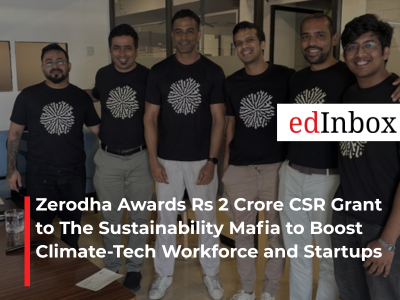
The Sustainability Mafia (SusMafia), a non profit that focuses on climate education, early stage incubation, and ecosystem building, was given a Rs 2 crore CSR grant by Zerodha. The grant is intended to be used for training a skilled and climate conscious workforce and for startup growth in the climate tech market in India.

On its website, the non profit organisation mentions that the grant is expected to elevate the rollout of products and services in the six sustainability domains of air, water, and sanitation, waste management, carbon reduction, and circular economy.

The organisation was set up in 2018 and in its activities, it brings together entrepreneurs, investors, and industry leaders to make sustainability the default approach for businesses and communities. A coalition runs the operation as a platform. It pools shared resources, networks, and expertise to overcome challenges in climate action. SusMafia is gearing up for the launch of impact driven startups, creating green jobs, and securing the funding necessary for a sustainable future.

The Bengaluru-based non-profit said its programmes are designed to address some of the biggest gaps in the climate ecosystem—particularly the shortage of industry-ready talent, lack of early-stage validation support for founders, and limited access to trusted platforms connecting innovators with capital, corporates, and pilot opportunities.

Through its flagship Climate Ninja programme, the organisation claims to have trained over 400 climate professionals. It has also deployed Rs 1 crore in grants to support early-stage climate ventures. Today, its growing network includes more than 80 climate entrepreneurs working across multiple sustainability sectors.

“Strong climate outcomes emerge when founders, practitioners, and learners have access to the right knowledge and support early in their journey. The Sustainability Engine Foundation is building this connective tissue for the climate ecosystem, and we’re pleased to back their work,” said Nithin Kamath, CEO of Zerodha.

With the new funding, The Sustainability Mafia plans to train over 300 Climate Ninjas, support 20+ early-stage climate startups, and host regional and national ecosystem events such as SusCrunch, bringing together key stakeholders from across the sustainability landscape.

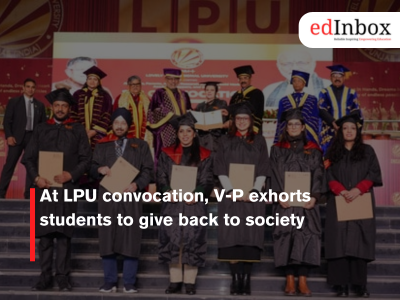
Lovely Professional University held its 12th convocation on Friday, where India's Vice president CP Radhakrishnan was the chief guest. Over 50, 000 students of 2023, 2024 and 2024, 2025 batches from regular, online and distance education modes were awarded degrees by the university. LPU also bestowed academic medals to 320 students out of which 37 gold medals and 861 PhD scholars were recognised.

Punjab Governor Gulab Chand Kataria was the president of the convocation where former United Kingdom Prime Minister Mary Elizabeth Truss was conferred an honorary doctorate, which recognised her leadership, public service and contribution to global political discourse.

During his convocation speech, Radhakrishnan complimented the students for reaching a milestone and said a convocation is a moment of fulfilment Cthat also renews responsibility, not only graduates but parents, faculty members and institutions who have moulded the students

He advised graduates to uphold the qualities of honesty, diversity, compassion and service. He said, "It's not wrong to live for yourself, but it is wrong to live only for yourself. We have to give back to society."

Further, he praised LPU's efforts in fostering self- reliance through the use of campus, made products of Indian origin, and at the same time, the university's help to the families of the armed forces through Jai Jawan Scholarships.

Kataria, however, emphasized to the students that education is much more than just scoring good in exams. It also involves the nurturing of one's character, values, and a feeling of responsibility towards the community. The speaker urged the graduates vehemently to uphold honesty, discipline, and moral conduct in every aspect of their life.

While addressing the desire of India to be a world leader by the year 2047, the governor said that this dream of the nation was dependent on the capacity, integrity, and social awareness of the youth.

Ashok Kumar Mittal, a member of Rajya Sabha and founder chancellor of LPU, urged the graduates to turn their knowledge into a positive influence, thus benefiting society and at the same time fortifying India's role in the global knowledge economy.

From 26 December to 29 December 2018, IMI Kolkata hosted the 19th ISDSI Global Conference in partnership with the following organisations: Directors of Business School, Research Scholars from around the world, Accreditors and other stakeholders, Policymakers at the National and State Level, Corporate Leaders, Investors, and Founders of Startups.

The conference was attended by representatives from 26 countries and was highlighted by a total of 1,218 research papers and 220 business/start-up ideas. All Indian Institute of Management (IIMs), top Indian Institutes of Technology (IITs) and universities/Business Schools and Incubators around the world were represented in total over the course of the conference. The scale of participation underscored ISDSI’s position as one of the largest global platforms for management research hosted in India.

The plenary sessions and panel discussions included senior academic administrators from institutions like production management, management science and information technology, and operations research, as well as many international scholars from North America and New Zealand who are affiliated with EFMD, AACSB and AMBA-BGA; other credentialing organisations.

Professor Bharat Bhasker, an IIM Ahmedabad faculty member, made a keynote address about the role of technology in achieving sustainability goals, stating that India must leverage digital innovation to maximise the benefit to society in alignment with the VIKSIT BHARAT 2047 vision.

Two directors’ panels anchored the academic discourse. The first panel discussion had a specific objective to identify the way that technology and digitalisation will impact the future of MBA programs. All of the panel members shared common views regarding the positive impact of technology on Productivity but emphasized that management education should focus on teaching how to use Good Judgment, to be Flexible and to create a Foundation for Long Term Career Success. The second panel focused on Business School’s Role in supporting India as it transitions to 0 emissions, including establishing sustainability as a core focus area within the curriculum, research, campus operations, and connecting with Industry Partners on this journey.

A separate panel on Indian Knowledge Systems explored how traditional wisdom frameworks could inform contemporary leadership and organisational decision-making.

The conference also marked the launch of IMI Kolkata’s Global Investment Summit under its business incubator, IKN Innovation Foundation. Following mentoring over two months, 57 startups pitched to investors, with nine ventures securing investment commitments worth Rs. 5.1 crore.

The conference concluded with a strong collaboration between academic institutions, industry, and policymakers, as stated by Professor Mohua Banerjee from IMI Kolkata (Director) and Professor Bhimaraya Metri from ISDSI-Global president indicating that the 2025 Conference would be an important and significant step forward for international management research.

The Bapu Pariksha Bhawan in Bihar has undergone a major overhaul to facilitate large- scale competitive examinations in the state. It now boasts of extensive security measures, accessibility and candidate, friendly facilities.

As per the Bihar School Examination Board (BSEB), the six Bapu Pariksha Bhawan conduct examinations in both offline and online modes across the three blocks. Blocks A and B are used for offline and hybrid mode examinations while Block C has been operating as an online examination centre since September 24, 2025. Apart from the main complex, online model examination centres have been set up in the nine divisional districts of the state where nearly 24 lakh candidates have appeared for computer based tests (CBT).

The examination complex has been the venue for tests conducted by national and state, level bodies such as the Union Public Service Commission (UPSC), National Testing Agency (NTA), Bihar Staff Selection Commission, Bihar Combined Entrance Competitive Examination Board, Bihar Police, Aryabhatta Knowledge University, the Postal Department and the Bihar School Examination Board.

Security and monitoring have been emphasized in the examination arrangements. The entire complex is being monitored live through 944 CCTV cameras linked to an Integrated Command and Control Centre. In addition, jammers have been placed to stop the use of unfair means in examinations. Candidates and staff are being frisked with the help of hand held metal detectors, door, frame metal detectors, and baggage scanners, and women candidates have been separately arranged for. The Bapu Pariksha Bhawan has also been made accessible for persons with disabilities. Wheelchairs are available for divyang candidates, nine big lifts are running across the three blocks, and separate washrooms for divyang persons have been made on every floor. Together with these facilities, 24 escalators have been installed across Blocks A, B, and C to the movement of candidates.sus

Basic amenities have been prioritized for the examinees as well. Drinking water of standard quality is made available by means of RO units and water coolers fitted on each floor and supported with the help of an in- house water treatment plant. To ensure the examination process is not hampered even for a single moment, the complex has an electric substation as well as two big diesel generator sets for power backup. BSEB Chairman Anand Kishore said that the complex is being run in a hybrid mode where examinations can also be held online apart from the offline mode i.e. depending on the requirement. After the recent capacity expansion, the complex is able to accommodate around 11, 000 candidates simultaneously in the case of online examinations, whereas at present, about 3, 000 candidates are there in Block C to be seated at a time.

The proposed ₹92,000-crore Great Nicobar mega infrastructure project has sparked fresh concern among educationists, linguists, and anthropologists, who warn that the development could trigger a “linguicide” — the extinction of living indigenous languages — alongside ecological and cultural loss.

Great Nicobar, a UNESCO Biosphere Reserve, is home to the Nicobarese and Shompen communities, among India’s most isolated and ecologically attuned indigenous groups. While environmental and social impacts of the project have been widely debated, experts say its consequences for indigenous languages and education-linked knowledge systems remain dangerously overlooked.

Researchers point out that the Nicobarese language family alone includes six distinct tongues — Pu, Sanenyo, Luro, Mout, Lamongse and Takahanyi Lang — many of which survive with only a handful of speakers. The Shompen language, classified as a linguistic isolate with no known relatives, faces an even greater risk. If lost, it would erase centuries of ecological knowledge, oral history, medicinal science, and cultural memory that are not documented in written form.

Education scholars argue that indigenous languages are not merely communication tools but repositories of place-based learning. From disaster preparedness to biodiversity classification, these languages encode sophisticated systems of environmental understanding. During the 2004 Indian Ocean tsunami, indigenous communities in the Andaman region reportedly survived by interpreting early warning signs embedded in their traditional vocabulary — a powerful example of language as life-saving knowledge.

The Great Nicobar project’s first phase is expected to consume over 166 sq km of land, much of it within protected tribal reserves. This could displace communities from forests, coastlines, and sacred spaces that form the foundation of their cultural education systems, informal learning, and intergenerational knowledge transfer.

Experts caution that forced displacement, demographic influx, and cultural disruption often accelerate language loss. Similar patterns have been observed globally where megaprojects override indigenous educational ecosystems in favour of urban-centric development models.

From an education policy perspective, the issue raises fundamental questions: Can development coexist with indigenous learning systems? How should India balance infrastructure growth with linguistic diversity and knowledge preservation? And what is lost to national education when ancient, ecologically rich languages disappear?

As India pushes toward its Viksit Bharat 2047 vision, scholars argue that safeguarding indigenous languages must be seen not as cultural nostalgia but as an educational imperative — vital for biodiversity conservation, sustainability education, and the preservation of diverse ways of knowing the world

With the onset of winters, schools in various parts of North India are again being compelled to make changes, not because of examinations and holidays, but because of poor air quality, dense fog, and cold wave. During the past few weeks, various state administrations and district authorities have come out with a list of directives concerning attending schools, particularly in areas where pollution and adverse weather patterns are most prevalent.

GRAP limitations on online classes in the Delhi-NCR region, to the cold-wave notified school closures and timetables in Uttar Pradesh and Bihar, this is how the education sector is coping in response to different circumstances.

Delhi/NCR: Schools go online/hybrid as Delhi’s AQI enters 398

Given the dipping air quality in the national capital entering the severe zone, the government had to enforce the GRAP Action Plan’s Stage IV, the most severe of the lot.

As per the directions issued by the Delhi Directorate of Education, physical classes in nursery up to Class V are temporarily halted and all classes are conducted online, as reported by TNN. For Class VI to IX and Class XI students, the directions issued are to conduct classes through the hybrid system; in other words, both online and offline classes are possible, considering feasibility. These are applicable to all government and recognized Private Schools.

The same has been repeated in other district administrations in Noida and Ghaziabad, where schools up to class V began online learning, and seniors attended combined classes. These steps were taken based on guidelines issued by the Commission for Air Quality Management (CAQM) under GRAP IV.

Alongside these emergency steps, the Delhi government has also planned a medium-term intervention. According to reports by TNN, under the ‘Breathe Smart’ campaign, the education department has confirmed the installation of air purifiers in 10,000 government school classes, starting with the top 10 worst-hit areas with respect to pollution levels during the winter months.

Uttar Pradesh: Cold wave and fog cause district-level shutdowns

In the state of Uttar Pradesh, school closings have been influenced primarily by IMD warnings regarding dense fog and cold-wave situations, as ordered by district magistrates.

In Bareilly, schools for classes up to eight were shut by the administration due to low visibility and cold, as reported by PTI. This includes government as well as private schools, but excludes examinations.

A comparable measure was taken in the city of Kanpur as the district magistrate directed the shutdown of all schools from Nursery to Class XII for two days as an official weather warning was issued.

The other districts that have ordered the temporary closure of educational institutions for the young students include Rampur, Shahjahanpur, Pilibhit, Budaun, as well as Gonda. All of the above are due to the prevailing cold and fog conditions.

Bihar: New school hours introduced for the protection of school-going children

However, instead of complete closure of schools, some districts of Bihar decided to modify the timing of schools with official district notifications.

As per reports in PTI, a directive was issued by the district magistrate of Madhubani regarding not conducting any academic activities prior to 11 am and after 3:30 pm for a fixed period of time, including schools, pre-schools, and anganwadi centers. This was a bid to cut children's interface with extreme cold.

The Patna District Administration also changed the timing to suit the needs of the schools, which can now function from a late morning to earlier afternoon.

As reported by the media, the Buxar district ordered the closure of schools from Class 1 to 8 till December 25 owing to cold weather.

Why these decisions are being made

It has been emphasized by the authorities that children are some of the most susceptible groups affected by air pollution and cold. In this case, schools are supposed to restrict physical attendance based on hazardous levels of air quality under GRAP IV. In cold wave conditions, the decision to close schools or change timing is done based on orders from the IMD.

Although it differs from place to place – online classes for children living in pollutant cities, closure of schools in areas affected by fogs, and changed timings for colder areas – the motive remains unchanged: taking care of children's health and limiting disruptions.

What parents and students need to bear in mind?

However, authorities made it clear that these are only temporary and adaptive, and may change depending on AQI scores and meteorological conditions on a daily basis. Parents are advised to: Follow official guidelines from district administrations as well as education departments. Be aware of school notifications and local announcements Prevent exposure of kids to early morning outdoor conditions during times of high pollution and low temperatures.

More Articles ...