
In an ambitious endeavor aimed at equipping the country's schoolteachers for the future, the University Grants Commission has called upon all HEIs in the country to recommend teaching faculty willing and ready to serve as national mentors under the National Mission for Mentoring.
The initiative has been instituted under the umbrella of the National Education Policy 2020, representing a partnership between the National Council for Teacher Education and the Department of School Education & Literacy, which envisages a strong national mentoring network with the capability to contribute to the enhancement of teacher professional development throughout the country.
The directive requires that each HEI should select a faculty member who expresses interest and shows an inclination for mentoring and guiding schoolteachers.
The mission contemplates a pool of 1,000 national mentors who would support, advise, and collaborate with the about 95 lakh school teachers in India-whether permanent, contractual or para-teachers like Shiksha Mitra and Niyojit Shikshak.
WHAT THE MISSION WILL DO
The Bluebook for NMM, prepared by NCTE, lays out a detailed, structured road-map of how the mentoring mission shall be rolled out.
Some of the key features:
The mentors will resource schoolteachers on personal guidance, facilitation, reflection, and sharing of best practices.
A variety of resources will be created and translated targeting different mentoring contexts. Capacity building of mentors, awards/certificates, and non-monetary incentives will also be considered.
Technology-enabled platforms and networks enable interactions between mentors and mentees across geographies.
Ongoing evaluation, feedback by mentors and mentees, and institutionalization of the mentoring structures are emphasized.
At this scale, and with approximately 95 lakh teachers in the country, decentralized, peer-driven continuous professional support is urgent and strategic.
It calls upon HEIs for faculty nominations. In doing so, UGC draws upon the pool of mentoring talent in the higher education ecosystem to link experienced professionals with school-level practitioners from across the country.
WHAT A FACULTY NEEDS TO KNOW
According to UGC notification, institutions should be looking at teaching faculty that:
Demonstrate willingness and aptitude to mentor teachers
Have a history of participation in professional development and support of one's peers Are you willing to be onboarded into the NMM mentoring network? For individual faculty members considering nomination: Realize that the role of mentorship is not just a title; it is an active engagement, mentorship, and collaboration with mentees who are schoolteachers. Be prepared for training, onboarding, and perhaps technology-enabled mentoring sessions. Appreciate that this is a service to the teaching-learning ecosystem. Recognition, though non-monetary, may be part of the framework. Looking Ahead With HEIs now being asked to nominate mentors, the National Mission for Mentoring is all set to move from mere conceptualisation into actual implementation. The real test will be in how the mentor-mentee network is operationalized, how mentorship interactions are sustained, and how outcomes in teacher professional growth and student learning are tracked. If done successfully, this may be a big leap forward in teacher professional development in India, using peer-led mentoring and institutional collaboration at scale.
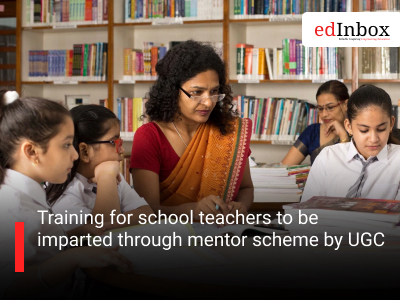
Training for school teachers to be imparted through mentor scheme by UGC
Typography
- Smaller Small Medium Big Bigger
- Default Helvetica Segoe Georgia Times
- Reading Mode