
When Professor Shambhu Nath Singh took charge as Vice-Chancellor on April 4, 2023, fears over his rather chequered past-removed as VC of Patna University in 2012 under circumstances that were not exactly above board-did not convert into any scrutiny from the Union government. Within months, however, Tezpur University was mired in charges that suggested all was not well with academic integrity.
According to senior faculty members, Vice-Chancellor Shambhu Nath Singh pressured the department head, Prof. Nilratan Roy, and the Dean, Prof. Raja Rafiul Haque, to insert Kumar’s name despite the screening committee’s decision to reject him. Roy has since stated that Kumar failed to meet UGC eligibility norms, and colleagues recall that his interview performance was weak. Yet the VC allegedly silenced objections and ensured Kumar’s selection. Soon after, Kumar was elevated to Director of the Centre for Open and Distance Learning, an unusually high administrative post for a newly appointed faculty member. Kumar himself has acknowledged that he appealed his exclusion and was subsequently added and appointed.
A month later, on September 25, 2023 another controversy emerged during the hiring of an Assistant Professor in the Hindi Department. Goma Devi Sharma, who had not been shortlisted, having failed to meet essential requirements such as a translation or language diploma, was allegedly added to the list on the VC’s instruction. The Head of Department, Prof. Pramod Meena, has said that the VC not only compelled the screening committee to include her but also warned him “not to ask any question” during the interview, adding that if he objected, he “would not be allowed to stay in the university.” External experts on the interview panel were replaced with individuals believed to be close to the VC. Despite stronger candidates in the pool and Sharma’s interview being recorded as “not satisfactory,” Singh allegedly pushed through her selection.
For a long time, these frustrations remained internal, surfacing only occasionally as murmurs within departments. But as other controversies mounted in 2025, the pattern of absence began to be seen not as an inconvenience but as systemic neglect.
These concerns were further exacerbated by financial issues that surfaced in FY 2024–25. It had discovered that out of a Rs 6.5-crore UGC capital grant, Rs 4.5 crore had been spent on books and e-resources in ways that seemed to violate procurement norms. Most of the spending was allegedly distributed to a few Delhi-based vendors, bypassing competitive tendering and flouting General Financial Rules. By mid-2025, faculty complaints had grown to include serious construction lapses in newly built hostels funded through substantial HEFA loans, buildings that developed cracks and faulty utilities soon after completion. Allegations also surfaced that the VC had created high-paying posts, such as that of a Computer Centre director, for preferred individuals, even as essential academic vacancies remained unfilled.
The crisis that engulfed Tezpur University began to surface publicly after September 19 this year, when beloved Assamese singer Zubeen Garg passed away and the state declared official mourning. While much of Assam fell silent, the university went about its routine classes and even held a student union election on September 21, a decision which many on the campus saw as at best indifferent and at worst disrespectful. When students demanded a formal condolence meeting, the Vice-Chancellor, Prof. Shambhu Nath Singh, and his administration gave no response. Matters came to a head on the evening of September 22, when some grieving students confronted Singh about what they saw as the university’s callousness. Singh reportedly told them, “Don’t make things funny,” an observation that incensed the students. As tensions rose, students mobbed him and asked for an apology. Instead of engaging with them, Singh abruptly left the campus—“nearly fled”, in the words of several witnesses—leaving students and staff aghast. The incident, perceived as an insult both to a cultural icon and to the students’ emotions, ignited the first open revolt against his leadership.
The administration, with the public watching, hastened to announce plans for a statue of Zubeen Garg on campus and even floated the idea of an honorary degree in his name. But the damage had been done. That same day, the university’s Public Relations Officer, Samaresh Barman, resigned in protest, accusing Singh of autocratic conduct and placing personal image above institutional needs. By September 24, faculty, students, and staff gathered in an unusually unanimous assembly to demand the VC’s immediate removal, framing the Zubeen incident as the latest example of a broader pattern of “neglect and paralysis.”
Over the following days, the TUTA formally raised the stakes by sending a detailed memorandum to the Governor of Assam, who is also the university's Chancellor, and to the Chief Minister. The memorandum listed a series of grave charges: financial irregularities in procurement, poor-quality infrastructure including newly built hostels riddled with cracks and faulty amenities, non-transparent award of contracts to repeat vendors, and pressure on faculty to approve work orders without proper documentation. TUTA also cited the decision to abolish the Pro-VC post and to fill senior administrative roles with favourites while key offices such as the Registrar remained vacant. Singh's remarks about Zubeen Garg, according to the association, had deepened the unrest and warranted immediate intervention.
By late September, the crisis had escalated sufficiently for the Visitor and the Union Ministry of Education to constitute a formal fact-finding committee. A three-member inquiry panel, headed by Director, IIT Guwahati, Prof. Devendra Jalihal, assisted by the Vice-Chancellor of Dibrugarh University and a Secretary, Education, Government of Assam, visited the campus on October 1 to record statements on charges that reportedly ranged from financial misappropriation to manipulation of contracts. The Union Ministry of Education also sent a high-level team of its officials to assess the situation independently.
Students described the act as symbolic, meant to “cleanse” the university of its troubles. They vowed to continue peaceful protests till transparency and integrity were restored. The anger was sharpened by the belief that Singh had effectively gone “missing,” with no communication for the third consecutive week. The same week saw legal escalation: TUTA President Prof. Kusum K. Bania filed an FIR against Ramakrishna Mathe, the VC-appointed Computer Centre Director, accusing him of criminal trespass, cheating, impersonation and IT Act violations for allegedly accessing university systems remotely and acting without authorization.
The administration continued to unravel. On 16 October, Acting Registrar Pritam Deb resigned, and his resignation was promptly accepted by the acting Vice-Chancellor (the senior-most professor, since Singh remained missing). His exit, coming within a fortnight of the PRO's resignation, signalled acute internal dissension and drilled home the perception of an imploding administration.
One trip lasted 22 days. For many, this data crystallized the experience of "neglect and paralysis," and the fact that Singh had not returned since the incident involving Zubeen increased the demand for his removal. An Acting VC, Prof. Raja R. Haque, was now effectively running the university, underlining the fact that Singh had retreated completely from campus affairs. Meanwhile, neither the Governor's fact-finding committee, nor the district magistrate, tasked to report within a week, released their findings, fuelling frustration as October drew to a close.
By early November, it was already well into the second month of the movement. TUTA also pointed out other anomalies: the non-establishment, without any explanation whatsoever, of the announced Bir Lachit Borphukan Defence Studies Centre; arbitrary extensions of key administrative tenures; delayed and denied payments to contractual workers; and sudden terminations constituting “mental harassment.” The width of grievances already made clear that the unrest had grown far beyond the Zubeen incident and into a rejection of the VC’s entire administrative regime.
At a press conference on November 17 in Guwahati, students spoke about how academic life had collapsed—exams postponed, results delayed, certificates unavailable—and elaborated on the travails of everyday campus life, from fees for open-source e-materials to broken equipment, deteriorating hostels, and even shortages of basic medicines. On the 66th day of the unrest, November 25, a new collective named Tezpur University United Forum was formed. It brought students, teachers, and staff together under one platform. They declared they had met Vineet Joshi, Secretary of Higher Education, demanding the release of the two inquiry reports. According to them, Joshi promised action within “2–3 days," but the week went by without any action, as frustration mounted. TUUF added new charges: misuse of central hiring schemes such as PM Rozgar Yojana, and the illegal appointment of Ramkrishna Mathe as Computer Centre Director on a high salary despite his prolonged absence and unauthorized access to sensitive systems like email servers and CCTV. At this moment, Singh had not visited the campus for more than two months, and the forum demanded immediate suspension with a judicial probe. Faculty members began to ask pointed questions about New Delhi's silence: "Why is Delhi not responding? With no intervention in sight, the campus moved into a more drastic phase.Their four conditions were clear: immediate suspension or removal of VC Singh; the physical presence of the Finance Officer to answer financial questions; the physical presence of the Executive Engineer to address construction lapses; and urgent intervention by the Ministry of Education. The disappearance of the VC became a rallying cry, with student leaders saying, “If he was innocent, he wouldn’t have run.”
Back on campus, stakeholders reiterated that new evidence had been submitted to authorities and warned that allowing Singh to remain VC in name continued to undermine institutional integrity. They again demanded the release of inquiry reports and action from Delhi. As of December 1, 2025, close to two months into the revolt, Tezpur University remains paralyzed. Singh has not stepped foot on campus since September 22, and students, faculty, and staff refer to him as “in hiding” or “absconding.” India Today NE has sent a set of 25 questions to Shambhu Nath Singh on these allegations.
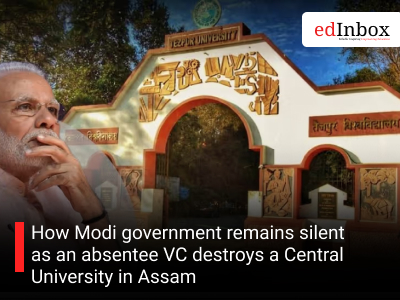
How Modi government remains silent as an absentee VC destroys a Central University in Assam
Typography
- Smaller Small Medium Big Bigger
- Default Helvetica Segoe Georgia Times
- Reading Mode