
The Narendra Modi government will bring the Viksit Bharat Shiksha Adhishthan Bill, 2025 during the winter session of Parliament to establish a commission to enable universities and other higher educational institutions “to become independent self-governing institutions and to promote excellence through a robust and transparent system of accreditation and autonomy.”
The bill, reviewed by HT, says the Commission will have three wings-the Regulatory Council, Accreditation Council and the Standards Council. The 12-member commission will comprise presidents of the Regulatory Council, Accreditation Council and the Standards Council, Union higher education secretary, two eminent and distinguished academicians not below the rank of professor from the State Higher Educational institutions and five eminent experts and a member secretary.
The appointments are to be made by the Centre alone through a three-member search panel. The proposed law proposes that no prosecution or legal proceedings shall be instituted against any office bearer or employee of the Commission or Council “for anything which has been done or intended to be done in good faith under this Act.”
The bill also proposes a steep fine of minimum of ₹10 lakhs to ₹30 lakhs if an educational institution contravenes the provisions of the new law and fail to rectify the mistakes. For repeated offence, a higher educational institution may have to pay at least ₹75 lakhs or face suspension.
The new commission will formulate and suggest schemes to improve quality of education and advise the Centre and the states for the “holistic development of higher education in the country.”
This Bill will apply to all Institutions of National Importance and any other Institution set up by Parliament, Universities in India, colleges, institutions regulated under the Architects Act, 1972, institutions regulated under the All India Council for Technical Education (AICTE), open and distance learning institutions, amongst others.
There would be a 14-member Regulatory Council. According to the bill, the mandate of the council would be to ensure “all higher educational institutions attain full accreditation and thereby autonomy in a graded manner”, to transform the current higher education sector into one “comprising autonomous, vibrant and empowered multidisciplinary higher educational institutions with high quality education, research and service including integrated vocational education, training and skilling programs.”
The council will develop a “coherent policy to prevent commercialisation” of higher education. It will also look into public self-disclosure of all finances, audits, procedures, infrastructure, faculty, courses, educational outcomes and accreditation related information by higher educational institutions on a public website maintained by the Regulatory Council and on the websites of institutions.
The council will lay down norms for the entry of certain foreign varsities to operate in India and “facilitate high performing Indian Universities to set up campuses in other countries.”
Another 14-member accreditation council will develop “an outcome-based Institutional Accreditation Framework in consultation with relevant stakeholders, which shall be used to assess and accredit higher educational institutions leading to accreditation with or without open and distance learning, online or digital learning, or any other form of learning.”
It can also empanel and de-panel accrediting institutions to develop a high-quality and high-integrity accreditation system with adequate capacity to meet the requirements for accreditation of higher educational institutions. The council will monitor the performance of the accrediting institutions and review their work.
Bill says, the Institutional Accreditation Framework shall lay down parameters for accreditation involving only educational outcomes, good governance, financial probity and stability and transparent public disclosure of all academic, operational and financial matters to guide the accrediting institutions in such manner as may be specified by regulations made by the Accreditation Council.
The Standards Council or viksit bharat shiksha manak parishad, shall take all such steps as it may think fit for the determination of academic standards in higher educational institutions for higher education.” The panel will also frame “expected learning outcomes (also referred to as “graduate attributes”)” and provide the nomenclature of “certificate” and “diploma”, and the levels of educational qualifications, other than “Doctor of Philosophy".
It will give the norms on credit transfers, equivalence, and related matters to ensure mobility for students and develop "a suggested broad framework of higher education qualifications" for institutions and programmes. The body, according to the bill, would "lay down clear minimum standards for setting up and operation of higher educational institutions" and establish "frameworks for innovative development of curriculum, pedagogy, assessment and student support including promotion of internationalization of education to attain world class standards in all areas as well as the Indianization of education to promote Bharatiya knowledge, arts and languages, for enhanced student experiences and to meet learning outcomes."
The body will also lay down qualifications for any person to be appointed as the staff of the higher educational institutes. The office tenure for the chairperson of the Commission and the president of each Council shall be three years initially and extendable up to five years. The bill says they shall be eligible for reappointment for another term. They can be removed by the President of India. The Commission shall have an own Fund to be known as the Viksit Bharat Shiksha Adhishthan Fund and all sums which may, from time to time, be granted to it by the Central Government.
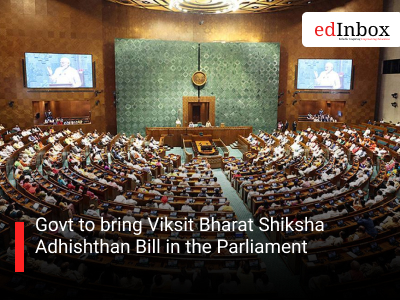
Govt to bring Viksit Bharat Shiksha Adhishthan Bill in the Parliament
Typography
- Smaller Small Medium Big Bigger
- Default Helvetica Segoe Georgia Times
- Reading Mode