
University Grants Commission (UGC) jointly with the Supreme Court through the latter 's directions in the hearings of suicides cases of Rohith Vemula and Payal Tadvi has put out for public consultation the Draft UGC (Promotion of Equity in Higher Education Institutions) Regulations, 2025. This draft aims to ensure that no one gets discriminated against on the grounds of religion, race, caste, sex, and birthplace and to spread the notion of inclusion in higher education institutions (HEIs). But it has been pointed out by the critics that the regulation, which on paper sounds like a progressive step, lacks the requisite structural, strategic and operational depth that is essential for it to be able to effectively break down the social hierarchies that are deeply ingrained in Indian academia.
This is one of the few policy drafts through which the UGC is bringing its policies in line with the National Education Policy (NEP) 2020. The draft boldly and ambitiously states a target that discrimination against Scheduled Castes, Scheduled Tribes, Other Backward Classes, and Economically Weaker Sections will be totally eliminated. However, the whole framework seems to be quite dependent on symbolic gestures, awareness, raising campaigns, the sensitization of the public, posters, slogans and committees, which are far from being enforceable safeguards or systemic accountability.
The chief concept of the regulation is the idea of creating a center for Equality Opportunity in every HEI with the Head of the Institution viz. Vice, Chancellor or Principal being the Chairperson and 9 other members. The regulation also proposes the formation of ‘Equity Squads’ and ‘Equity Ambassadors’—terminologies that seem more performative than transformative
This is not the first time such measures have been introduced. Earlier bodies similar to the Equal Opportunity Cells (2012), Students Grievance Redressal Committees (2023), and SC/ST Special Cells are still in place. However, people who have experienced caste, based discrimination in the form of harassment, denial of educational support, or even suicides, feel that these measures have failed to prevent such instances. The persistent recycling of the same framework leaves us with a dilemma: These models have been on the ground for over a decade and have not really worked, so why should they now?
Documents provided by the UGC to the Supreme Court reveal that 3, 067 Equal Opportunity Cells and 3, 273 SC/ST Cells have been set up, which have in total received 1, 503 complaints and supposedly resolved 1, 426. With India having more than 1, 200 universities, 58, 000 colleges, and over 9.3 million SC/ST students, the above figures look to be entirely unrealistic. In fact, the discrepancy below strongly indicates either very severe underreporting, institutional silencing, or lack of faith in the redressal mechanisms on the part of the victims.
More alarming is the social reality within HEIs. Caste-based humiliation, academic isolation, and psychological distress remain pervasive. Government data shows that between 2018 and 2023, nearly 19,000 SC, ST, and OBC students dropped out of centrally funded institutions. During this period, at least 61 students from disadvantaged communities died by suicide in IITs, NITs, and IIMs. Between 2022 and 2024 alone, 115 suicides were reported across IITs. These numbers are not just statistics—they reflect a systemic failure.
These two students Rohith Vemula and Payal Tadvi were not the only victims.
They were just faces of a large- scale dignity, safety, and belonging crisis in the higher education system in India.
The research findings are a testimony to the fact that Indian universities, instead of being places of liberation, are still spaces where caste based discriminations and social exclusions are perpetuated.
What is particularly disturbing today is that in many cases these students have lost their lives after the 2012 equity regulations had been put in place. This inquiry is essential: If the existing policies have been accompanied by deteriorating conditions, then what is the 2025 draft doing differently?
The new regulation without the support of a legally enforceable accountability, independent grievance monitoring, time, bound investigations, psychological support systems, caste, sensitivity training for faculty, and transparent public reporting of complaints might turn out to be just another bureaucratic formality.
Equity is not a matter of slogans, nor should it come from committees only. It demands the redistribution of power, the infusion of institutional bravery, and concrete actions that can be verified.
An unambitious reform, that is more like a facade, if the UGC does not bring in a survivor, centric, rights, based, and data driven, a 2025 draft will join the list of well intentioned but ineffective policies that have failed the very people they claim to protect.
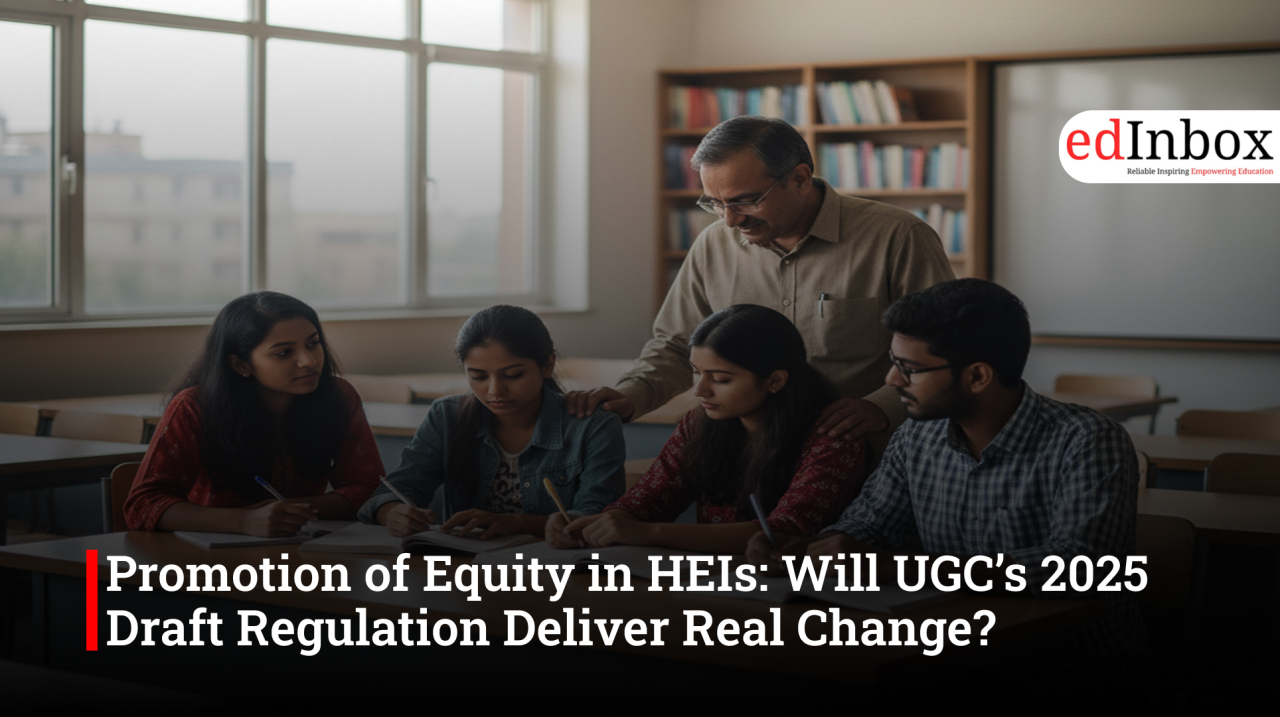
Promotion of Equity in HEIs: Will UGC’s 2025 Draft Regulation Deliver Real Change?
Typography
- Smaller Small Medium Big Bigger
- Default Helvetica Segoe Georgia Times
- Reading Mode