
In a move that blends sustainability with crisis response, Indian Institute of Technology Bombay has developed a biomass-based energy system that converts fallen leaves and campus organic waste into cooking fuel, significantly reducing dependence on Liquefied Petroleum Gas (LPG).
The innovation, rooted in biomass gasification, is projected to save the institute nearly ₹50 lakh annually, replace close to 90 tonnes of LPG, and cut carbon dioxide emissions by around 300 tonnes. At a time when LPG supply disruptions are affecting campuses across India, the initiative offers a practical and scalable alternative.
The project traces its origins to 2014, when professor Sanjay Mahajani from the Department of Chemical Engineering proposed using biomass gasification to address rising fuel costs while utilising readily available campus waste. However, early implementation faced technical and operational hurdles.
One of the primary challenges was clinker formation—solid residues commonly found in Indian biomass that can clog gasifiers and reduce efficiency. Initial trials also struggled with excessive smoke, and kitchen staff were hesitant to adopt the unfamiliar system.
A breakthrough came in 2016, when the research team developed and patented a redesigned gasifier that significantly reduced clinker formation. The project gained further momentum in 2017 with the involvement of Sandeep Kumar from the Department of Energy Science and Engineering, who helped improve burner efficiency.
The system was later tested under real-world conditions through the institute’s “Living Lab” initiative, allowing for gradual user adoption alongside safety checks and performance optimisation.
Currently operational at the campus staff canteen, the system has reduced LPG consumption by 30–40%, according to the institute. It achieves a thermal efficiency of about 60% while maintaining emissions below 20 parts per million (ppm), and contributes to an annual reduction of approximately 8 tonnes of carbon emissions at the operational level.
The timing of the innovation has gained added relevance amid an ongoing LPG supply crunch linked to geopolitical tensions in the Middle East. Educational institutions across India, including Indian Institute of Technology Roorkee, have begun preparing contingency plans as cylinder availability becomes uncertain. Hostel kitchens in several campuses are considering alternative cooking methods while attempting to maintain meal quality.
The impact is also being felt in schools under the PM POSHAN Scheme, particularly in states like West Bengal and Maharashtra, where institutions have had to improvise with limited fuel supplies. Some schools have reverted to traditional chulhas using firewood, while others have simplified menus to cope with constraints.
To enable wider adoption, IIT Bombay has licensed the technology to Infixen Energy Pvt Ltd. The institute now plans to scale the system to larger hostels, where it could further cut LPG consumption, reduce operational costs, and lower emissions.
As campuses grapple with both sustainability goals and fuel uncertainties, IIT Bombay’s waste-to-energy solution signals a shift towards self-reliant, low-carbon infrastructure—turning everyday waste into a strategic resource.
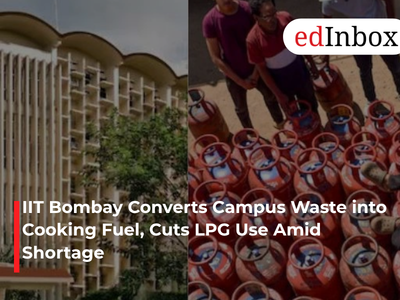
IIT Bombay Converts Campus Waste into Cooking Fuel, Cuts LPG Use Amid Shortage
Typography
- Smaller Small Medium Big Bigger
- Default Helvetica Segoe Georgia Times
- Reading Mode