
The Union Ministry of Social Justice and Empowerment has disbursed over ₹2,042 crore towards educational schemes for students from Other Backward Classes (OBCs), Economically Backward Classes (EBCs), and De-notified, Nomadic and Semi-Nomadic Tribes (DNTs) in the financial year 2025–26, according to an official statement released on Wednesday.
Union Minister Virendra Kumar said the initiatives are aimed at strengthening access to quality education and enabling sustained academic progress among historically disadvantaged communities. The schemes are being implemented by the Department of Social Justice and Empowerment as part of broader efforts to promote inclusive development through education.
The ministry reported that a total of ₹2,042.08 crore has been utilised under these programmes during FY26. Notably, expenditure on OBC welfare schemes recorded a sharp increase of 36.96 per cent compared to the previous financial year, underlining a renewed push towards targeted educational assistance.
A closer look at scheme-wise spending reveals significant growth across multiple categories. Funding under the Pre-Matric Scholarship scheme for OBCs, EBCs, and DNTs rose by 59.13 per cent, while the Post-Matric Scholarship scheme saw a 27.18 per cent increase. The most substantial rise was recorded under the Top Class Education in Schools initiative, which surged by 154 per cent. Similarly, expenditure for Top Class Education in Colleges increased by 105.80 per cent over FY25.
Officials stated that the rise in allocations reflects the government’s continued focus on expanding educational opportunities and improving access for students from socially and educationally disadvantaged groups. The enhanced funding is expected to support higher enrolment, reduce dropout rates, and facilitate access to premier educational institutions.
The ministry emphasised that these interventions are part of a sustained strategy to bridge educational gaps and promote equitable growth through targeted welfare delivery.
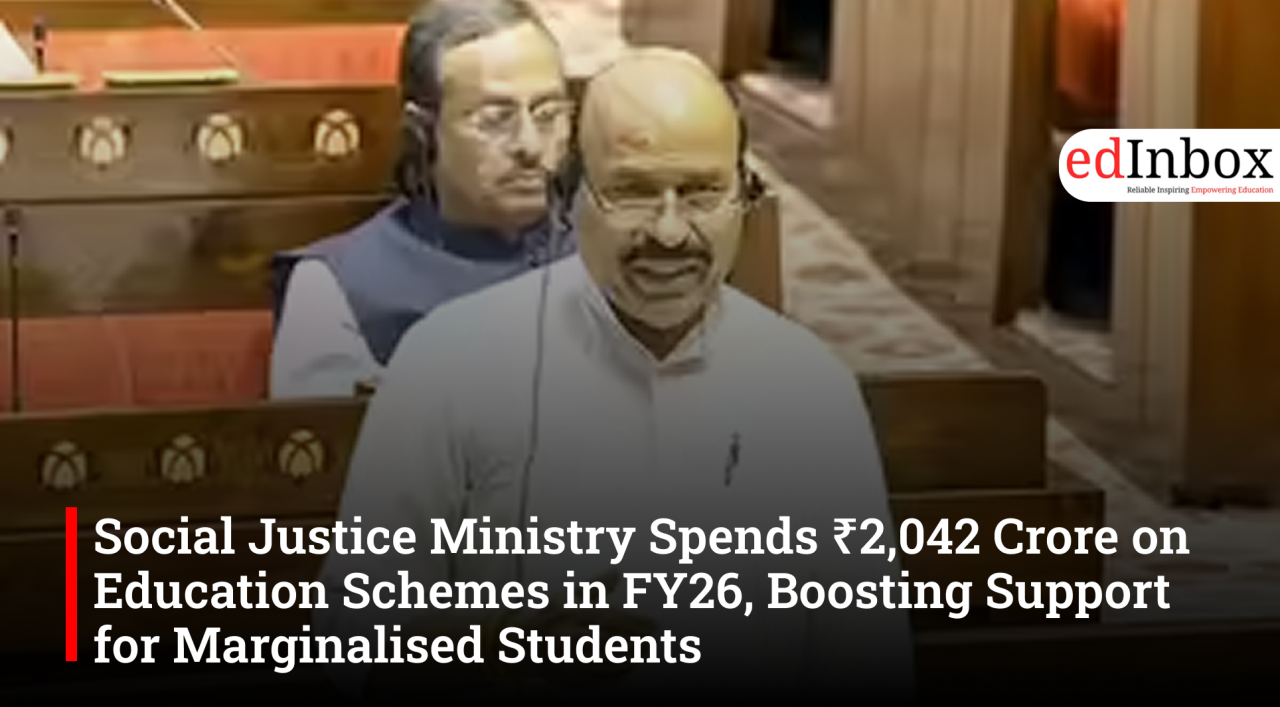
Social Justice Ministry Spends ₹2,042 Crore on Education Schemes in FY26, Boosting Support for Marginalised Students
Typography
- Smaller Small Medium Big Bigger
- Default Helvetica Segoe Georgia Times
- Reading Mode