
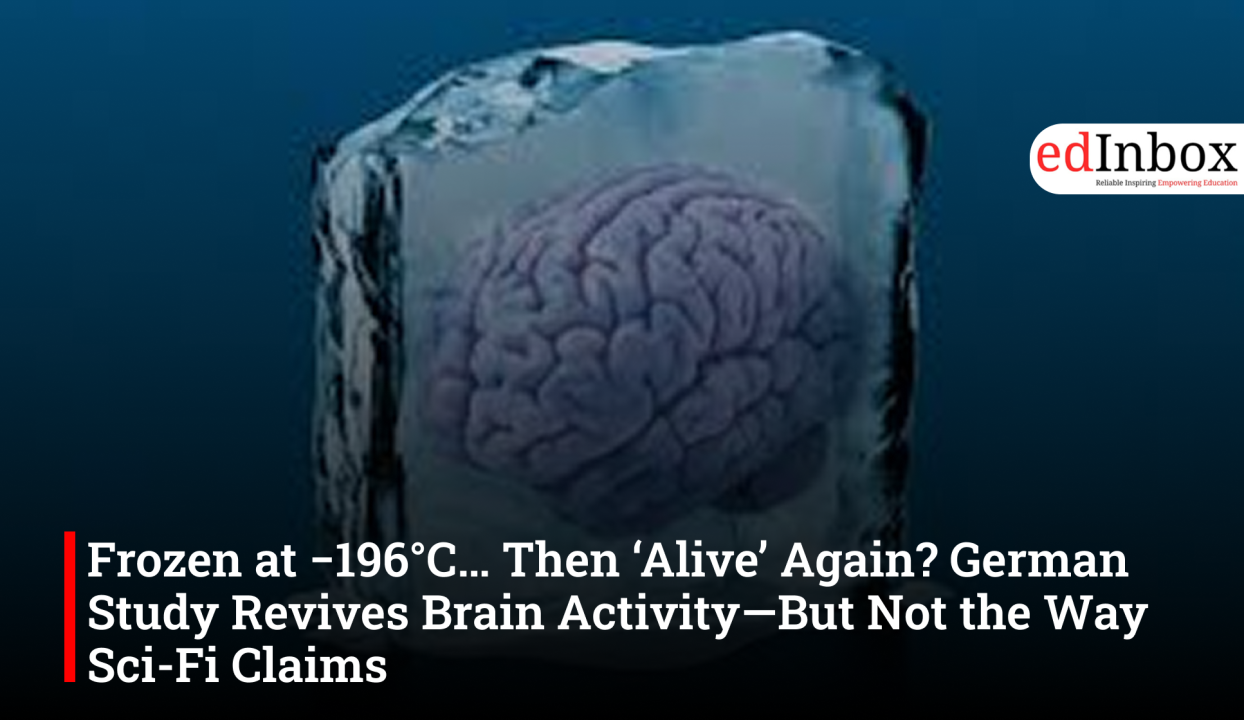
In a breakthrough that sounds straight out of science fiction, researchers in Germany have successfully frozen brain tissue to −196°C and brought it back to functional activity. But before visions of human cryosleep take over, scientists are clear: this is not about reviving frozen people—it’s about preserving delicate brain function under extreme conditions.
The study, conducted at Friedrich-Alexander-Universität Erlangen-Nürnberg and University Hospital Erlangen, focused on small slices of adult mouse brain tissue, specifically from the hippocampus—a region critical for learning and memory.
How scientists pulled it off
The team used a method called Vitrification, which avoids the formation of ice crystals—the biggest threat to cells during freezing. Instead of crystallising, the tissue enters a glass-like state using special cryoprotectant chemicals.
The preserved tissue was then cooled to −196°C using Liquid nitrogen. After a carefully controlled rewarming process, something remarkable happened: the brain tissue didn’t just look intact—it started functioning again.
Neurons resumed electrical activity, and signals began travelling across neural networks. Even more striking, researchers observed restored synaptic communication, including Long-term potentiation—a key process linked to learning and memory.
What this actually means
This is a significant step forward in Cryobiology. For the first time, scientists have shown that complex brain tissue can survive deep freezing and regain functional properties—not just structure.
However, the findings come with important caveats.
This was not a whole brain. It was not a living animal. And crucially, it does not demonstrate preservation of consciousness, identity, or memory as we understand it in humans.
In other words, this is not a step toward reviving frozen humans or achieving suspended animation.
Why it still matters
Despite the limitations, the implications are far-reaching. Preserving both the structure and function of brain tissue could transform how scientists store biological samples, study neurological diseases, and test new drugs.
It may also have future applications in organ preservation—one of the biggest challenges in modern medicine—where maintaining cellular function after storage is critical.
The bigger picture
The experiment pushes the boundaries of what’s possible in biological preservation. It shows that under the right conditions, life’s most complex tissue can endure extreme cold and “wake up” with key functions intact.
But the leap from revived brain slices to revived humans remains enormous.
For now, the takeaway is grounded in science—not sci-fi: we’re learning how to pause biology without destroying it. And that, in itself, could reshape the future of medicine and research.
Frozen at −196°C… Then ‘Alive’ Again? German Study Revives Brain Activity—But Not the Way Sci-Fi Claims
Typography
- Smaller Small Medium Big Bigger
- Default Helvetica Segoe Georgia Times
- Reading Mode