
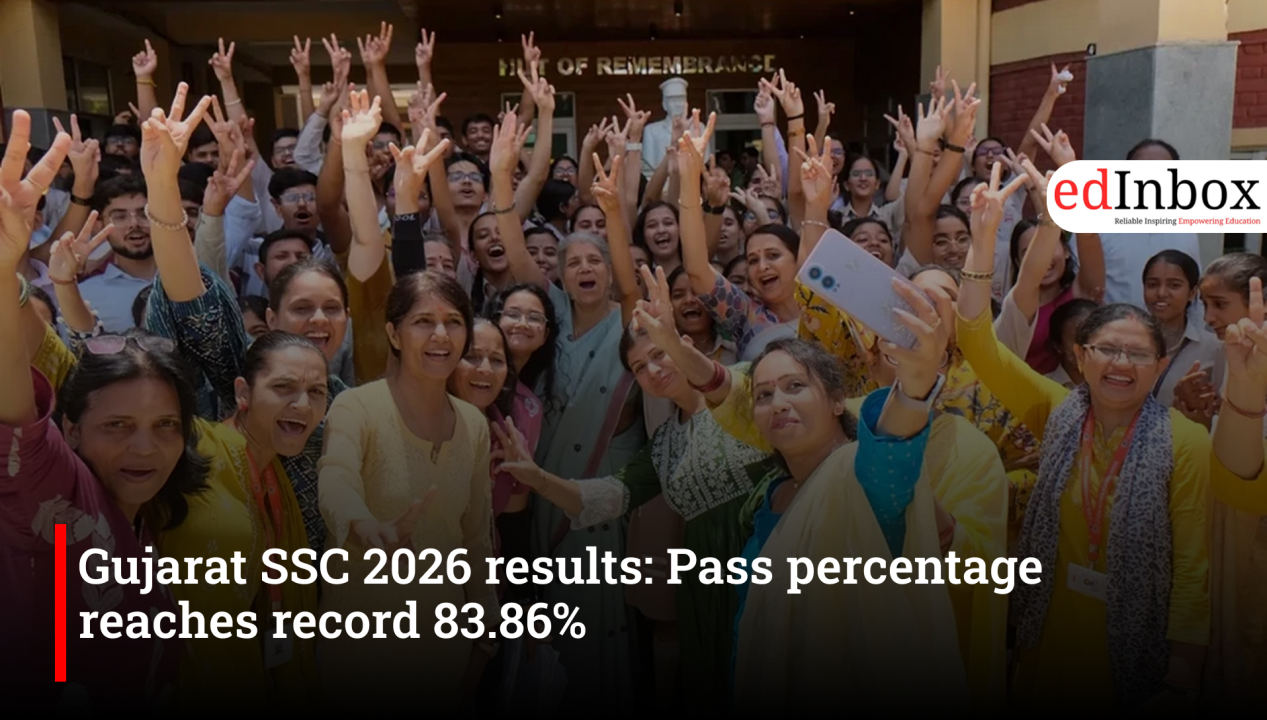
Gujarat Secondary and Higher Secondary Education Board has recorded its highest-ever Class 10 pass percentage, with 83.86 per cent of students clearing the SSC examination in 2026.
The result surpasses last year’s 83.08 per cent and continues the strong recovery trend seen after the pandemic years, when the pass percentage had dropped to 64.62 per cent in 2023.
District-wise performance improves
Among districts, Narmada emerged as the best-performing district with a pass percentage of 90.85 per cent, while Panchmahals recorded the lowest performance at 76.42 per cent.
The number of schools achieving a 100 per cent result also increased significantly to 1,697. Meanwhile, schools with pass percentages below 30 per cent declined to 164, indicating broader improvement in academic outcomes across the state.
Girls continue to outperform boys
Female students maintained their lead over male students across almost all categories of the examination.
Girls recorded an 88.28 per cent pass rate among regular candidates, compared to 80.12 per cent for boys. The trend was also visible among repeater candidates and students appearing through the Gujarat State Open School.
The gender performance gap has remained consistent over recent years, with girls outperforming boys in both 2024 and 2025 as well.
Science and Basic Maths show strong performance
Subject-wise data revealed exceptionally high scores in Science and Basic Mathematics.
A total of 8,250 students secured full marks in Science, while 3,529 students achieved perfect scores in Basic Maths.
However, Standard Mathematics continued to remain comparatively challenging. Only 91 students scored 100 marks in the subject, highlighting a sharp contrast between the two mathematics streams.
In English, the highest score recorded was 96 marks, achieved by 10 students.
Vocational subjects such as Banking & Financial Services and IT/ITES also saw a notable number of high scorers, reflecting growing student participation in skill-oriented streams.
What the trend could mean
Education analysts believe the rising pass percentages could intensify competition for admissions into higher secondary schools, especially in science and commerce streams in top-performing districts.
The continuing gap between Basic Maths and Standard Maths performance may also prompt curriculum reviews or targeted academic interventions to strengthen conceptual learning in advanced mathematics.
At the same time, the sustained academic advantage shown by female students could encourage policymakers to examine factors influencing lower performance among boys while continuing efforts to support girls’ education and retention.
Gujarat SSC 2026 results: Pass percentage reaches record 83.86%
Typography
- Smaller Small Medium Big Bigger
- Default Helvetica Segoe Georgia Times
- Reading Mode