
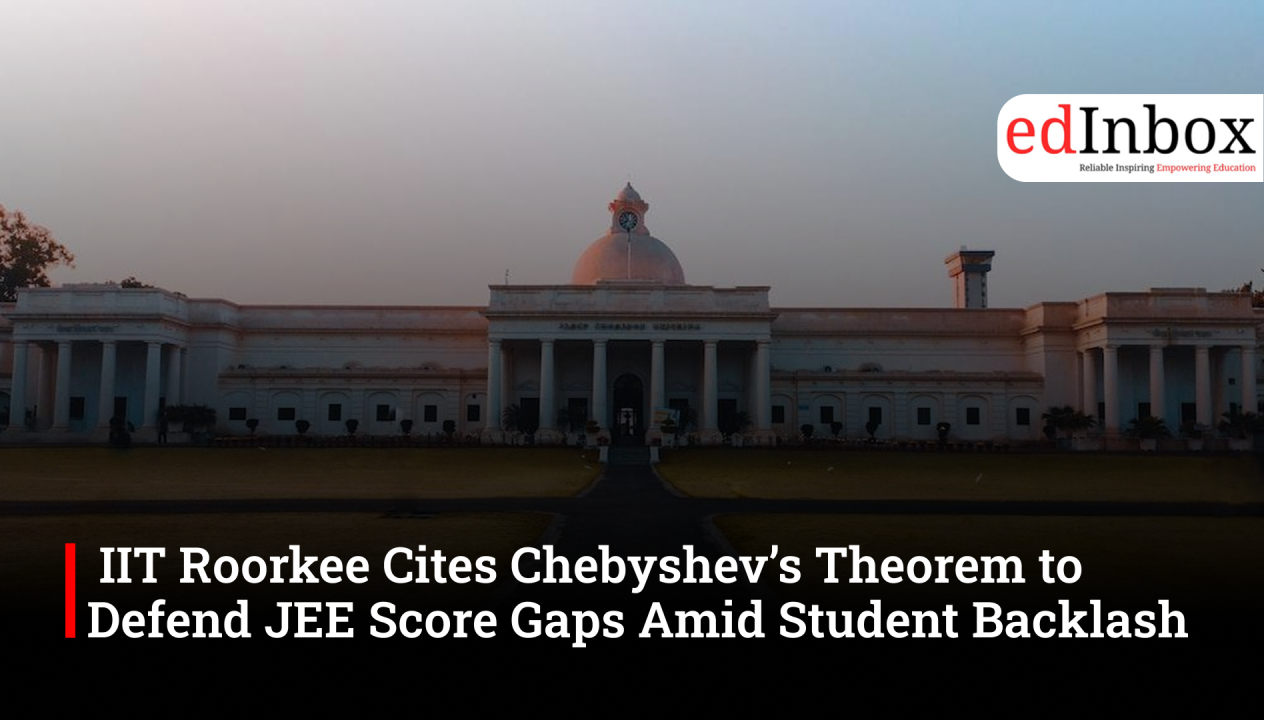
New Delhi: Amid growing debate over unusually large score differences between Paper 1 and Paper 2 in JEE Advanced 2026, IIT Roorkee has defended the results, stating that such variations are statistically expected and do not indicate any evaluation errors or irregularities.
The institute cited Chebyshev’s inequality, a statistical principle, to explain that extreme score differences can naturally occur in large competitive datasets such as JEE Advanced, which has nearly 60,000 candidates.
‘Large Score Gaps Are Statistically Normal’
According to IIT Roorkee, the observed differences between candidates’ Paper 1 and Paper 2 scores fall within expected statistical ranges.
Officials explained that variations arise due to differences in question difficulty, paper structure, marking distribution, and individual performance across sections.
The institute also noted that similar patterns have been consistently observed since the introduction of the two-paper format, reinforcing that such disparities are not unusual.
Student Concerns Over 100-Mark Differences
The clarification comes after several candidates took to social media alleging extreme discrepancies—some reportedly exceeding 100 marks between the two papers.
Examples shared online included cases such as a negative score in one paper and a high score in the other, triggering widespread debate over fairness and evaluation transparency.
Many students argued that both papers are based on the same syllabus and conducted on the same day, questioning how such large variations could occur.
No Irregularities Found, Says IIT Roorkee
Addressing the concerns, IIT Roorkee stated that there is no evidence of cheating, technical error, or evaluation mistake in the results.
The institute emphasized that the scoring pattern aligns with historical trends and does not indicate any anomaly in the examination process.
Experts Divided Over Explanation
While some academics supported the institute’s reasoning, others have expressed skepticism.
IIT Kanpur Director Manindra Agrawal reportedly backed the statistical explanation, noting that extreme variations are expected in large-scale competitive exams governed by probability distributions.
However, many students remain unconvinced, arguing that statistical models do not fully address perceived inconsistencies in individual results.
How the Controversy Escalated
The issue gained traction after students began posting score comparisons online, with some reporting extreme contrasts between the two papers.
The debate intensified further as candidates questioned whether identical syllabi and same-day testing should produce such divergent outcomes.
In response, IIT Roorkee reiterated its position via official communication, stating that the results are consistent with established statistical behavior and previous years’ trends.
What It Means for Candidates
The clarification comes at a crucial time as counselling and admissions processes begin for IITs and other top engineering institutes.
While the institute’s explanation aims to reassure candidates about the integrity of the examination system, the ongoing debate highlights the tension between statistical theory and student perceptions of fairness in one of India’s most competitive entrance exams.
IIT Roorkee Cites Chebyshev’s Theorem to Defend JEE Score Gaps Amid Student Backlash
Typography
- Smaller Small Medium Big Bigger
- Default Helvetica Segoe Georgia Times
- Reading Mode