
Teachers to help identify and document rare manuscripts across the capital as part of a nationwide effort to preserve over one crore historical records.
In a significant step towards preserving India's rich literary and cultural heritage, the Delhi government has deployed 300 Urdu and Sanskrit teachers to support the Gyan Bharatam Mission, a nationwide initiative aimed at identifying, documenting and preserving historical manuscripts.
The deployment has been approved by the Directorate of Education in collaboration with the Department of Art, Culture and Languages, Government of the National Capital Territory (NCT) of Delhi. The teachers will assist in locating and cataloguing manuscripts housed in libraries, museums, academic institutions and private collections across the city.
According to an official communication issued by the Education Department, district education authorities have been directed to ensure that all selected teachers are informed about their responsibilities and report for duty whenever called upon by the competent authority. The directive follows reports that some teachers and Heads of Schools had not received information regarding their assignment under the project.
The department has also clarified that teachers engaged in the mission during the summer vacation period will be treated as “On Duty.” They will be entitled to Earned Leave benefits in accordance with the Central Civil Services (Leave) Rules. The official order, signed by the Deputy Director of Education (Schools), was circulated to schools on June 5 along with the list of teachers selected for the assignment.
The Gyan Bharatam Mission seeks to preserve more than one crore manuscripts across India, many of which are written in classical and traditional languages and remain undocumented. These manuscripts are considered valuable repositories of knowledge spanning fields such as literature, philosophy, science, medicine, history and culture.
Officials believe the involvement of Urdu and Sanskrit teachers will be crucial in identifying, interpreting and cataloguing manuscripts that may otherwise remain inaccessible due to language barriers. Their expertise is expected to strengthen efforts to create a comprehensive inventory of historical texts and support long-term preservation initiatives.
The mission forms part of broader efforts to safeguard India's intellectual heritage and make historically significant manuscripts available for future research, scholarship and public access. By involving educators with linguistic expertise, authorities hope to accelerate the documentation process and ensure that rare knowledge resources are preserved for future generations.
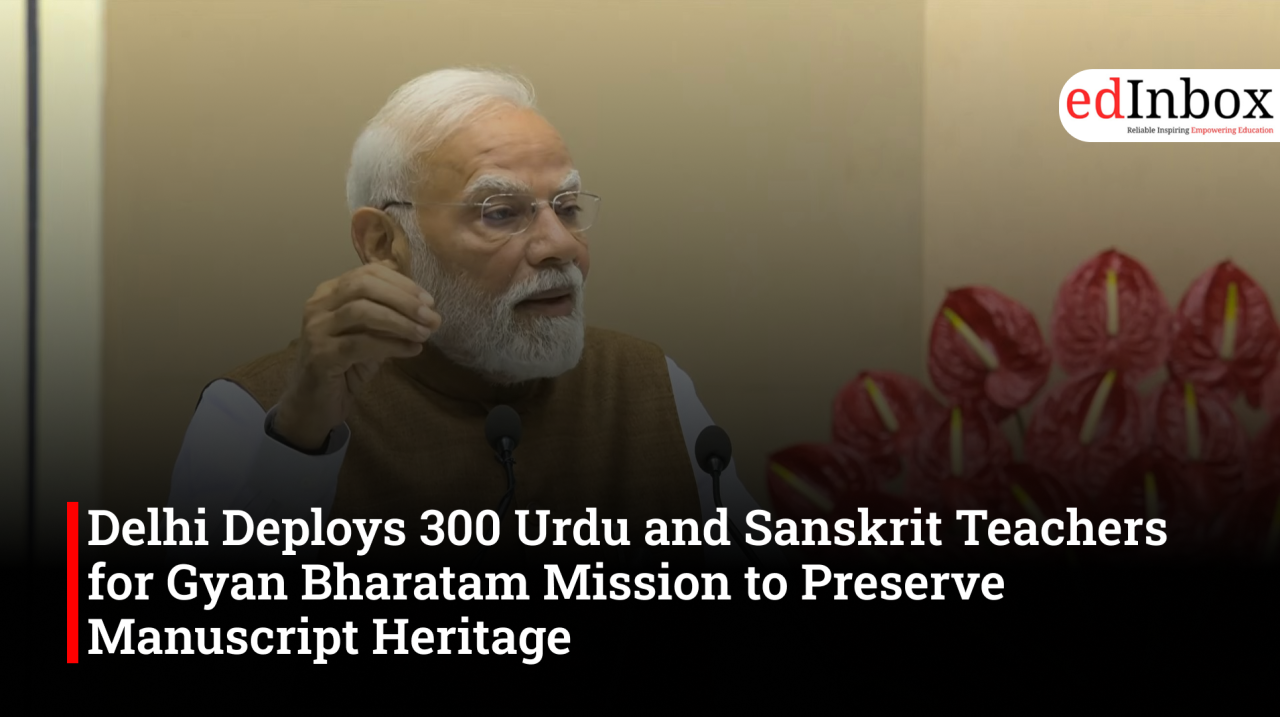
Delhi Deploys 300 Urdu and Sanskrit Teachers for Gyan Bharatam Mission to Preserve Manuscript Heritage
Typography
- Smaller Small Medium Big Bigger
- Default Helvetica Segoe Georgia Times
- Reading Mode