
Supreme Court on EWS Quota and Private Medical College Fees: What the Ruling Means for Medical Aspirants
In a significant ruling on the affordability of medical education, the Supreme Court has dismissed a petition filed by an Economically Weaker Sections (EWS) candidate challenging the high fees charged by private medical colleges in Rajasthan.
The petitioner argued that the annual income ceiling of Rs 8 lakh for EWS eligibility contradicts the reality of private medical college fees, which range from Rs 18.9 lakh to Rs 25 lakh per year, making medical education inaccessible to many deserving students.
However, a Bench comprising Justices B V Nagarathna and Joymalya Bagchi upheld the Rajasthan High Court's decision, ruling that the fee structure approved by the State Fee Regulatory Committee is legally valid and does not violate EWS reservation provisions.
Private Medical Colleges Cannot Charge Government-Level Fees: Supreme Court
During the hearing, Justice Nagarathna observed that private medical colleges and government medical colleges operate under fundamentally different financial models.
"You cannot say private educational institutions shall charge the same fees as government institutions. These are self-financing institutions, while government colleges receive state subsidies," the Court noted.
The Bench emphasized that private institutions play a critical role in expanding medical education capacity in India and cannot be expected to function on subsidised fee structures similar to government-funded colleges.
Referring to landmark judgments, including the Supreme Court's decision in the TMA Pai Foundation case, the Court reiterated that while capitation fees are prohibited, private colleges are legally entitled to charge reasonable tuition fees determined by regulatory authorities.
EWS Reservation Does Not Guarantee Fee Concession
A key issue raised by the petitioner was whether EWS reservation loses its purpose when students from low-income families are unable to afford private medical college fees despite securing admission under the quota.
The Rajasthan High Court had earlier clarified that EWS reservation applies only during the admission process and does not automatically entitle students to reduced tuition fees in private institutions.
The court further noted that no existing law mandates private medical colleges to provide fee concessions or subsidies specifically for EWS candidates.
The Supreme Court agreed with this interpretation and declined to interfere with the High Court's findings.
'If You Cannot Pay, Seek Scholarships': Supreme Court
Addressing concerns about affordability, Justice Nagarathna suggested that students facing financial difficulties should explore scholarships, education loans, and fee subvention schemes.
"If you are unable to pay, get scholarship, get subvention," the Court remarked during the proceedings.
The observation highlights the growing debate around medical education affordability in India, particularly for students from economically weaker backgrounds who qualify for reservation but struggle with the high cost of private medical colleges.
Why the Judgment Matters
The ruling is likely to have implications for thousands of NEET-qualified students seeking admission under the EWS category in private medical colleges across India.
While the judgment reaffirms the legality of private medical college fee structures approved by regulatory authorities, it also raises broader questions about access to medical education, financial aid mechanisms, and whether existing EWS policies adequately address the economic challenges faced by aspiring doctors.
Dismissing the petition, the Supreme Court stated: "We do not find any reason to interfere with the High Court order. The petition is dismissed. Question of law, if any, is kept open."
The decision effectively reinforces the distinction between admission reservation benefits and fee-related concessions, making it clear that EWS reservation guarantees access to seats but does not automatically reduce the cost of studying in private medical institutions.
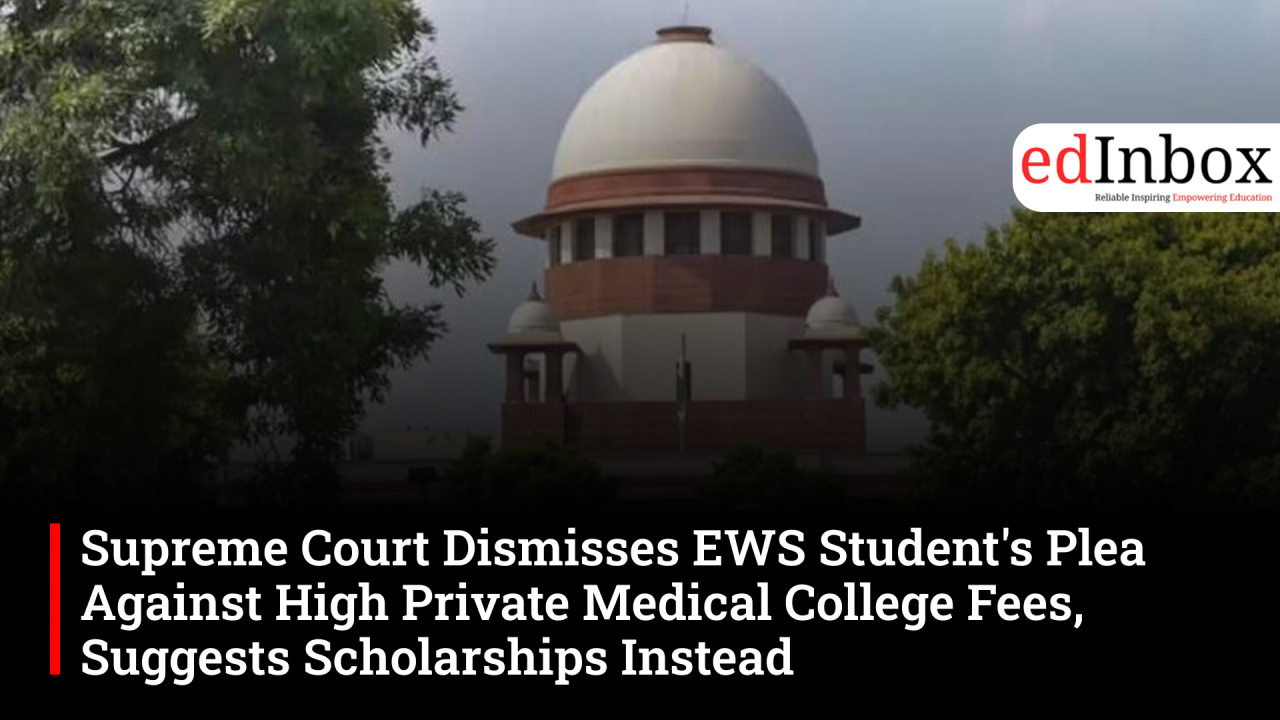
Supreme Court Dismisses EWS Student's Plea Against High Private Medical College Fees, Suggests Scholarships Instead
Typography
- Smaller Small Medium Big Bigger
- Default Helvetica Segoe Georgia Times
- Reading Mode