
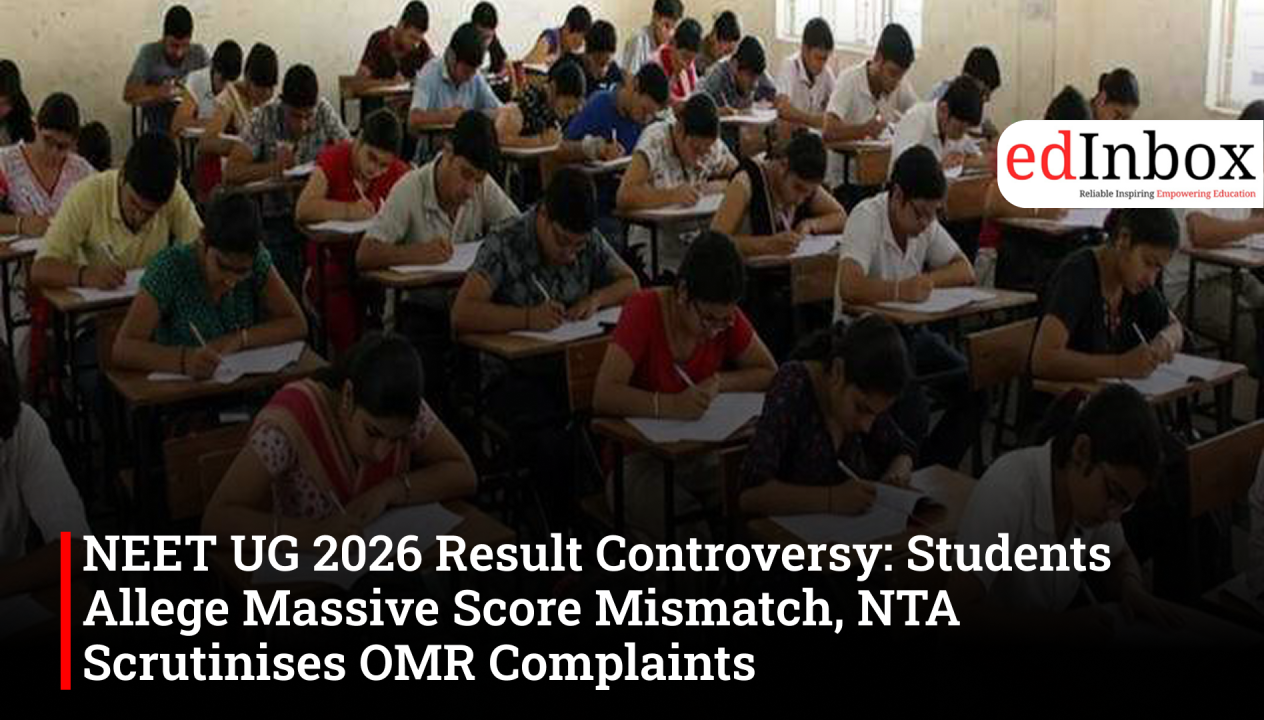
The NEET UG 2026 result controversy has intensified after several candidates claimed that their official scores were drastically lower than what they had calculated using the provisional answer key. From aspirants expecting more than 600 marks receiving scores below 200, to one student claiming she expected 640 marks but was awarded only 38, the allegations have triggered widespread concern over the accuracy of the NEET UG 2026 re-exam results. In response, the National Testing Agency (NTA) has said it is examining every complaint while warning that anyone submitting fake or AI-generated OMR sheets during the verification process could face legal action.
The controversy emerged soon after the NTA announced the NEET UG 2026 re-examination results on July 16. The re-test, conducted on June 21, followed the cancellation of the original May 3 examination after allegations of a question paper leak. Around 11.21 lakh candidates qualified for admission to nearly 1.37 lakh MBBS seats, along with undergraduate dental, AYUSH and allied health programmes across the country.
However, soon after the results were declared, social media platforms were flooded with posts from students alleging significant discrepancies between their expected and official scores.
Among the most widely discussed cases is that of Lucknow-based aspirant Pratibha Trivedi, who claimed she had estimated around 640 marks after matching her responses with the provisional answer key but received only 38 marks in the official result. She said she had emailed the NTA multiple times but had not yet received a response.
Similarly, Arya Singh from Kanpur alleged that while her self-evaluation indicated 609 marks, the result portal initially displayed 540 marks before later dropping to 167 marks. Another candidate, Lakshya Singh from Ranchi, claimed his expected score of around 660 marks was reflected as only 116 marks in the final result. He maintained that the OMR sheet he submitted for verification was genuine and carried the required barcode, thumb impression and signature.
The authenticity of these individual claims has not been independently verified, but they have fuelled demands for greater transparency in the evaluation process.
Addressing the growing concerns, the NTA stated on social media that it is closely scrutinising all complaints related to the NEET UG 2026 results. The agency said it had found several OMR sheets submitted for verification to be manipulated and cautioned students and parents against uploading fake or AI-generated documents. According to the agency, any attempt to submit fabricated evidence may invite legal action.
An official from the Union Education Ministry also confirmed that an inquiry into the complaints is underway. The ministry is expected to release details regarding the number of grievances received and how many involve suspected fraudulent or manipulated OMR sheets in the coming days.
Education experts have urged candidates not to jump to conclusions until the investigation is completed. Keshav Agarwal, Vice-President of the Coaching Federation of India, said discrepancies could arise due to factors such as incorrect mapping of question paper codes, software-related issues or manipulation of OMR images in some cases. He advised students with genuine grievances to use the NTA's official complaint mechanism and await the outcome of the verification process.
The issue has also sparked a political debate. Opposition leaders have criticised the NTA over recurring examination controversies, questioning its ability to conduct high-stakes national entrance examinations transparently. They have demanded greater accountability and reforms in the examination system.
Meanwhile, the Central Bureau of Investigation (CBI) continues to probe the alleged NEET paper leak that led to the cancellation of the original examination. Thirteen people have been arrested so far, and the agency is expected to file its charge sheet later this month.
As thousands of medical aspirants await clarity, the NTA's scrutiny of complaints is expected to determine whether the reported score discrepancies stem from isolated cases, technical errors, or other factors. The findings are likely to play a crucial role in restoring confidence in one of India's largest medical entrance examinations.
NEET UG 2026 Result Controversy: Students Allege Massive Score Mismatch, NTA Scrutinises OMR Complaints
Typography
- Smaller Small Medium Big Bigger
- Default Helvetica Segoe Georgia Times
- Reading Mode