
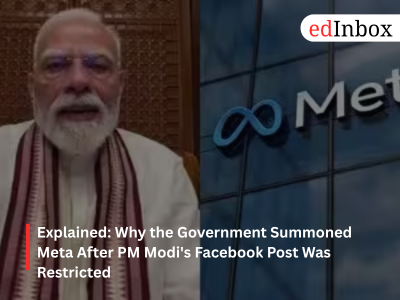
A brief restriction of Prime Minister Narendra Modi's Facebook post has escalated into a major regulatory issue, with the Centre summoning senior global executives from Meta and seeking a detailed explanation for what the social media giant has described as an AI moderation "glitch."
Although Meta restored the content within hours and issued an apology, the Ministry of Electronics and Information Technology (MeitY) has made it clear that it considers the explanation inadequate. The incident has reignited questions about AI-driven content moderation, platform accountability, and the legal responsibilities of technology companies operating in India.
What Happened?
The controversy began after Prime Minister Modi uploaded his first direct selfie video on Instagram on July 23, which was subsequently shared on Facebook.
In the video, the Prime Minister addressed India's youth, promising strict action against examination paper leaks and announcing that the government would introduce stronger legislation to tackle the issue. Days later, the Lok Sabha passed the Anti-Paper Leak Amendment Bill amid protests from Opposition members.
However, the Facebook version of the post was briefly restricted before later being restored.
Meta acknowledged that the removal had occurred "in error" and apologised for the incident.
Meta's Explanation
According to government sources, Meta informed officials that the issue resulted from a malfunction in its AI-powered automated content moderation system.
The company reportedly explained that automated filters were reviewing multiple shared versions of the Prime Minister's post circulating across Facebook. During that process, the original post was mistakenly flagged and temporarily restricted.
Meta has reportedly:
- Apologised for the error.
- Admitted that the restriction was unintended.
- Maintained that the incident resulted from an automated system glitch.
- Offered to "ringfence" high-profile accounts to reduce the chances of similar incidents occurring again.
A Meta spokesperson stated that the content had been removed by mistake and was restored once the error was identified.
Why the Government Is Not Satisfied
Despite Meta's apology, the Centre believes the explanation raises more questions than it answers.
IT Secretary S. Krishnan said the government appreciates the company's admission but does not consider the explanation adequate.
Officials argue that simply attributing the incident to an AI malfunction is insufficient, particularly for a global technology company whose platforms rely extensively on automated moderation systems.
According to government sources, if artificial intelligence can mistakenly restrict content from the Prime Minister's verified account, Meta must clearly explain:
- Why the error occurred.
- What safeguards failed.
- How similar mistakes will be prevented in the future.
- Whether its moderation systems fully comply with Indian legal requirements.
The government has therefore summoned Meta's Global Head of Public Policy and other senior executives to engage directly with Indian authorities.
Why Summon Global Executives?
Officials say the issue extends beyond India's local operations.
By involving Meta's international leadership, the government wants to ensure that concerns raised in India receive attention at the highest levels of the company.
The move also reflects India's expectation that global technology firms remain accountable for how their AI systems operate in one of the world's largest digital markets.
Growing Questions Around AI Moderation
The incident has highlighted broader concerns about AI-driven content moderation.
As social media companies increasingly rely on automated systems to detect harmful or policy-violating content, questions have emerged about transparency, accuracy, and accountability when these systems make mistakes.
Cyber law expert Pavan Duggal argues that companies cannot simply invoke "technical glitches" when errors affect important public communications.
According to Duggal, platforms operating in India must be prepared to accept greater legal responsibility if AI moderation systems fail to comply with applicable laws.
Experts also note that governments worldwide are demanding greater transparency regarding how AI moderation systems function, how decisions are made, and what safeguards exist against significant errors.
Part of Broader Regulatory Scrutiny
The latest dispute is not an isolated incident.
In recent weeks, MeitY has taken several actions involving Meta-owned platforms, including:
- Issuing a notice to WhatsApp over its proposed username feature, citing concerns about phishing, impersonation, and digital fraud.
- Raising concerns over Instagram advertisements allegedly containing child sexual abuse material (CSAM).
Separately, a parliamentary committee has summoned representatives of major social media companies, along with officials from MeitY and the Ministry of Home Affairs, for discussions on digital platform regulation.
Bigger Picture
The controversy reflects a broader global trend in which governments are demanding stronger oversight of major technology companies.
As artificial intelligence increasingly influences what users can view, share, or access online, regulators across countries are seeking greater transparency over algorithmic decision-making, stronger safeguards against automated errors, and clearer accountability when platform actions affect public discourse or democratic institutions.
For India, the episode underscores that AI-powered moderation systems cannot operate as opaque "black boxes." Instead, technology companies are expected to demonstrate that their automated systems are reliable, transparent, and fully compliant with Indian law.
Explained: Why the Government Summoned Meta After PM Modi's Facebook Post Was Restricted
Typography
- Smaller Small Medium Big Bigger
- Default Helvetica Segoe Georgia Times
- Reading Mode