
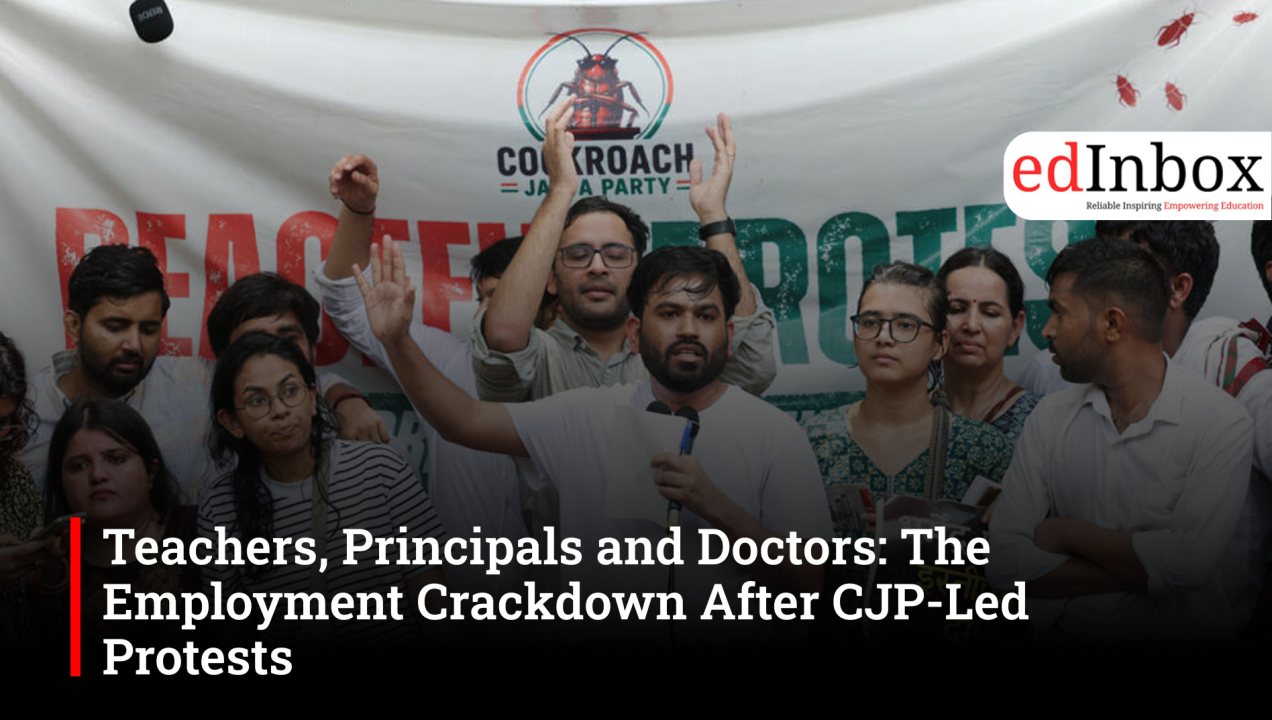
For seven weeks, the protests at Delhi’s Jantar Mantar were largely framed as a political confrontation between protesters and the government.
But away from the headlines, another story was unfolding.
Teachers, professors, principals and doctors who participated in or supported the protests began facing suspension orders, termination notices and departmental inquiries.
For some, the action was temporary. For others, it meant losing their jobs. And in several cases, those affected say they were not given a clear explanation or a meaningful opportunity to defend themselves.
The cases have raised a larger question: Can participation in a protest outside the workplace cost a person their livelihood?
Assistant Professor Returns From Protest, Finds Termination Letter
For 32-year-old Mohit Bhardwaj, the return journey from Delhi to Bareilly should have been a moment of celebration.
He had travelled to Jantar Mantar with students and other residents of Bareilly to support the education-related protests. The movement had ended with a major political development, with Union Education Minister Dharmendra Pradhan resigning on July 25.
But when Bhardwaj returned to his college, the welcome was very different.
On July 22, he says, the principal called him and handed him a termination letter.
Bhardwaj was an assistant professor teaching Accounts and Business Studies at Ganna Utpadak PG College in Bareilly.
According to him, the college administration had seen videos of him participating in the Jantar Mantar protest.
The termination letter referred to “repeated complaints” against him but, he said, did not clearly identify the complaints or provide him with a specific opportunity to respond.
“I had not been informed beforehand, given any notice, or provided any formal reason for the termination,” Bhardwaj said.
He subsequently approached the authorities seeking an opportunity to present his case and an impartial inquiry.
On August 5, the Allahabad High Court overturned his termination.
He was still awaiting reinstatement at the time of the report.
Why Did Bhardwaj Join the Protest?
Bhardwaj said his decision to join the movement was linked to his experiences as a teacher.
He had seen students affected by issues including the 2024 Uttar Pradesh police recruitment examination leak and had previously raised concerns about public education and campus infrastructure.
After climate activist and educationist Sonam Wangchuk was detained in Delhi during his hunger strike, Bhardwaj expressed solidarity on Facebook.
He then mobilised around 35 people from Bareilly, including students, business owners, young engineers and medical graduates, to travel to Delhi.
Bhardwaj also claimed that police came to his home after monitoring his social media posts and attempted to prevent the group from travelling to Delhi.
He eventually left for the capital with some students.
The college management, however, disputed his account and alleged that Bhardwaj attended the protest in a political capacity rather than as a teacher.
Trust representatives also cited his earlier political association with the Samajwadi Party youth wing.
Bhardwaj maintains that the protests were not the property of any political party and that he participated because of concerns affecting students and education.
Students Stand Behind Their Professor
Bhardwaj's students saw the matter differently from the college management.
Kshitij, a 21-year-old BCom student, said the professor had gone to Delhi to raise students' concerns.
Another student, 24-year-old Jyoti Chaudhry, said Bhardwaj had helped her and other students secure admission when they could not afford the course.
The students' support has added another dimension to the dispute.
For them, the question is not simply whether their professor attended a protest.
It is whether a teacher should lose his livelihood for speaking about issues affecting the very students he teaches.
Teacher Suspended After Supporting Jantar Mantar Protest
Bhardwaj's case was not isolated.
In Haryana's Rohtak district, guest teacher Sulekha Dalal was suspended after attending the Jantar Mantar protest in support of her 21-year-old son, who was preparing for the police services.
Her participation was captured on video and circulated on social media.
Dalal was suspended on June 8, two days after participating in the protest.
The suspension order reportedly did not specify a detailed reason, although the District Elementary Education Officer said she had violated conduct rules applicable to government employees.
The action was subsequently revoked, and Dalal was reinstated after the Cockroach Janta Party (CJP) intervened and offered legal assistance.
Her case ended with reinstatement.
Others were not so fortunate.
Principal Suspended Despite Inquiry Finding No Staff Involvement
In Haryana's Kanina village, 55-year-old Naresh Kumar Kaushik found himself facing a different situation.
Kaushik was the principal of the Government Senior Secondary School in Kanina, Mahendragarh district.
On July 17, 15 girls from the school held a protest outside the school premises in support of Sonam Wangchuk.
Videos of the protest circulated widely.
The slogans included criticism of the BJP and an appeal against remaining silent about the country's future.
An inquiry committee headed by Block Education Officer Suresh Kumar was subsequently formed.
According to Kaushik, the committee found that the demonstration had taken place after school hours and outside the school premises. It also found that teachers and other staff members had neither instigated nor supported the students in organising the protest.
Yet Kaushik was suspended on July 20 under Rule 5 of the Haryana Civil Services (Punishment and Appeal) Rules, 2016.
The principal says he does not understand why he was removed despite the inquiry finding no evidence of his involvement.
“I was not even given a chance to be heard,” he said, questioning the lack of transparency.
The District Education Officer declined to comment on the individual case but said appropriate action had been taken according to the rules.
For Kaushik, the consequences are particularly serious. He is the sole breadwinner of a family of five and is also 80 percent disabled in his legs.
He has since been approaching government offices seeking reinstatement.
Doctor Suspended After Solo Protest
The employment consequences were not limited to the education sector.
In Bahraich, Uttar Pradesh, resident doctor Dr Rupak Ikhe was suspended after staging a solo demonstration in support of Wangchuk and the Jantar Mantar protests.
On July 17, Ikhe stepped out wearing a T-shirt carrying a message of support and held a placard that read:
“Yeh desh nahi bikne dunga. Yeh desh nahi mitne dunga.”
He said he had not invited anyone to join him and had organised the demonstration independently.
Images and videos of the protest later circulated on social media.
The principal of Maharaja Suhel Dev Government Medical College, Dr Sanjay Khatri, subsequently suspended Ikhe and ordered a departmental inquiry.
Ikhe was reinstated roughly 10 days later.
But the young doctor has chosen not to speak publicly about the episode, citing pressure from family and well-wishers.
He is now focusing on his final examinations.
The Larger Question: Can Protest Participation Cost a Job?
These cases raise a difficult legal and institutional question.
Government employees are subject to service and conduct rules, and those rules can place restrictions on participation in political activities or certain forms of protest.
But the central issue in these cases is whether such rules were applied consistently, transparently and with due process.
Academic and writer Apoorvanand argued that educational institutions are increasingly losing their autonomy and questioned why employees could face action for participating in protests while educational institutions can also host programmes associated with ruling-party or RSS-linked organisations.
He also questioned the rationale for penalising teachers in Uttar Pradesh and Haryana for participating in a protest in Delhi.
The controversy therefore goes beyond the individual cases.
It touches on academic freedom, employee rights, institutional autonomy, political expression and the boundaries of government service rules.
A Culture of Fear?
Perhaps the most striking element running through these cases is fear.
Kaushik does not want to speak extensively to the media because he worries about further repercussions.
Ikhe, despite being reinstated, has chosen to stay quiet.
Bhardwaj, meanwhile, says he hopes other teachers and graduates who supported the protests will not remain silent simply because they fear losing their jobs.
His own experience demonstrates why that fear exists.
He is the sole earning member of a family that includes his ailing mother, wife and two young children.
For nearly three weeks, his salary disappeared.
Although he has a fruit wholesale business to fall back on, many government employees and teachers may not have that option.
A suspension or termination is therefore not merely an administrative action.
For a family dependent on one person's salary, it can become an immediate economic crisis.
From Protest Site to Workplace
The Jantar Mantar protests may have ended, but their consequences have continued far beyond the protest site.
A teacher returning to his college.
A guest teacher supporting her son.
A principal whose students staged a demonstration.
A doctor taking out a solo march.
Different people, different institutions and different circumstances — but a common thread connects their stories.
They participated in, supported or became associated with a movement.
And their workplaces responded with disciplinary action.
Some were reinstated.
Some are still waiting.
Some remain afraid to speak.
The question now is not simply what happened at Jantar Mantar.
It is what happens after citizens return home from a protest.
If participation in a democratic demonstration can put a teacher's salary, a principal's career or a doctor's future at risk, then the debate must move beyond politics.
It must examine the relationship between dissent and livelihood, service rules and due process, and democratic participation and institutional freedom.
For Bhardwaj, the message after the court overturned his termination was simple:
“Satyamev Jayate.”
But for many others still facing disciplinary action, the fight may be far from over.
Teachers, Principals and Doctors: The Employment Crackdown After CJP-Led Protests
Typography
- Smaller Small Medium Big Bigger
- Default Helvetica Segoe Georgia Times
- Reading Mode