
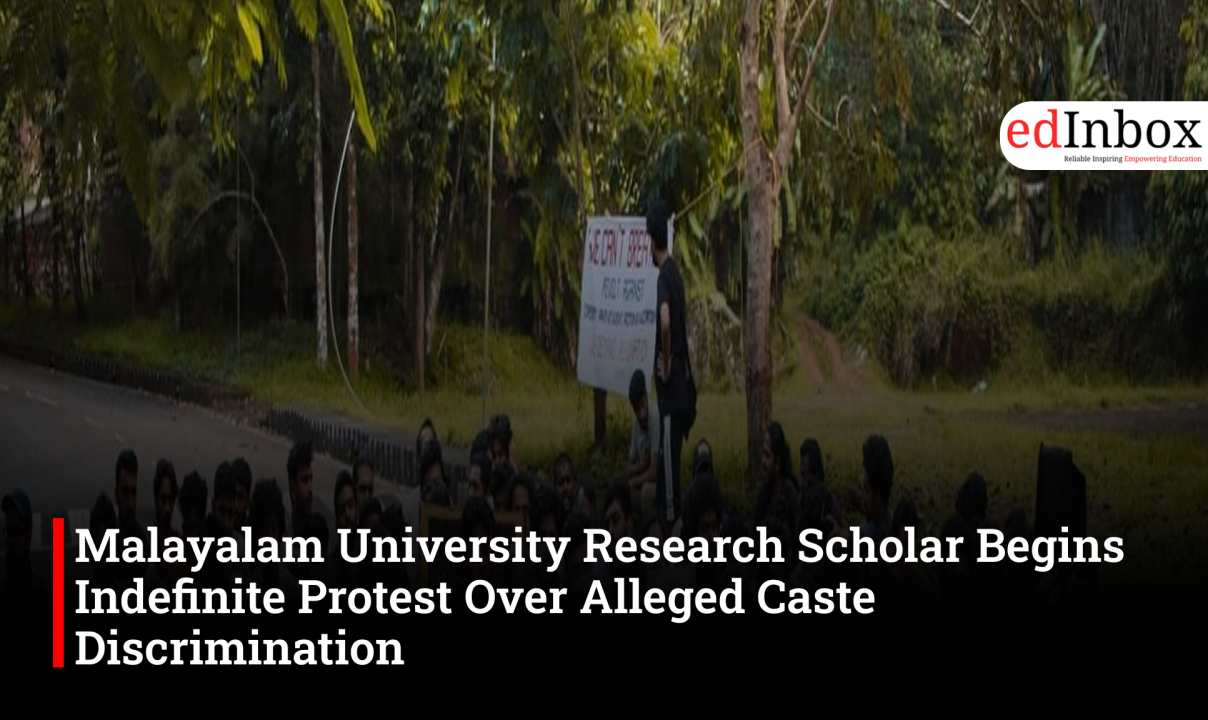
A research scholar at Thunchath Ezhuthachan Malayalam University in Tirur has launched an indefinite protest at the university entrance, alleging caste-based discrimination, harassment and denial of academic support. Anagha Sasi, a research scholar in the Department of Environmental Studies, has accused several faculty members of subjecting her to caste-related harassment since 2024.
Sasi, who is from Kochi, has alleged that despite submitting multiple complaints over the past two years, the university failed to adequately address her grievances. She is now demanding an independent investigation into her allegations and suspension of the faculty members named in her complaints pending the inquiry.
The university, however, has rejected her allegations, describing them as baseless.
Research Scholar Alleges Caste-Based Harassment
According to Sasi, she faced a series of incidents that she considers discriminatory and humiliating during her research work at the university.
She has alleged that she was assigned tasks such as sweeping classrooms, dusting books and files and cleaning laboratory equipment, despite being a research scholar. She also claimed that she was denied essential academic and research support and was at times asked to stand in a corridor without a chair.
In one of her allegations, Sasi claimed that a faculty member told her that she would have to follow his directions if she wanted to continue her PhD studies. She further alleged that the faculty member made a remark suggesting that her fellowship was awarded because of her caste rather than her academic qualifications.
The allegations have raised concerns over the treatment of research scholars and the need for effective mechanisms to address complaints of caste discrimination in higher education institutions.
Scholar Seeks Independent Inquiry
Sasi has said that she approached the university with complaints on several occasions but was dissatisfied with the action taken.
She has also alleged that inquiry committees constituted by the university submitted reports that were unfavourable to her claims. Citing concerns over the impartiality of the previous inquiries, she is seeking an investigation by an independent external agency.
As part of her current protest, Sasi has demanded that the faculty members named in her allegations be suspended while an independent inquiry is conducted.
She has stated that she will continue her indefinite protest until she receives what she considers justice.
MLA, Welfare Party Leader Back Protest
Sasi's protest has received support from political and social figures.
P.K. Navas, a local MLA, has publicly supported her demands and called for an external agency to investigate the allegations. Navas stressed the need to ensure that students receive institutional support and that complaints of discrimination are addressed fairly.
On August 16, Razak Paleri, State President of the Welfare Party of India, visited Sasi at the protest site and also called for an independent investigation.
Paleri questioned the decision to have the university Registrar oversee the inquiry, arguing that the Registrar had previously dealt with Sasi's complaints. He said an external agency would be better placed to examine the allegations impartially.
Paleri also called for Sasi's research guide and research topic to be approved without further delay and urged the university to provide her with the academic resources required to continue her research.
University Rejects Allegations
The university has categorically rejected Sasi's allegations, maintaining that the claims are baseless and unfounded.
The disagreement between the research scholar and the university has now brought renewed attention to issues of caste discrimination, research support and grievance redressal mechanisms in higher education.
Sasi's demand for an external inquiry comes amid a continuing dispute over the earlier institutional investigations into her complaints. With the scholar continuing her indefinite protest and political representatives backing her call for an independent probe, the university is under pressure to address the matter and clarify the steps it intends to take.
The case also highlights the importance of transparent and independent grievance mechanisms for research scholars, particularly when allegations involve faculty members and questions of caste-based discrimination. Any determination regarding the allegations would ultimately depend on the findings of an impartial investigation.
Malayalam University Research Scholar Begins Indefinite Protest Over Alleged Caste Discrimination
Typography
- Smaller Small Medium Big Bigger
- Default Helvetica Segoe Georgia Times
- Reading Mode