
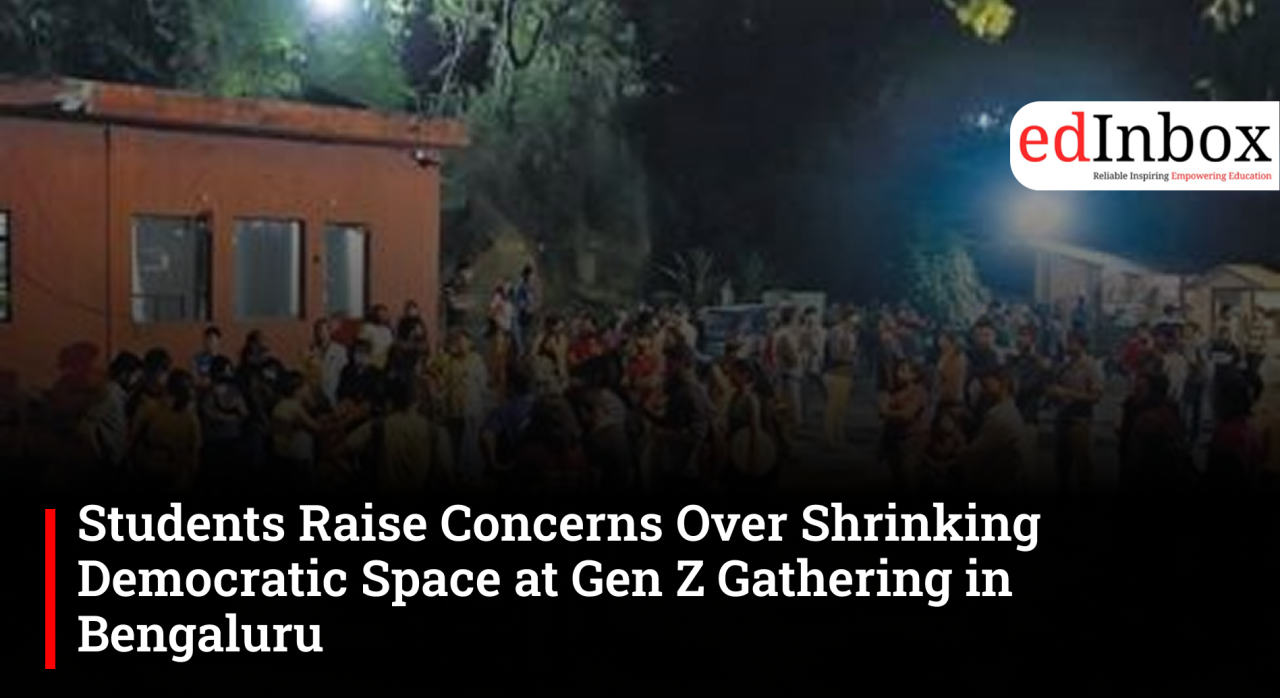
Students, activists and cultural figures gathered in Bengaluru on Sunday to discuss concerns over the shrinking democratic space in educational institutions, paper leaks, government school closures and challenges facing India's public education system.
The gathering, titled “GenZ on the March: Paper Leak, Accountability, and the New Wave of Youth Politics in India,” was organised by the All India Students’ Association (AISA) and the Revolutionary Youth Association (RYA). Speakers called for greater accountability in education and urged young people to engage more actively with social and political issues.
AISA Raises Concerns Over Education Policies
AISA national president Neha Bora spoke about her recent 23-day hunger strike in Delhi, during which she demanded the resignation of Union Education Minister Dharmendra Pradhan.
Bora said the closure of government schools should not be viewed simply as an administrative decision affecting institutions with low enrolment. According to her, such closures reflect wider concerns surrounding access to and investment in public education.
She also questioned what she described as differing responses to student protests in different parts of the country. Bora pointed to police action, including FIRs and detentions, during student demonstrations in Bengaluru and contrasted it with expressions of solidarity with student protesters elsewhere.
She urged political parties opposed to the BJP to move beyond symbolic support and adopt policies that directly address students' concerns.
Petition Seeks Democratic Campus Spaces
During the gathering, AISA launched a petition addressed to Azim Premji University, calling for the protection of democratic spaces on campus and seeking the removal of restrictions imposed on students.
Actor Kishore, who participated in the discussion, highlighted shortcomings in government schools, including inadequate toilets, classrooms, libraries and drinking water facilities. He argued that such gaps can contribute to student dissatisfaction and unrest.
Speakers also stressed that educational inequality cannot be separated from caste and economic disparities. They called for broader discussions on how these factors affect students' access to opportunities and participation in educational institutions.
Youth Urged to Engage With Politics
Musician and author TM Krishna said students cannot remain completely detached from political and social issues.
AISA also announced plans to organise solidarity programmes across campuses on September 5, the death anniversary of journalist Gauri Lankesh. The programmes are intended to encourage youth participation in public discourse and build solidarity around issues concerning students and democratic rights.
The Bengaluru gathering comes amid wider debates over student protests, examination paper leaks, education inequality and the future of India's public education system, with participants calling for greater student participation in shaping educational and political discourse.
Gen Z Gathering in Bengaluru: Students Raise Concerns Over Democratic Freedoms, Paper Leaks and Education
Typography
- Smaller Small Medium Big Bigger
- Default Helvetica Segoe Georgia Times
- Reading Mode