
Why rural India’s government schools are losing relevance — and how they can be rebuilt by 2030
India’s rural government school is not redundant. Its delivery model is.
The country has made remarkable progress in getting children into classrooms. But enrolment is no longer enough. The real question is whether a rural school enables a child to read with understanding, work confidently with numbers, communicate across languages, use technology safely, question an AI-generated answer and imagine a livelihood beyond inherited occupations.
Too many government schools are struggling to deliver that promise.
This is not an argument that every public school is failing, nor that private schools are automatically better. States such as Kerala, Himachal Pradesh, Punjab and Tamil Nadu demonstrate that government education can be effective, inclusive and trusted. Nor is consolidation always wrong. A school with five children and one overburdened teacher may genuinely benefit from becoming part of a stronger school complex.
The danger begins when consolidation becomes an excuse for abandonment.
Access has improved. Learning has not kept pace
ASER 2024 found that 98.1 per cent of rural children aged 6-14 were enrolled. The problem begins after the school gate.
Only 23.4 per cent of Grade III children in government schools could read a Grade II-level text in 2024. By Grade V, the figure rose to 44.8 per cent in government schools, compared with 59.3 per cent in private schools. Basic numeracy remains weak too.
The adolescent picture is equally concerning. ASER’s 2023 Beyond Basics survey found that only 43.3 per cent of rural youth aged 14-18 could correctly solve a three-digit-by-one-digit division problem. Around one in four could not fluently read a Grade II-level text in the regional language.
Digital access has not automatically produced digital capability. While 82.2 per cent of 14-16-year-olds knew how to use a smartphone, only 57 per cent had used one for education in the previous week, compared with 76 per cent for social media.
A child may be able to scroll through a video feed and still struggle to verify a source, complete an online form, protect a password or question an AI-generated answer.
NEP 2020 promises a different child
The National Education Policy 2020 envisages a 5+3+3+4 structure built around foundational literacy and numeracy, competency-based learning, multilingual education, vocational exposure, digital learning, inclusion and stronger teachers.
NIPUN Bharat translated the foundational literacy promise into a national mission, with Grade III as a key milestone. Yet the 2025 target has passed while learning gaps remain.
The problem is less about policy ambition than delivery.
A rural school cannot teach mathematics, English, science, digital skills and now AI literacy simply because a new curriculum or online module has arrived. It needs teachers, libraries, laboratories, connectivity, school leadership, transport, health support and protected teaching time.
NEP also challenges the old divide between academic and vocational education. A rural child should be able to learn algebra and understand a water pump, study English and food processing, or combine science with agriculture and local enterprise.
Too often, government schools currently provide neither strong foundations nor credible pathways to work and higher education.
The chain of small failures
NITI Aayog’s 2026 report on India’s school education system illustrates how individual weaknesses reinforce one another.
India has around 14.71 lakh schools serving more than 24.69 crore students. Yet more than one-third of schools have fewer than 50 students, while 1,04,125 are single-teacher schools serving more than 33.7 lakh children.
The government share of school enrolment has also fallen over the decade, while private unaided schools have expanded their share.
Infrastructure figures tell another story. Although functional girls’ toilets and electricity coverage have improved, thousands of schools still lack usable toilets, drinking water, handwashing facilities or functional electricity. Computers are available in fewer than two-thirds of schools, while smart classrooms remain far from universal.
A national pupil-teacher ratio can therefore conceal the reality of a remote teacher handling several grades, administrative paperwork, meals, surveys and non-teaching duties.
The result is a vicious cycle: fragmented schools make staffing difficult; weak staffing affects learning; poor learning pushes families towards private alternatives; falling enrolment then strengthens the case for consolidation.
The school becomes empty partly because families lose faith. Families lose faith partly because the school becomes empty.
Families are voting with their feet
Parents do not need a national survey to know when their child is falling behind.
They see a paragraph copied without comprehension, incorrect calculations at a market stall, a teacher managing several grades and a private school promising English, regular tests, transport and a clearer future.
The demand is not necessarily for elite education. It is for visible capability.
Parents want children who can read a medicine label, calculate a wage, understand a loan, write an application, use a government portal, identify a scam, communicate with a customer or build a local enterprise.
That is where rural schooling must change.
English should become a bridge rather than an aspiration detached from context. Mathematics can be taught through markets, farms, wages and measurement. Science can begin with water, soil, health and local ecology. Digital education should include public services, livelihoods, privacy and verification.
The goal is not an artificial English accent or another coaching centre. It is a child who can use knowledge.
When citizens enter the classroom
The 2026 School Thik Karo — Fix the Schools campaign by the youth group known as the Cockroach Janata Party, or CJP, brought another dimension to the debate.
Volunteers entered government schools, documented conditions and circulated videos showing problems involving toilets, drinking water, electricity, classrooms, meals and teacher attendance.
Such footage can expose a gap between official infrastructure data and lived reality. But it cannot substitute for trained inspection, learning assessments or social audits. Some campaigners also faced allegations involving unauthorised entry, filming, threats and political confrontation, while campaign organisers disputed some of those claims.
These allegations require investigation rather than instant conviction.
The answer should be neither mob inspection nor official secrecy. Schools need lawful citizen access, child-protection safeguards, independent audits, transparent school-level records and effective complaint mechanisms.
Teachers, many of whom work under difficult conditions, should not be collectively demonised. But a public school cannot become an institution beyond scrutiny.
Money is moving. Trust is not.
Public investment in education remains substantial. The Union’s 2026-27 allocation includes funding for school education, Samagra Shiksha, PM POSHAN, PM SHRI and Atal Tinkering Labs. States are also announcing school-repair programmes, model schools, AI labs and infrastructure projects.
The challenge is ensuring that investment reaches the last mile.
A sanctioned amount does not educate a child. A functioning toilet does. A present teacher does. A reliable meal does. A library that children actually use does.
Funding must therefore be weighted towards remote, poor, tribal, migrant and disability-heavy communities. Maintenance funds must arrive predictably, their use must be visible and teachers must be protected from excessive non-teaching work.
Kotlapur offers a lesson
The government school in Kotlapur, Karnataka, shows what can happen when leadership and community trust return.
The school had effectively lost its students to a nearby private school. After headmaster Dr Vijaya Kumar arrived in 2025, he worked with the community, improved the campus, developed a Kannada language laboratory and library and went door-to-door to reconnect with parents.
The village contributed to CCTV. Students received visible support through uniforms, books, shoes, socks and eggs. By 2025-26, reported enrolment had risen to 42 students with four teachers.
The lesson is powerful — but also uncomfortable.
A school should not need a heroic headmaster, donations and extraordinary personal initiative simply to become functional.
The best practices of states such as Kerala, Tamil Nadu, Himachal Pradesh, Punjab and community-linked models elsewhere should become systems rather than isolated success stories.
Rebuilding the rural school by 2030
India does not need every village school to look identical. It needs every child to receive a minimum guarantee.
That means safe classrooms, water, usable toilets, electricity, furniture, accessibility, meals, libraries and maintenance.
It means enough trained teachers, with school complexes providing access to specialist teachers where necessary.
It means assessing foundational learning every year and providing stigma-free catch-up support.
It means teaching English and mathematics for real-life use, rather than memorisation.
It means treating digital and AI literacy as questions of judgement, privacy, bias, source verification and safety — not simply smart-classroom hardware.
It means consolidating schools only after considering travel time, monsoon access, transport costs, girls’ safety, disability access and attendance.
It means introducing short, practical modules linked to agriculture, food processing, repair, crafts, energy, health, climate, digital services and enterprise without turning vocational education into caste or class tracking.
And it means giving School Management Committees genuine information and usable budgets while protecting children’s privacy.
The 2030 test is simple
By 2030, India should be able to ask every rural school a straightforward set of questions.
Can the child read a new text and explain it?
Can she calculate, estimate, measure and reason?
Can he use English and digital tools without losing the strength of his home language?
Can they recognise a scam and question whether an AI answer is true, fair and safe?
Can they learn a practical skill without being trapped in a predetermined occupation?
Can they remain in school through adolescence because transport, food, safety, health and hope are present?
These are more meaningful measures of educational success than enrolment figures alone.
A private tutor can sell English. A smartphone can deliver a video. A skill centre can teach a machine. But only a strong public school can combine learning, nutrition, dignity, citizenship, community and a pathway to the wider world for every child, including those whose parents cannot afford alternatives.
The rural school is therefore not an outdated institution.
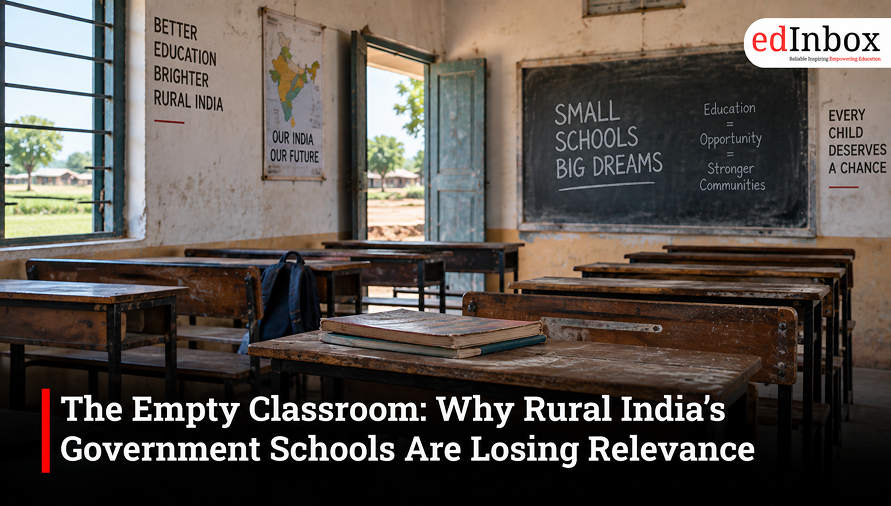
The empty classroom is a warning.
Closing a school may reduce an administrative line on a spreadsheet. Rebuilding one can change the trajectory of an entire family.
Kotlapur shows what is possible. Citizen campaigns show what happens when the present is left unexamined. NITI Aayog provides much of the policy architecture.
What remains is political courage: let citizens see, make teachers capable and respected, fund the last mile, and judge every school by the power it gives a child.
The Empty Classroom: Why Rural India’s Government Schools Are Losing Relevance
Typography
- Smaller Small Medium Big Bigger
- Default Helvetica Segoe Georgia Times
- Reading Mode