
Nowadays, artificial intelligence is discussed everywhere around the world. Some people are afraid of it, yet others see in it a source of hope and a strong tool for future development. At the same time, there is another concern which is growing, especially in Western countries-the steadily falling birth rates. Because of overall human development, better systems of education and healthcare, democratization, strong economies, personal freedom, and gender equality, birth rates in many countries-from Japan and Italy to Mexico and Australia-continue to fall. In several nations, the death rate has already outstripped the birth rate, and the total population has begun to shrink.
In such a scenario, these countries have become seriously dependent on immigrant workers to maintain economic growth and prosperity. Incidentally, India — now the world's most populous nation — has become one of the biggest contributors to this global labor supply. The country is seeing the exodus of all kinds of workers: skilled and unskilled, old and young. Indians are working as construction laborers in countries like Qatar and Kuwait, while in Germany and Canada too, a large section of food delivery workers are Indians. Many of them get citizenship after living in those countries for a certain period and do not return to India even after their working lives are over.
However, the problem is taking another turn in the direction where the very presence of so many foreign workers can't be digested by most citizens in these countries. The reasons are locals generally show hostility towards migrant workers; there is racism, and there are several restrictions imposed by their government. Examples were given by Italy, the United States, and the Netherlands. On the other hand, the nationalist governments of countries like India and the Philippines are being reluctant to see such a massive outflow of their own workforce.
As an Indian, all this may naturally sound daunting. It is understandable, considering the fact that India accounts for 1.4 billion people, of which millions still fight to find work. How will things be with the rising machines and AI?
Although India has not yet achieved the level of countries like Japan or Italy-and the big population may mask this reality for now-in the future, the number of young people in India also will start to go down. Therein lies a risk that economic growth may also slow down as families get smaller. By that time, migration from India to seek employment will no longer be purely an economic issue but a political and social one, particularly when the country itself starts facing a scarcity of workers. Maybe then, human destiny would be decided by intelligence that is not human. The poet Shakti Chattopadhyay once said, “Man is terribly alone; come and stand beside him.” And, in the end, it might be artificial intelligence that becomes humanity’s closest companion.
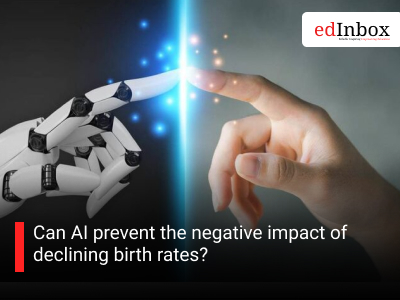
Can AI prevent the negative impact of declining birth rates?
Typography
- Smaller Small Medium Big Bigger
- Default Helvetica Segoe Georgia Times
- Reading Mode