
In an exclusive step, the government of India through the Ministry of Social Justice and Empowerment has partnered with PW (Physics Walla) to offer free coaching. This initiative is widely appreciated by many for being a breakthrough for education access. However, this inclusive Free Coaching Scheme is being called-out as a selective one because it skips general category students. Questions like: Where do we fit in such visions? Are gaining traction.
The Invisible Struggle of the General Category Student
General Category students are again left out while reserved classes are offered the best of opportunities. For years, General Category students have lived in a policy vacuum. They are presumed to be privileged, financially secure and able to manage on their own. In reality lakhs of them are from lower middle class and middle class families where income is barely sufficient to meet the monthly expenses, leave alone the expense of coaching where it can run into lakhs of rupees. They do not qualify for reservations. They seldom qualify for targeted schemes. And now, they are not eligible for free coaching as well!
The Brutal Paradox
Competitive exams in India are bloodthirsty. General category students face the maximum cut-offs, full fees, no relaxation in age and no safety net. They are competing for fewer seats and with a stricter set of benchmarks, while often subsisting entirely off family savings or loans for preparation. When the free coaching scheme comes into force without them, it does not feel like moving forward-it feels like one more reminder that they are supposed to suffer quietly.
What makes the situation more difficult is not only exclusion, but invisibility. The plights of General Category students are seldom recognised in policy matters. Their stress is often shrugged off as entitlement. Their failures are explained in terms of their personal shortcomings, rather than systemic gaps. Yet the pressure that they are under is immense financially, emotionally, and psychologically. Studying long hours without institutional support, seeing opportunities pass by on the basis of eligibility clauses, being told again and again to "adjust" takes a toll that is rarely measured.
Free Coaching Scheme is a Needed Intervention
No one is against this initiative. But when support is designed around categories as opposed to economic vulnerability, it risks creating a new imbalance. There are General Category students that are poorer than many who receive aid. There are families one crisis away from collapsing. For them exclusion is not ideological, it is practical, immediate and painful.
Free Coaching Feels Like a Closed Door
Free coaching by Physics Wallah, which is a big step in the education sector by the government of India, is a powerful tool. No one denies that. But when eligibility is framed narrowly, it sends an unintended message to General Category students: “Figure it out on your own.” At a time when competition is fiercer than ever, when private coaching is unaffordable, and when digital access still costs money, being left out doesn’t just feel unfair. It feels like being forgotten by the system you are asked to trust.
Equality Shouldn’t Mean Selective Support
The bigger question that India needs to pose to itself is a simple one, but uncomfortably so: if the goal is equal opportunity, why not make financial need the primary filter? Merit cannot be sustained on motivation alone. It requires access, guidance and time, which money often buys. Ignoring this reality does not strengthen the system, however, it diminishes trust in it.
What Can Be Done?
As this government-PW initiative expands, policymakers have an opportunity to correct the course. Inclusion does not mean taking opportunities away from one group in order to give to another. It means opening the lens to the extent that support reaches all students who need it - regardless of category. Without that balance, well-intended reforms run the risk of adding to the quiet resentment, rather than the confidence of the people.
For General Category students, this is no call for short-cuts. It is a plea for fairness. A request to be seen. A reminder that you can't pick and choose for equality and that silence shouldn't be misinterpreted as acceptance.
India Needs To be Practical
If India is indeed to democratize education, the conversation NEEDS to be broadened. And because a system that asks one group to constantly sacrifice and adjust and wait will eventually lose the very faith it depends on.
General category students are also students; general category people are also people, then why is sacrifice always expected from them? Why do they need to work harder for something others are getting with less effort? Even when one keeps everything aside, one prominent question still remains: If education promises equal opportunity, why does equality stop at the starting line?
Questions are many, but the answer general category people get is the same: we believe in inclusivity. But who is willing to scream in the face of our policymakers to tell them that THIS is Selectivity not Inclusivity.
Do you agree? Share your thoughts via email at
This email address is being protected from spambots. You need JavaScript enabled to view it. and get a chance to be featured.
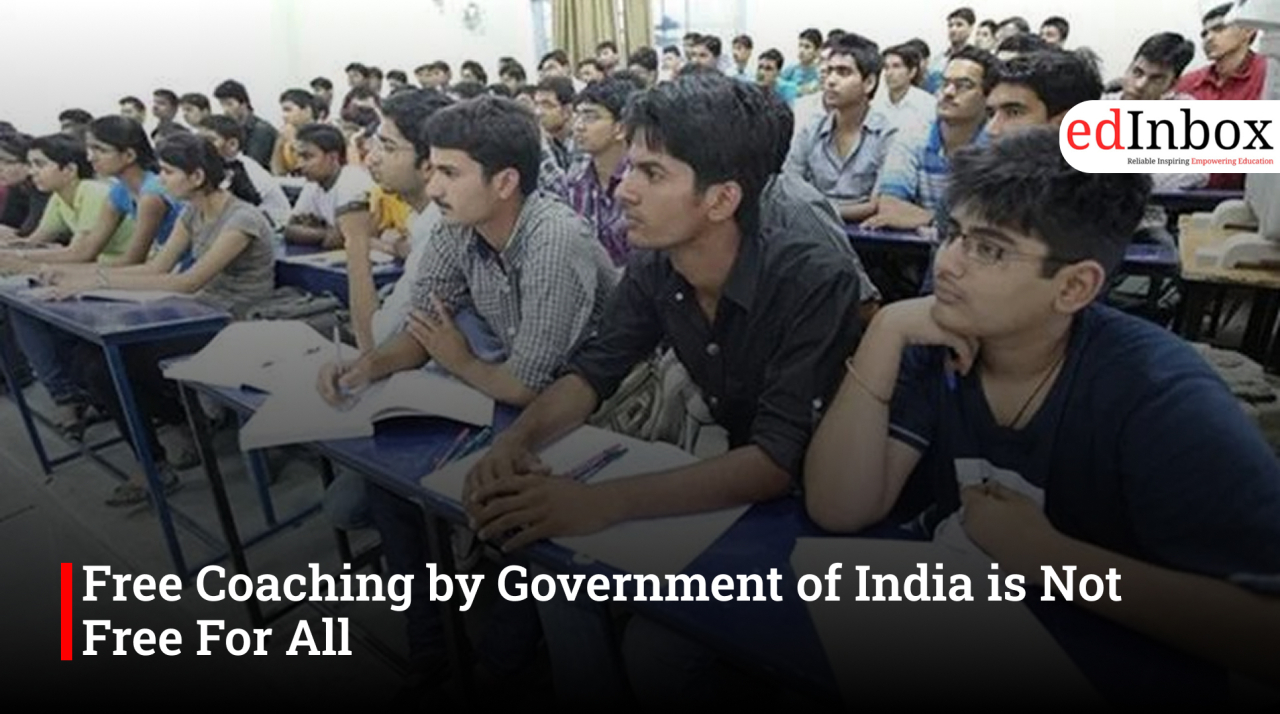
Free Coaching by Government of India is Not Free For All
Typography
- Smaller Small Medium Big Bigger
- Default Helvetica Segoe Georgia Times
- Reading Mode