
The New Dream: Fame in Your Pocket
Once upon a time, popularity meant passion. Anyone passionate about something, builds a
dream, executes it became famous. But today, that dream is distorted.
You don’t need to move cities, build networks, or wait for opportunities. Recognition
doesn’t require institutions — studios, publishers, newsrooms.
Today, fame lives inside your phone.
A 15-second video. A trending sound. A clever caption. And suddenly, thousands —
sometimes millions — know your face.
For Genz, this shift is powerful. You no longer have to “arrive” somewhere to be seen. You
can upload and be discovered.
But here’s the question very few people ask:
Why do we want to go viral so badly?
Is it money or momentum? Because most viral content earns nothing.
Is it influence or interaction? Most viral creators are forgotten within days.
Is it fame or frivolity masquerading as content?
The answer is more psychological than practical.
The Validation Economy
We live in what can be called a validation economy.
In this economy, approval is measurable.
Followers. Views. Likes. Shares. Comments.
Numbers have become emotional currency.
Every notification triggers a small dopamine release in the brain. Every like feels like an
acknowledgement. Every share feels like expansion.
For students navigating identity, this is especially intense. Colleges and schools are already
environments of comparison — grades, popularity, talent. Social media adds another layer.
Now your personality has metrics.
If a post performs well, it feels like personal success.
If it doesn’t, it feels like rejection.
The algorithm doesn’t know who you are. But it can influence how you feel about yourself.
And that’s powerful.
Visibility vs. Veracity
Although Virality creates visibility, visibility is not the same as veracity.
When something goes viral, it means it has travelled far. It does not necessarily mean it
went deep. A thousand people can watch something that makes no sense. But it doesn’t
make it real.
A million people might watch a video. But how many actually remember it?
This is where confusion begins.
Students often equate being seen with being valued. But attention is temporary. Algorithms
reward spikes — not stability.
Going viral is a moment. Connection is built over time.
The danger is mistaking the spike for substance.
Living life or Curating Content?
How many videos do we come across where a content creator is showing her haul, her trips,
her daily routine? The answer is countless. But why are we making such content? Just for
the sake of lives, or is there a pensive loneliness creeping in our society that we deny
admitting?
Think about it. If you open Instagram right now:
A birthday is content.
A meeting is content.
A workout is content.
A personal struggle is content.
The question shifts from “How does this feel?” to “Will this perform?”
When everything becomes potential content, identity starts blending with performance.
Are you expressing yourself?
Or are you performing a version of yourself that the algorithm prefers?
Trend culture encourages repetition. Popular formats get copied. Viral sounds get reused.
Originality becomes risky.
Slowly, individuality is filtered through what is likely to “do well.”
That is how virality shapes behaviour — not by force, but by reward.
Relevance vs. Reality.
For students of today, relevance feels urgent.
You want to matter. You want to be noticed. You want to feel part of something larger than
yourself.
Virality signals cultural relevance. It tells you that you understood the moment.
But relevance online is unstable. It shifts quickly. What works today disappears tomorrow.
When identity becomes tied to engagement, self-worth becomes fragile.
One viral post can feel like triumph.
Ten low-performing ones can feel like failure.
That emotional volatility is exhausting.
And the algorithm does not provide emotional stability. It provides unpredictability —
because unpredictability keeps users hooked.
The Myth of Overnight Success
Another reason students chase virality is the illusion of instant success.
We see stories of people “blowing up” overnight. We rarely see the years of work behind it
— or the many who disappeared after one viral moment.
Virality is amplification. It does not automatically create sustainability.
Many viral creators struggle to convert attention into something lasting — a career, a brand,
a community.
Going viral is not the same as building credibility.
One is explosive.
The other is slow.
And slow growth rarely trends.
Who Benefits From Your Virality?
It’s important to understand that social media platforms are businesses.
Their goal is not to make you famous. Their goal is to keep you engaged.
The more you chase virality, the more you post.
The more you post, the more data they collect.
The more data they collect, the more advertising revenue they generate.
This does not mean students should avoid social media. It means they should understand
the system they are participating in.
When you know the rules, you are less likely to confuse performance metrics with personal
value.
Redefining What “Going Viral” Means
Perhaps the question isn’t why everyone wants to go viral.
Perhaps the real question is: What are we hoping virality will give us?
Confidence?
Belonging?
Recognition?
Opportunity?
Those needs are human. But numbers are unstable foundations for them.
Instead of asking, “Will this go viral?” students could ask:
Does this represent who I am?
Does this add value?
Is this aligned with what I want to be known for?
Attention is loud.
The impact is lasting.
Virality is a spike.
Reputation is built slowly.
As students, you are both consumers and creators. You have the ability not just to chase
trends, but to question them.
Because when the numbers fluctuate — and they will — the most important thing left is not
your engagement rate.
It is your identity.
And that should never depend on an algorithm. That should depend on authenticity!
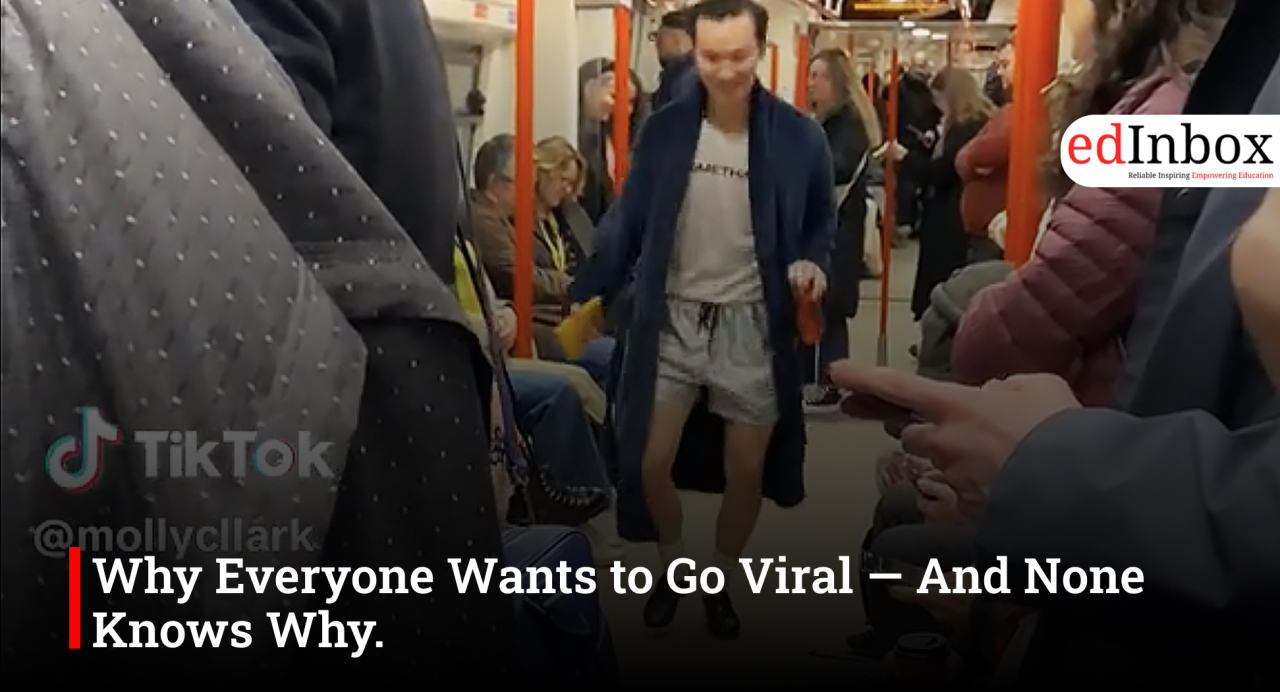
Why Everyone Wants to Go Viral — And None Knows Why.
Typography
- Smaller Small Medium Big Bigger
- Default Helvetica Segoe Georgia Times
- Reading Mode