
The Most Digitally Political Generation
When millennials were growing up, political engagement was limited to the 9 PM news
anchor showing primetime news to occasional rallies against corruption, government
disruptions, etc.
But for Gen Z, politics begins on a screen.
A trending hashtag.
A viral clip from Parliament.
A meme about a new policy.
A thread breaking down a complex issue in simple language.
Born into the digital age, Gen Z does not “seek out” political information in traditional ways.
It comes in their feed — blended with music, humour, fun, fashion, sports, and
entertainment. Politics is no longer confined to news channels; it lives on Instagram stories,
YouTube explainers, and short-form videos. One viral piece of content, and the politicians
face either envy or embarrassment.
This constant exposure has made Gen Z one of the most politically aware generations in
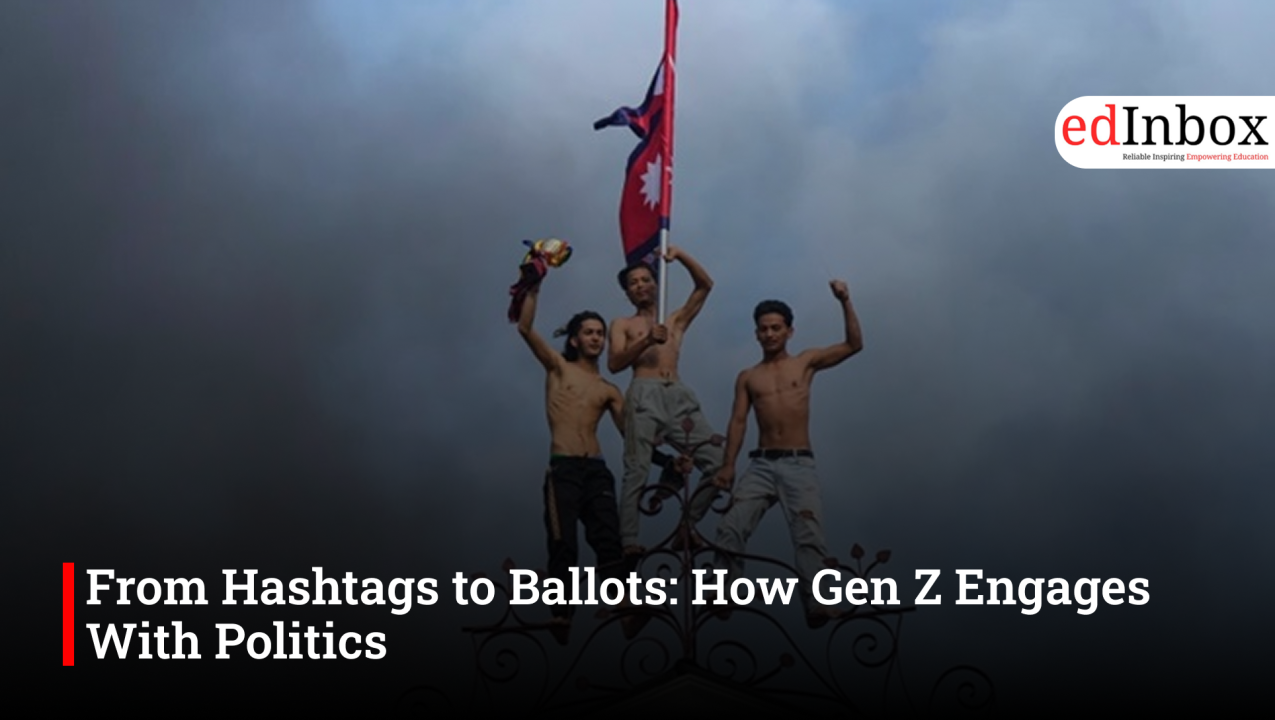
history — but also one of the most complex. And the recent movement in Nepal and
Bangladesh has shown the world: it’s not a generation that should be taken lightly by the
politicians or the governments. If they can make a meme, they can also create a movement.
Awareness Without Gatekeepers
One defining feature of Gen Z’s political engagement is access.
Previous generations depended on limited media sources. Today, a student can watch a live
parliamentary debate, read global opinions, compare international policies, and fact-check a
claim — all within minutes.
There are no fixed gatekeepers.
Creators break down budgets in reels.
Students explain constitutional rights in threads.
Podcasts decode international conflicts.
Political information is no longer elite or distant. It is immediate.
This has created a generation that is not afraid to question authority. Whether it is climate
change, gender rights, education reforms, or economic policy, Gen Z is willing to speak up —
often loudly.
But awareness alone does not equal understanding.
The Rise of Hashtag Activism
Hashtags have become modern protest banners.
From climate strikes to social justice movements, online campaigns have mobilised millions.
A single hashtag can unite people across cities and countries.
For Gen Z, activism often begins digitally:
Sharing posts.
Signing petitions.
Participating in online discussions.
Amplifying causes through stories and reels.
Critics call this “slacktivism” — activism that stays online.
But that view can be simplistic.
Digital campaigns have influenced real-world change. If we look back at the last 5 years, we
can see various revolutions across the globe that started with digital activism. They have
brought visibility to issues that traditional media often ignored. They have pressured
institutions to respond faster than before. When everyone is so engaged on their social
platforms, that becomes the most popular platform for any persuasion and politics is no
exception.
However, at the same time, online activism has limitations. Posting a hashtag is easier than
sustained civic engagement. It creates momentum, but not always a long-term strategy.
The question, then, is not whether hashtag activism matters — but how far it goes.
Issue-Based, Not Party-Based
Unlike older generations who often align strongly with political parties, Gen Z tends to be
issue-driven.
They may support environmental policies but disagree on economic ones. They may
advocate for gender equality but critique other aspects of the same leadership.
This flexibility reflects both independence and fragmentation.
Gen Z does not always identify with political labels. Instead, they rally around causes.
Climate change.
Mental health.
Student loans.
Digital privacy.
Human rights.
This issue-based approach allows for broader coalitions but can also create instability.
Without clear ideological anchors, political engagement can become reactive rather than
structured.
Memes, Satire, and Political Expression
Political discourse for Gen Z often includes humour.
Memes have become a language of discourse. A single image with a caption can critique
policy, expose hypocrisy, or summarise public frustration. And it does it without any sharp
words, just with sharp humour. Gen Z are the master of satire, and the other generations
are amused, but also slowly accepting.
And why not? Satire makes politics accessible.
Complex debates are simplified into relatable formats. Leaders become characters. Policies
become punchlines.
While this increases engagement, it also reduces nuance. Political issues are layered and
complex. Memes are sharp and compressed.
The risk is oversimplification.
But the benefit is real. It creates mass reach. Intellectualisation comes later. Interaction
comes first.
And Gen Z has found a way to make politics conversational rather than just conflicting.
Trust and Scepticism
Another defining trait of Gen Z is scepticism.
They grew up during global financial crises, climate warnings, pandemics, and constant
online exposure to institutional failures.
As a result, they tend to question governments, media outlets, and corporations.
This scepticism can be healthy. It encourages critical thinking and independent research.
However, it also creates vulnerability to misinformation.
When trust in institutions declines, alternative sources rise — and not all of them are
reliable.
Algorithms often amplify emotionally charged content. Polarising posts receive more
engagement. Echo chambers form quickly.
Gen Z is politically aware, but they are also navigating a landscape filled with misinformation
and digital manipulation.
From Online Voice to Offline Action
The real test of political engagement lies beyond the screen.
Are students registering to vote?
Are they attending discussions?
Are they participating in policy debates?
In many regions, Gen Z voter turnout is rising. Youth-led climate marches and social justice
movements have translated into physical demonstrations.
However, participation is uneven.
Some engage deeply. Others stay at the level of commentary.
The transition from hashtag to ballot requires effort — research, patience, and long-term
commitment.
Political awareness must evolve into civic responsibility.
A New Model of Engagement
Gen Z’s relationship with politics is different — not weaker.
It is faster.
More expressive.
More visible.
More decentralised.
They do not wait for permission to speak. They document injustice. They challenge
narratives. They build communities around causes.
At the same time, they must navigate the pressures of digital visibility — where political
opinions can attract both support and backlash instantly.
Political engagement today is not quiet. It is public and permanent.
Every post leaves a record.
The Responsibility of Being Aware
Being politically aware in the digital age comes with responsibility.
It requires verifying information.
Understanding multiple perspectives.
Separating emotional reaction from informed opinion.
Gen Z has the tools to be the most informed generation ever. But tools alone are not
enough.
Critical thinking, media literacy, and active participation determine whether awareness
turns into meaningful change.
From hashtags to ballots, Gen Z is redefining what political engagement looks like.
The real question is not whether they care.
It is how they choose to act.
Because in the end, democracy does not function on trends.
It functions on participation.
From Hashtags to Ballots: How Gen Z Engages With Politics
Typography
- Smaller Small Medium Big Bigger
- Default Helvetica Segoe Georgia Times
- Reading Mode