
Being respected by the whole nation because of the job and skills is something we all desire. As a child who didn’t know much about the world, but still always ran to look at the plane, helicopter flying is one of the signs the desire was built. Some of them later choose to be pilots while some have bigger visions and choose to be fighter pilots. Undoubtedly, it’s challenging to be one but trying is always better than giving up on the dream of becoming a fighter pilot in India.
Air combat is evolving at a fast pace and countries around the globe are working on sixth generation fighter planes, which will be stealthier, smarter and more connected than any fighter plane that has ever flown. These aircraft are not just meant to be used for air-to-air combat, but also for controlling drones, real-time battlefield data processing, and as command centres in the air.
With India's defence forces getting ready to enhance their capabilities and look at the future of aviation technologies, the fighter pilots of tomorrow could be flying some of the most advanced fighter planes ever created. If you are one of those students who aspire to wear the uniform of the Indian Air Force, then there has never been a better time to know how it all starts.
How to become a fighter pilot in India after12th?
Among the most asked questions by defence aspirants is: "How to become a fighter pilot after class 12? The most direct path is via the National Defence Academy (NDA). To be eligible for the Flying Branch of the Indian Air Force, students need to have studied Physics and Mathematics in Class 12. The candidates of both gender are eligible to apply with the prescribed age and eligibility criteria.
The first step is to pass the UPSC NDA Examination, which is held twice a year. The examination comprises Mathematics and General Ability Test (GAT). The qualified candidates are invited to attend the Services Selection Board (SSB) interview where their leadership qualities, confidence, decision making ability, communication and officer like qualities are evaluated.
What is the CPSS Test and why is it important?
A lot of students do not know that to become a pilot, one needs to pass the NDA exam and much more. All candidates wishing to join the Flying Branch will also have to pass the Computerised Pilot Selection System (CPSS). This is a special test that assesses the candidate's ability to fly and tests coordination, reaction time, concentration and psychomotor skills. If candidates do not qualify for CPSS, they cannot move forward in the process of becoming a pilot in the Indian Air Force.
Are there any restrictions on girls becoming fighter pilots in India?
Yes.The Indian Air Force offers both male and female candidates with eligibility to join the Flying Branch. Women fighter pilots have been a source of inspiration for the new generation of students in recent years, proving that determination and performance are more important than stereotypes.
With the ongoing development of the aviation and defence industry, the scope of opportunities for women in military aviation is likely to expand even more.
What happens after NDA?
Those who pass all the selection stages go to the National Defence Academy, Khadakwasla, for three years of military and academic training. Upon completion of NDA, cadets are transferred to the Air Force Academy (AFA), Dundigal, where they are given specialised flight training. They study navigation, aviation theory, simulator operations, aircraft handling and operational flying skills here.
A lot of students think that all pilot trainees are fighter pilots. In fact, the allocation of streams occurs in training. Cadets can be placed in the Fighter stream, the Transport stream or the Helicopter stream based on their aptitude, performance, instructor assessment and service needs.
How much does an Indian Fighter Pilot earn?
One of the most frequently asked questions by students is about income. The salary and allowances of Fighter pilots in the Indian Air Force are based on Government Pay structures, Rank, Flying duty and Service benefits. In addition to salary, they are provided with world-class training, healthcare benefits, accommodation support and opportunities for professional development.
But most serving fighter pilots will say that the allure of the job is not just about the money. The chance to fly advanced aircraft and serve the country is the greatest incentive.
Why 6th-Generation Fighter Jets Could Change Everything
As a matter of fact, future fighter aircraft will be quite different from today's jet fighters. Defence experts believe that sixth-generation fighters will be a combination of stealth, artificial intelligence, advanced sensors, cyber capabilities and drone coordination in one platform. These aircraft could work in teams of unmanned aircraft, and handle vast amounts of data in real time.
This will require more than just flying skills for future fighter pilots. They will require technological awareness, quick decision making skills, adaptability and leadership.
If you are interested in aviation, science, engineering, defence technology and national service, then the next generation of fighter aviation might be one of the most exciting career paths of the coming decades.
Should I become a Fighter Pilot?
The way is not easy. It's a rigorous selection process, a rigorous training program, and a competitive program. However, thousands of students prepare for NDA every year, knowing what is beyond the challenge.
If you think it's only about flying fast planes to be a fighter pilot, you should rethink your career choices. Being a fighter pilot is a matter of responsibility, discipline, courage and service. It's about trust in technology that is at the forefront of a country's defence capability.
And the students who are preparing for NDA today may be the officers who will fly the sixth generation fighter jets tomorrow. This is why being wise and conscious about your career choices becomes important.
Remember, the path to that cockpit starts on the ground: It starts in a classroom, with a dream, a plan, love for the country, and a decision to follow it.
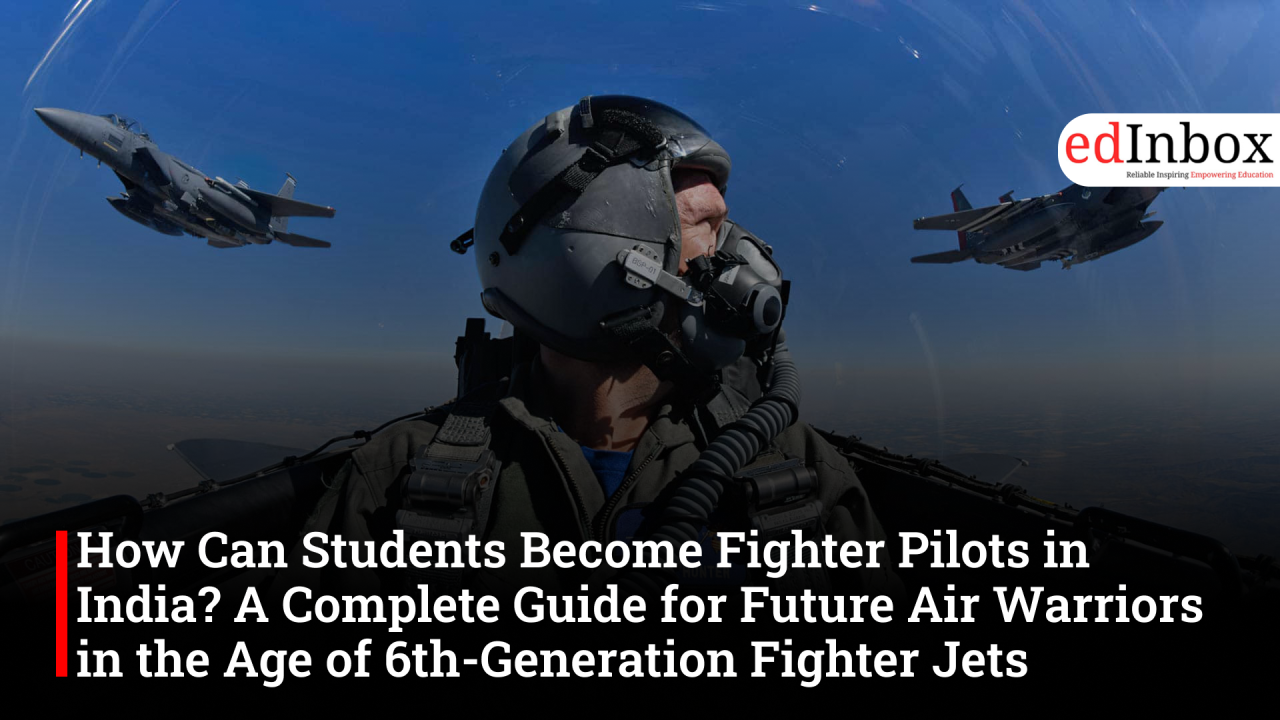
How Can Students Become Fighter Pilots in India? A Complete Guide for Future Air Warriors in the Age of 6th-Generation Fighter Jets
Typography
- Smaller Small Medium Big Bigger
- Default Helvetica Segoe Georgia Times
- Reading Mode