
By Mathew Mattam
There are moments in a nation's history when an unexpected movement becomes much larger than the issue that triggered it. It becomes a symbol of hope, a reminder that democracy belongs to the people and not merely to those who occupy positions of power. The emergence of the Cockroach Janata Party (CJP) Movement appears to be one such moment. For many young Indians, it has filled a vacuum that has existed in student politics for decades and has rekindled interest in constitutional values, democratic participation, and peaceful civic engagement.
My own political awakening began during the 1970s when I was a school student. Those were difficult years, marked by the Emergency. Even as students, we believed that we had a responsibility to stand up for justice and defend the rights of young people. Participating in student movements during that period shaped my understanding of democracy and gave me the inspiration that has guided my work over the past fifty years in public service, youth development, and nation-building.
For many years, however, I believed that India had lost that spirit. Student politics had become increasingly confined to political party organisations, while millions of talented young people remained outside the democratic process. The result was a generation that often-viewed politics with cynicism rather than hope. Over the past few days, however, I have begun to feel differently. I see in the Cockroach Janata Party Movement the same energy, courage, and idealism that inspired students during the 1970s. It gives me renewed confidence that India's future is still bright.
The greatest contribution of the CJP Movement is not merely its protest. Its greatest achievement is that it has encouraged thousands of young people to believe that they have both the right and the responsibility to participate in public life. Democracy cannot remain healthy if citizens participate only once every five years during elections. It requires continuous engagement, peaceful questioning, constructive criticism, and active citizenship.
Every adolescent and young person should experience democratic participation. Such involvement teaches leadership, responsibility, negotiation, public speaking, constitutional values, and respect for differing opinions. These qualities cannot be learnt only in classrooms. They are developed through participation in civic life.
Unfortunately, India has witnessed a gradual decline in broad-based student political engagement. During the first fifty years after Independence, many of India's finest political leaders emerged from universities and student movements. Students, teachers, lawyers, social workers, and intellectuals actively shaped national policy. Politics was regarded as public service and nation-building.
Today, the situation appears different. Political leadership increasingly emerges from dynastic politics, religious mobilisation, business interests, or identity-based mobilisation. Many talented students deliberately stay away from politics because they perceive it as dominated by money, criminal influence, conflict, and personal ambition rather than public service. The CJP Movement has demonstrated that there remains enormous untapped leadership potential among ordinary young Indians who are willing to stand for constitutional values without necessarily belonging to established political parties.
One of the movement's important messages is that politics should be reclaimed by citizens. Public life should not become the exclusive preserve of political professionals. Democracy belongs equally to students, farmers, workers, professionals, entrepreneurs, women, and ordinary citizens.
At the same time, every democracy has a responsibility to maintain both public order and the constitutional rights of its citizens. Peaceful assembly, freedom of speech, and democratic protest are fundamental rights guaranteed under the Constitution of India, but these rights also coexist with the state's responsibility to ensure safety, prevent violence, and enforce the law fairly. Any response to peaceful protest should therefore remain proportionate, lawful, and respectful of constitutional freedoms.
Reports that participants in the movement were discouraged from attending protests, including through visits by officials or requests to share their live locations, have raised concerns among many citizens about civil liberties. Such reports, where accurately established, deserve careful examination because democratic societies depend upon citizens being able to express peaceful disagreement without unnecessary intimidation. Equally, authorities have a responsibility to act only within the framework of the law and to distinguish peaceful protesters from those who engage in unlawful conduct.
The uneasiness displayed by sections of the political establishment suggests that organised, peaceful youth participation can be politically significant. Democracies should not fear peaceful citizen mobilisation; they should welcome it as evidence that citizens remain engaged in public affairs.
Many observers have also questioned whether restrictions such as internet shutdowns, transport disruptions, or broad prohibitory measures are always necessary when dealing with peaceful demonstrations. Such actions should be carefully balanced against constitutional freedoms and used only when clearly justified by law and genuine public safety concerns. Peaceful and unarmed protesters should, wherever possible, be enabled to express their views safely while authorities maintain public order.
The contrasting experiences of public demonstrations in different cities also offer lessons. In Pune, large gatherings reportedly proceeded under police supervision, with law enforcement facilitating peaceful movement and maintaining order. Such examples demonstrate that cooperation between citizens and police can strengthen democracy. Professional policing aims to protect both public safety and the right to peaceful assembly. Every city can learn from practices that reduce confrontation while upholding the rule of law.
The movement also raises larger questions about the quality of India's political culture. For democracy to remain healthy, governments must be accountable, institutions must remain independent, and citizens must retain confidence that constitutional rights apply equally to everyone regardless of political opinion. A democracy grows stronger when governments respond to criticism with dialogue rather than viewing every disagreement as hostility.
Equally important is the role of the media. A free and independent press serves democracy by presenting diverse perspectives, verifying facts, and holding every institution—including governments, opposition parties, corporations, and civil society—to account. Citizens expect journalism that informs rather than polarises and that gives voice to different sections of society, including young people.
The judiciary also occupies a special place within India's constitutional framework. Public confidence in the courts depends upon the perception that justice is administered independently, fairly, and consistently according to the Constitution. In this context, recent observations by Supreme Court Justice Ujjal Bhuyan are significant. He remarked that public space for expressing divergent opinions appears to be shrinking and reaffirmed that peaceful protest and freedom of expression are essential democratic freedoms. Such observations remind the nation that debate, disagreement, and peaceful dissent are not weaknesses but strengths of a constitutional democracy.
The long-term significance of the Cockroach Janata Party Movement lies not in any single protest but in its ability to inspire a new generation of citizens. India requires young leaders who enter public life not for power, wealth, or personal gain, but for constitutional governance, public service, social justice, and national development. The movement has reminded many young people that politics can once again become a noble vocation dedicated to improving society.
India's democracy has always renewed itself through the participation of ordinary citizens. Every generation has produced individuals willing to defend liberty, equality, justice, and fraternity. The responsibility now rests with today's youth to continue that tradition peacefully, responsibly, and constitutionally.
If the Cockroach Janata Party Movement succeeds in inspiring thousands of ethical young leaders to engage constructively with democratic institutions, respect constitutional values, and place the nation above partisan interests, its contribution will extend far beyond a single protest. It will have helped restore faith that Indian politics can be cleansed not by anger alone, but by integrity, participation, accountability, and unwavering commitment to the Constitution of India.
Long live democratic participation. Long live constitutional values. Long live the spirit of responsible citizenship.
Disclaimer: The article is conceptualised and edited by Mathew Mattam. Mathew Mattam is the Founder of Centre for Youth Development and Activities (CYDA) and YouthAid Foundation.
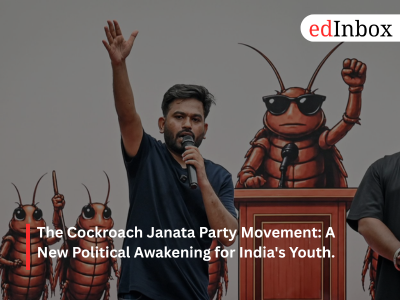
The Cockroach Janata Party Movement: A New Political Awakening for India's Youth.
Typography
- Smaller Small Medium Big Bigger
- Default Helvetica Segoe Georgia Times
- Reading Mode