
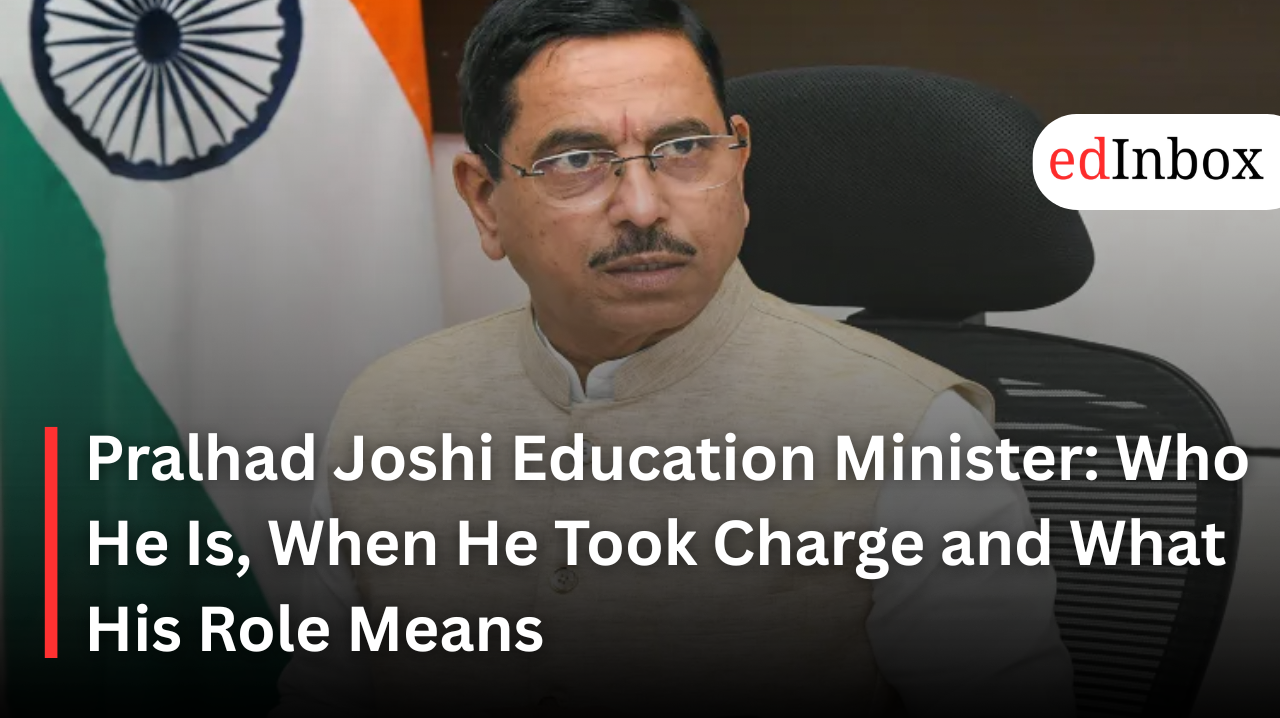
Pralhad Joshi is now India's Union Education Minister, taking charge of the Ministry of Education at a time when India's education sector is dealing with major questions around access, quality, technology, research and employment.
On July 25, 2026, the President gave the Ministry of Education to Pralhad Joshi, apart from his ministerial duties. He formally took charge of the ministry at Kartavya Bhavan on July 26.
Students, parents and education professionals are now asking themselves the following questions: "Who is Pralhad Joshi?," "Who is the new Education Minister of India?," and "What does Pralhad Joshi's Education Ministry role mean?".
Who is Pralhad Joshi?
Pralhad Joshi is the Union Cabinet Minister and is now in charge of the Ministry of Education. He also has the portfolio of Consumer Affairs, Food and Public Distribution and New and Renewable Energy. His new role places him at the heart of the national education administration in India, encompassing school and higher education.
When Did Pralhad Joshi Become Education Minister?
On July 25, 2026, the President accepted Dharmendra Pradhan's resignation from the Union Council of Ministers and directed that Pralhad Joshi be assigned charge of the Ministry of Education, in addition to his existing portfolio. The CJP protest played a big role in this.
He formally took over the Ministry of Education on 26th July 2026. Immediately after assuming the leadership, he convened a review meeting with the top officials in the ministry to discuss the implementation of various schemes and initiatives.
What Does the Education Minister Do?
The Ministry of Education is headed by the Union Minister of Education who is responsible for the national education framework and the important programmes in the school and higher education sectors.
It can directly impact the broader education context in which students learn, such as in higher education, school education, research, and technology-enhanced learning and access to education.
The ministry is also a crucial bridge between national education policy and the implementation of policy at the institutional and government levels.
What are the Education Policy Changes?
It is too early to attribute a new policy agenda to Pralhad Joshi solely on the basis of his appointment. However, the Ministry of Education's current work shows the breadth of issues on its agenda.
The ministry has recently introduced digital learning and creative technology initiatives, PM-Vidyalaxmi higher education loans, university townships, education-to-employment initiatives, PM SHRI schools, school infrastructure and higher education data and assessment.
This provides students and education institutions with a better understanding of what the ministry is working on and what new initiatives will be undertaken by Joshi will be clearer in the future as the government announces its plans.
Why is the New Minister of Education Important to Students?
Students may have practical questions about a change in the Education Ministry: Will entrance exams change? Will there be a change in higher education policies? Will new schemes or scholarships be created?
Students should be able to differentiate between official government announcements and speculation at this point. Admission dates, eligibility, examination rules and counselling schedules should be continued to be checked from the official authorities responsible for each examination or institution.
The one thing that is certain is that Joshi will have to take the responsibility of a vast education system, from school education to higher education, from access to infrastructure to technology and employment linked initiatives.
What Happens Next?
Pralhad Joshi has already started to look at the ongoing schemes and initiatives of the Ministry of Education. Minister of State for Education Jayant Chaudhary attended the review meeting along with senior officials of the Department of Higher Education and Department of School Education and Literacy on July 26.
The next few months will be crucial to see if the ministry will add new priorities or continue to develop existing programmes.
The best way for students to go is to stick to the official announcements of the Education Ministry, the examination authorities and individual universities, and not to what they hear on social media that hasn't been verified.
Pralhad Joshi Education Minister: Who He Is, When He Took Charge and What His Role Means
Typography
- Smaller Small Medium Big Bigger
- Default Helvetica Segoe Georgia Times
- Reading Mode