
It all starts with a mask in the forest—Avantika's sturdy, battle-worn mask, forgotten almost like evidence of a life spent fighting. But for Baahubali, it becomes something else altogether. In "Khoya Hai," he doesn't envision the fierce rebel she is; he envisions an apsara gliding through waterfalls, hair billowing like a shampoo commercial. Before even meeting her, he etches a fantasy in sand—replete with flowing hair and perfectly carved eyes.
All the way back in 2015, journalist Anna M.M. Vetticad had caught this contradiction early. In her sharply titled piece “The Rape of Avantika,” she questioned the way Baahubali turns a soldier into his personal makeover project in the name of romance. Almost a decade later, Tamannaah Bhatia revisited that article in an interview—and instead of examining the filmmaking, she claimed the critique policed her sexuality. But the article wasn’t about her; it was about the cinematic language which equates a woman’s resistance with flirtation, and her discomfort with character development.
Take, for example, the infamous “fight” scene. Avantika is throwing punches like her life depends on it; Baahubali is… smiling. Leisurely dodging blows, gently undressing her, untying her hair and—why not—giving her a waterfall bath. There's beauty in the visuals, sure. But beneath the spectacle lies the subtext: her fierceness is a hurdle, her masculinity-coded armour something to literally wash away. The camera insists that she must be softened, lightened, prettied up—because only then can she be worthy of his love song.
Years later, Rajamouli justified the scene, referring to Avantika as a "wounded divine feminine", as if the audience was supposed to be grateful that Baahubali unleashed her inner goddess through unsolicited grooming.
This isn't new. Bollywood and South Indian cinema have a long love affair with troubled men and the women expected to love them into redemption. Just ask Dia Mirza, who has openly admitted that Rehnaa Hai Terre Dil Mein hasn't aged well. On the other hand, there are actors like Rashmika Mandanna, defending deeply flawed characters like Ranvijay from Animal as "raw expression," as though audiences exist in a vacuum devoid of influence. Kiara Advani keeps insisting that Kabir Singh is not "about the slap"-as if editing out one moment erases the trail of toxic entitlement leading up to it.
Their defenses reveal a fascinating truth about the industry: actresses often bear an onus of contextualising problems they didn't create. Caught between massive fandoms, strict PR machines, and the politics of pleasing directors, responses from actresses become partially survival strategy, partially conditioning, partially unexamined loyalty. But when they defend the indefensible, they unknowingly reinforce the very stereotypes their on-screen characters suffer under.
Which brings us back to Avantika, and Baahubali's grand re-release. Nearly a decade later, the visuals still dazzle, the soundtrack still soars—but the questions linger louder than ever. Does an actor's responsibility end once the camera stops rolling? Can fantasy excuse every narrative blind spot? And how is it that a character written as a warrior ends up remembered for a makeover she never asked for? Perhaps the true epic isn't what transpires on screen but, rather, the conversations we're finally willing to have about it.
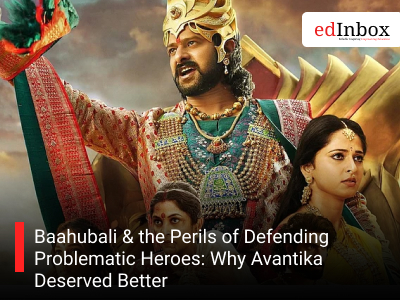
Baahubali & the Perils of Defending Problematic Heroes: Why Avantika Deserved Better
Typography
- Smaller Small Medium Big Bigger
- Default Helvetica Segoe Georgia Times
- Reading Mode