
 Edinbox Team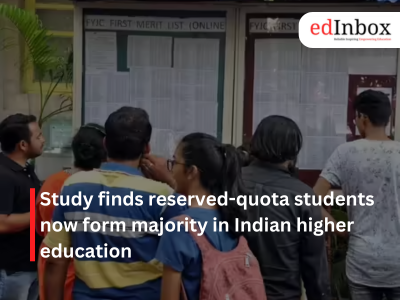
A new analysis of higher education enrolment in India shows that over the last decade, caste representation has indeed changed dramatically, with a majority across universities and colleges now comprising students from Scheduled Castes, Scheduled Tribes, and Other Backward Classes.
Based on 13 years of the All-India Survey of Higher Education, or AISHE, the findings challenge long-standing claims regarding “upper-caste dominance” in this sector.
A study by the Centre for Development Policy and Management at IIM Udaipur (CDPM) draws on AISHE data from 2010–11 to 2022–23, covering 60,380 institutions and 43.8 million students.
The dataset, described by researchers Venkatramanan Krishnamurthy, Thiyagarajan Jayaraman, and Dina Banerjee, is among the most comprehensive assessments of caste representation in Indian higher education.
“This report breaks many of the conventional myths about the social profile of students in Indian higher education,” said Prof. Krishnamurthy.
American sociologist Dr. Salvatore Babones welcomed the findings and observed that the paper “lays out the data on access to higher education by caste category” and should inform India’s reservation debates. Former Chief Justice B.R. Gavai is quoted in the report as again calling for extending the creamy-layer principle to SC and ST communities as well, out of concern that repeated benefits to the same families could create “a class within a class.”
Co-author Thiyagarajan echoed the concern, saying that AISHE data shows that opportunities for SC, ST, and OBC students are now “above average,” and the focus should shift to ensuring equitable distribution within these groups.
CasteFiles’s analysis of the same dataset, cited in the report, found that the SC/ST/OBC students comprise 62.2 per cent enrolment in government institutions and 60 per cent in private institutions, signalling a widespread demographic shift.
This means that social policy needs to be evidence-driven if it is going to remain effective, Dr. Babones said. The study published by CDPM of IIM Udaipur was available for researchers, journalists, and policymakers examining the long-term structural changes in Indian higher education.

 Nibeditaa Speaks
 Miss Kanishka


Add comment