
A committee established by the Ministry of Education has proposed sweeping changes to India's high school education system, aiming to limit coaching centre hours and reduce student dependence on external tuition, said a report. The panel has recommended capping coaching classes at "2-3 hours per day", redesigning school curricula to align more closely with competitive entrance examinations, and increasing the weightage of board examination results in college admissions.
According to a report in The Indian Express, the proposals respond to concerns regarding the "psychological toll of competitive exams and the pressure to enrol in coaching from an early age". Members also want to see the introduction of career guidance starting in Class 8 and the possibility of competitive tests in Class 11, the report added.
The committee, headed by Vineet Joshi, Secretary of the Department of Higher Education, was constituted in June 2025 to examine the effectiveness and fairness of competitive entrance examinations, the proliferation of dummy schools, and the growing influence of coaching institutes across academic pathways. The panel included senior officials such as CBSE chairman Rahul Singh, NTA Director General Rajesh Lakhani, and professors from leading technical institutes. During meetings at Shastri Bhawan, members discussed the "growing concern around the proliferation of coaching centres and their impact on student well-being, equity of education, and the role of schools".
Throughout the talks, several times, it was mentioned that one of the reasons students get stressed and depend on private guidance is because there is no proper counselling or career guidance available in schools. The committee, in its report, along with other things, pointed out that a major problem was the gap between the school curriculum and what is required in highly competitive exams like JEE and NEET. The transition from Class 10 to Class 11 was noted as a stress point. The committee considered the "lack of alignment between CBSE's analytical and conceptual approach and the objective, MCQ-based format of entrance exams" a "root cause" of the dependence on coaching, fueling dummy schools and a parallel education economy.
The committee observed that many teachers in schools are not adequately trained to teach beyond board exam requirements, while coaching centres often employ subject experts, including engineers and medical graduates. The article also pointed out that schools don't have an environment where students are regularly tested, their performances analyzed and study materials curated enough for students to be forced to study from outside.
Among the suggestions was that NCERT be the lead agency, supported by NTA, CBSE, and other boards, to ensure syllabus alignment between school curricula and competitive exam requirements.
The committee suggests imposition of more rigorous measures on the tutoring centres such as their advertising being regulated and them being made legally responsible for disclosure of teaching methods, faculty credentials, and student success rates. Other proposals on the table are the increased number of entrance tests and giving more weight to board exam scores for admissions. The different working groups have been asked to review the syllabi of different boards and check whether competitive examinations can be held in Grade 11.
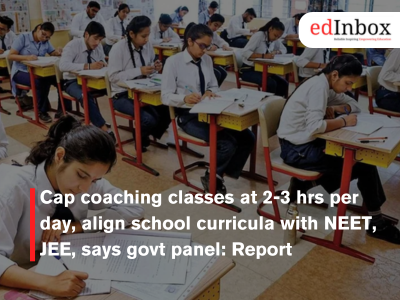
Cap coaching classes at 2-3 hrs per day, align school curricula with NEET, JEE, says govt panel: Report
Typography
- Smaller Small Medium Big Bigger
- Default Helvetica Segoe Georgia Times
- Reading Mode