
The change isn't just economic. It's in how students think. They don't wait until graduation to consider jobs. Instead, they assess outcomes from day one, what skills will survive in four years, which fields are fading, and if their degree allows movement between sectors and regions. Employability isn't the finish line anymore, it's the first question.
Universities are scrambling to respond. Internships aren't extras anymore - they're built into programs. Capstone projects solve real industry issues now. Experiential learning - once seen as side work - is necessary. Still, a gap lingers: academic structures change slowly at the same time industries redefine roles every 12 to 18 months.
Technology, especially AI, is the main engine of the transformation that's happening. The effect of AI is less about creating new messy things, and more about redesigning things. For example, classrooms are no longer just places for learning by memorizing but rather places for doing projects that require skills like judgment, creativity, and synthesis which AI finds it difficult to replicate. And at the same time, companies are looking for people who have hybrid capabilities: technical knowledge combined with communication, context, and decision-making.
International education is a part of this. Students nowadays are not choosing their study destinations solely on the basis of the highest reputation. They are also taking into account cost, visa stability, post-study work options, and long-term career mobility. The emergence of transnational education comes as a reflection of this change providing global exposure and local industry integration along with multiple options for the learners. Meanwhile, the importance of the campus experience has not diminished it has just gained a new dimension. It is not just about social life or physical facilities anymore. The campus of today is expected to be a working place of innovation.
The campuses that fail to connect experience and outcomes fall behind. When both are built together, student growth accelerates. Curiosity grows from real-world engagement. Confidence builds through hands-on work. Collaboration thrives in shared challenges. Clear career paths turn exploration into action. Students see where their interests lead.
Right now, institutions winning trust don't treat degrees as fixed labels. They embed internships directly into coursework. Classrooms become spaces where learning happens daily. Degrees evolve with student needs instead of staying unchanged over time.
Future success won't rely on old buildings or long-standing traditions. It'll belong to schools that link what students learn to what they do after graduation. Graduates will be ready to change roles, respond to shifts, and build skills in new environments without losing direction.
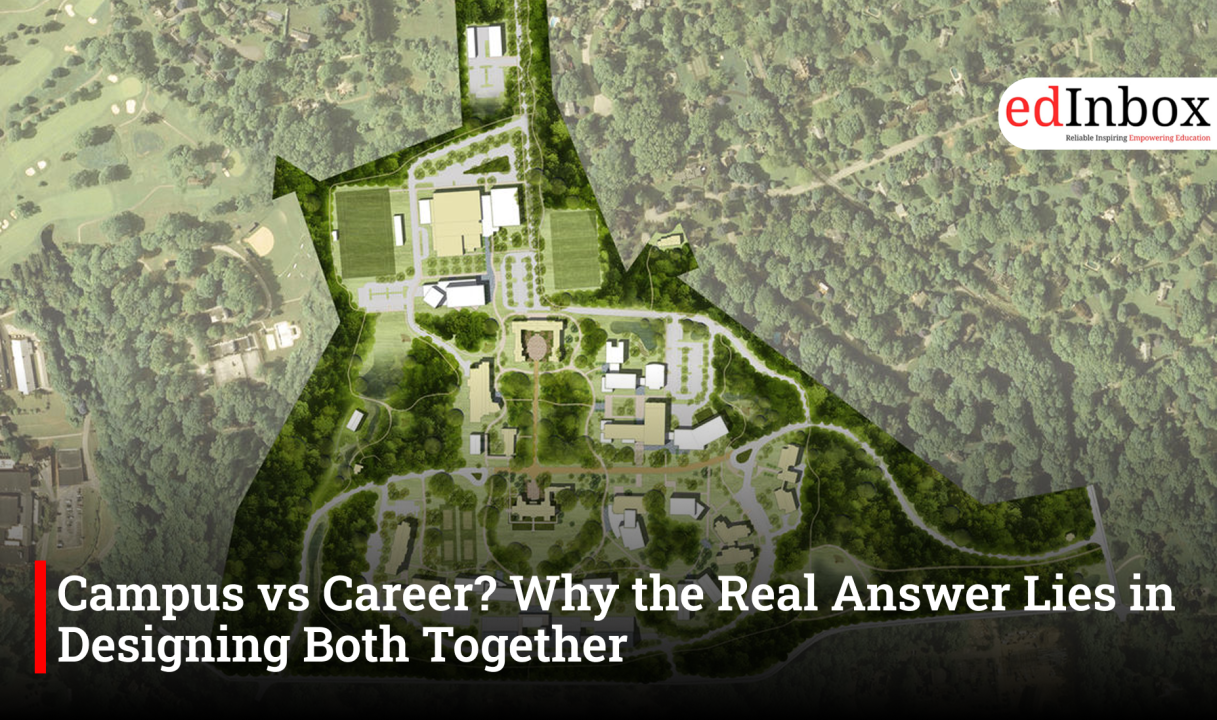
Campus vs Career? Why the Real Answer Lies in Designing Both Together
Typography
- Smaller Small Medium Big Bigger
- Default Helvetica Segoe Georgia Times
- Reading Mode