
New Delhi: India and Russia are working together on a new university-level ranking system that could eventually be expanded across BRICS nations, marking a significant step toward building a shared academic and innovation framework among emerging economies.
The initiative, currently in early development, is being tested bilaterally between India and Russia before being opened to broader participation from other BRICS members.
A Joint Push for Academic Collaboration
According to Debjit Chakraborty, Director of the Chamber for Indo-Russo Technology Collaboration, the ranking framework is being developed in partnership with a Moscow-based university and is part of a wider effort to strengthen educational and technological cooperation.
Speaking at the TV BRICS studio during the St. Petersburg International Economic Forum (SPIEF), Chakraborty said the project aims to create a unified mechanism to evaluate and encourage academic excellence across BRICS institutions.
He added that the long-term goal is to extend the system beyond India and Russia to include all BRICS+ countries.
Focus on Emerging Technologies
The collaboration is not limited to education policy alone. It is closely tied to joint work in key future-facing sectors such as:
- Artificial Intelligence (AI)
- Cybersecurity
- Health technology
- Educational technology (EdTech)
- Trusted digital infrastructure
- Green energy systems
Officials involved in the initiative say the goal is to strengthen indigenous technological capabilities and reduce reliance on external systems.
Building a Shared Innovation Ecosystem
The proposed ranking system is expected to do more than just evaluate universities. It is designed to promote deeper academic cooperation, research partnerships and cross-border knowledge exchange among institutions in BRICS countries.
Experts suggest that such a framework could eventually help shape a shared innovation ecosystem across emerging economies in Africa, the Middle East and Southeast Asia as well.
Beyond India and Russia
Chakraborty emphasized that the initiative is part of a broader vision that goes beyond bilateral cooperation.
“Everything we are doing is intended to encompass the entire BRICS+ community, not just India and Russia,” he said, highlighting the long-term ambition of the project.
Towards a New Global Education Model
The BRICS+ Tech Forum and related sovereign technology partnerships are also expected to play a role in strengthening collaboration in science and innovation among member countries.
If implemented successfully, the ranking system could offer an alternative global education assessment model and potentially reshape how universities across the Global South are evaluated and connected.
While still in its early stages, the initiative signals a growing push among BRICS nations to build independent academic and technological frameworks that reflect their shared developmental priorities in a rapidly changing global landscape.
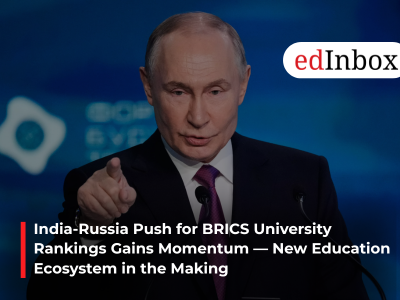
India-Russia Push for BRICS University Rankings Gains Momentum — New Education Ecosystem in the Making
Typography
- Smaller Small Medium Big Bigger
- Default Helvetica Segoe Georgia Times
- Reading Mode