
The road to Pithoragarh has a subtle effect on the mind of the traveler. With the mountains getting steeper, mobile signals disappearing and the dark sky gradually taking over its age, old reign, it dawns on you that you are venturing not only through geography but also through time.Here, in Uttarakhand’s easternmost district where darkness is still natural and silence still earned, the stars no longer remain distant spectators. They are now the destination.
Perched amid these Himalayan folds, a new astronomical observatory in Pithoragarh is rewriting how we think of travel in the mountains — not as an escape from the world, but as an encounter with the universe. Conceived by the District Tourism Department in partnership with astro-tourism pioneers Starscapes, the observatory marks Uttarakhand’s decisive step into science tourism, where wonder is measured not in selfies, but in constellations.
Just as the sun was setting and the sky was changing colors, the Tourism Minister of Uttarakhand, Satpal Maharaj, with district officials, was there to make the inaugural event successful. This was a dream that we had been nurturing for a long time, said Maharaj, reflecting the silent ambition of the project by his words. Astro, tourism is not just a science promotion tool. It generates jobs, money, and a new kind of bond between people and nature. More observatories, he promised, will follow — mapping the state not just by roads, but by stars.
What makes the Pithoragarh observatory exceptional is not only its telescopes or contemporary design, but its community-first philosophy. This is not a sealed scientific enclave. It breathes with the village around it. Starscapes has initiated an Astro Guide Training Programme where they have recruited and trained the local youth to not only operate the telescopes, but also conduct professional stargazing sessions and narrate the night sky in a confident and empathetic manner. The development of skills in this case is not something that has been added on; it is, in fact, the very core of the project.
“Pithoragarh has something increasingly rare — truly dark skies,” the District Tourism Development Officer explains. “Our goal is to make it a responsible astro-tourism destination where the community benefits directly.” In a time when tourism often extracts more than it gives, this model feels quietly radical.
As darkness deepens, the observatory comes alive. A telescope turns. A young local guide explains Saturn’s rings. A child gasps. In these moments, science sheds its intimidating cloak and becomes intimate again. Educational programmes, student sessions, and public astronomy nights ensure the observatory is as much a classroom as it is a travel experience.
Hem Sharma of Starscapes puts it simply: “Astro-tourism works when world-class infrastructure is matched with trained local talent.” The result, he believes, is not just better visitor experience, but sustainable livelihoods rooted in place.
In Pithoragarh, tourism is no longer only about reaching a viewpoint by day. It is about staying up at night. About slowing down. About remembering that long before borders, hotels and itineraries, humans travelled by the stars.
And now, thanks to this observatory, travellers can do that once again — not as explorers of land, but as witnesses to the cosmos.
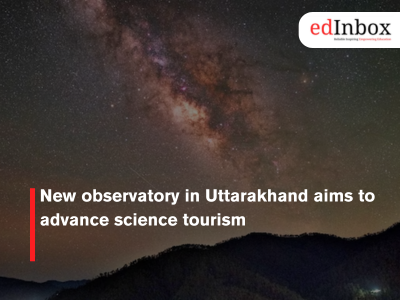
New observatory in Uttarakhand aims to advance science tourism
Typography
- Smaller Small Medium Big Bigger
- Default Helvetica Segoe Georgia Times
- Reading Mode