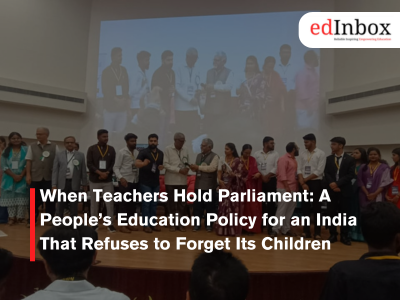
Around 1,000 teachers from schools, colleges, and universities,representing 20 states and union territories,assembled at the Apex Auditorium of MS Ramaiah Institute of Technology under the banner of the All India Save Education Committee (AISEC) on January 24th to convene a People’s Parliament on education, and to ratify an alternative national framework called People’s Education Policy 2026 (PEP 2026). It was positioned openly and unapologetically against NEP 2020, which they argued had been announced during the COVID period without ratification in the Indian Parliament.
This was not a symbolic photo opportunity, and it did not pretend to be one. It was the outcome of a year-long chain of deliberations across Indian cities, aimed at shaping a policy they described as scientific, secular, democratic, and inclusive, covering the full continuum from KG to PG, and extending to research and adult education. In an era where education conversations are increasingly reduced to slogans, this assembly attempted to restore education to its rightful place: as a national responsibility, a constitutional promise, and a public good.
The Point Was Simple: Education Must Answer to the People
At the heart of this People’s Parliament was one non-negotiable principle: education policy must be accountable to the people—especially to the teaching-learning community—rather than being treated as an executive document that is announced, packaged, and pushed down the system. The gathering summarily rejected NEP 2020, not as a matter of small policy disagreements, but as a statement of direction. Their argument was that India does not merely need amendments; India needs an education policy that protects public education, resists ideological distortions, and restores institutional autonomy so that learning can breathe again.
Behind that argument sat a deeper anxiety: if education is allowed to drift, quietly and steadily, away from public responsibility, then a republic begins to lose its most reliable mechanism for social mobility, citizenship-building, and national cohesion. That drift does not announce itself with a siren. It arrives through closures, vacancies, contracts, costs—and eventually through resignation.
The Quiet Crisis: How Public Education Is Being Hollowed Out in Plain Sight
The case for PEP 2026 was built on a set of indicators that were presented not as statistics, but as evidence of a system being emptied of capacity. The discussions cited that nearly 90,000 government schools have closed over the last decade, up to the end of December 2025. They further cited that while around 70% of India’s 14.7 million schools are government-run, nearly 50% of students now attend private schools—an inversion that, in their reading, signals not “choice,” but the planned failure of government schooling.
Then came the human resource collapse that teachers experience daily, not in policy documents but in corridors and classrooms. The discussions referenced more than 7 lakh vacant posts at the elementary level and more than 1.2 lakh at the secondary level. They also cited that around one lakh government schools, serving 33 lakh children, are operating with only one teacher—an arrangement that is not merely inefficient but fundamentally dishonest, because it calls itself a school while denying the minimum conditions of schooling.
This staffing crisis is intensified by precarity. The discussions cited that about 40% of schools and 74% of colleges and universities are being run by guest or contract teachers, a model that weakens continuity, mentorship, academic culture, and institutional memory. And even where teachers are present, infrastructure failures often ensure that dignity is absent. Dr Arun Kumar, former JNU professor and researcher, was highlighted in relation to the continuing reality that around 40% of government schools reportedly lack basic drinking water and proper toilets—failures that push children out early, and push girls out first.
The pipeline collapses before it can mature. The discussions cited that out of every 100 children entering Class 1, only 28% reach higher education. When public provisioning weakens and private costs rise, “quality education” becomes a privilege rather than a right—out of reach even for many middle-class families who are working hard yet being priced out of aspiration. This is the warning that the People’s Parliament insisted cannot be softened: when the state exits, the market enters, and education stops behaving like a right and starts behaving like a commodity.
The People’s Parliament did not treat NEP 2020 as an “imperfect reform” that needs fine-tuning. It treated it as a fundamental tilt—towards stratification, ideological interference, and commercialisation. In their telling, one of the most damaging consequences has been the creation of a manufactured conflict between English and Indian languages. They argued that NEP 2020 undermines English learning while turning language into a cultural battleground, when in reality it should be a practical learning question with equity at the centre.
They also warned that NEP’s design, when combined with escalating costs, pushes India toward a new regime of differential education for classes and masses, even within government-funded ecosystems. The concern was that procedure expands while content shrinks, and prospects for knowledge, employment, and global excellence weaken in the very generation that India expects to carry its economic future.
A sharper allegation followed, one that goes to the moral core of education: that NEP enables the ruling party to doctor textbooks and insert irrational or obscurantist ideas in the name of doctrinaire “Indianisation,” cultivating intolerance towards “others” and deepening caste, communal, and regional divides. Former IISER Director Dr Soumitra Banerjee was cited to underline the danger of replacing scientific temper with mythology-as-science, asking why claims such as “STEM cells and aircraft in Vedic times” were never made before modern science actually established these concepts.
When school closures and commercialisation move together, the People’s Parliament argued, the endgame is simple and brutal: pay to learn, or perish in ignorance. And the concern does not stop at schooling. Historian Dr Mridula Mukherjee called for a national movement, warning that research—especially in the social sciences—has been systematically weakened under central policy directions, including within elite spaces such as JNU, AMU, and DU. In other words, the crisis is not only about access. It is about what kinds of minds India will allow to be formed: minds trained to question, or minds trained to comply.
What PEP 2026 Demands: Restoring the State’s Duty, and the Student’s Right
PEP 2026’s demands were not framed as cosmetic corrections. They were framed as a return to first principles: education as a public responsibility and a public good. Funding, therefore, was central. The policy calls for 10% of the central budget for education, invoking the Kothari Commission’s longstanding spirit; it reiterates the 6% of GDP target, while arguing it has not been delivered; and it calls for 25% of state budgets to be allocated to education, noting that Delhi had briefly practised such prioritisation.
AIFUCTU President Arun Kumar Singh was cited to emphasise that declining educational spending does not merely reduce infrastructure; it reduces the learner’s awareness of education’s broader social role and holistic purpose. When the state underfunds education, it does not only deny resources—it denies meaning.
From funding, the policy moves to the teacher pipeline. PEP 2026 demands that all vacant teaching posts be filled permanently, and that infrastructure be built adequately in phases across institutions. This is not administrative housekeeping. It is the difference between schooling as care and schooling as crowd management, between a teacher who can mentor and a teacher who can only manage.
The policy also calls for ending four systemic ills that, together, distort the soul of education: commercialisation, communalisation, centralisation, and all forms of discrimination, so that equal and universal access becomes the baseline rather than the exception. On languages, PEP proposes not conflict but clarity: mother tongue plus English in schools, safeguards for linguistic minorities, and the freedom for institutions and learners to add other languages as options. And on the curriculum itself, the demand is uncompromising: syllabus and textbooks should be prepared only by academicians and education researchers, free from political interference; knowledge must be secular, scientific, and internationally recognised; and institutional autonomy must be restored so that scientific spirit and questioning minds are not treated as threats.
Credibility by Coalition: The Declaration Was Not a Lone Voice
The People’s Parliament claimed support from a cross-section of public intellectual and institutional life, including former UGC Chairman Prof Sukhdeo Thorat, former Supreme Court judge Justice J Chelameshwar, editor and Gujarati writer Prakash N Shah, economist Dr Parakala Prabhakar, JNU professor Dr Sachidananda Sinh as Speaker of the People’s Parliament, former CEO of Prasar Bharati Jawahar Sircar (IAS), historian Prof Aditya Mukherjee, Dr Shinty Antony of MS Ramaiah College of Education, and Prof Tarunkanti Naskar, AISEC General Secretary, among others. The gathering unanimously adopted a Bangalore Declaration, committing to take the movement nationwide and to demand implementation of PEP 2026’s core provisions.
If Youth Must Join, the Policy Must Speak Their Language Too
As a participant-observer perspective within the blog itself argues, the People’s Parliament is a novel and necessary intervention—especially in resisting commercialisation, stopping school closures, and protecting education from political interference. Yet if PEP 2026 is to become a true national youth movement, it must strengthen three pillars that are presently peripheral.
First, education must explain its economic logic without surrendering its moral logic. In India, education is not only about values and scientific temper; it is also a route to employment, skills, and entrepreneurship. If this remains under-articulated, the policy risks inspiring agreement but not mobilisation. A capabilities framework that links learning outcomes to employability and enterprise, stronger career guidance with apprenticeships and local economic integration, and entrepreneurship literacy treated as a civic skill—not only as a market skill—could make the policy speak more directly to lived aspiration.
Second, professional education has expanded dramatically. Management, media, design, development studies, and newer professional domains can no longer be treated as footnotes. A serious national policy must address professional education ecosystems, quality standards, affordability, faculty upskilling pathways for applied disciplines, and industry-academia linkages that are transparent and non-exploitative.
Third, post-pandemic learning has changed the map. Informal and virtual education, homeschooling, blended learning, and technology integration have leapfrogged since the pandemic, and ignoring them leaves a policy looking backward in a world that has moved on.
A digital learning rights charter that covers devices, connectivity, accessibility and safety; standards for blended learning that protect depth rather than only delivery; and public digital infrastructure that reduces dependence on costly private platforms are not “extras.” They are now core.
None of these additions dilute PEP’s central argument. They complete it—so that a people-centric policy also speaks to the lived realities and future demands of young India.
The Message We Cannot Afford to Forget
When public schooling shrinks, vacancies grow, and infrastructure fails, the system quietly tells millions of children that their learning is negotiable. The People’s Parliament in Bengaluru rejected that bargain and demanded a reset—toward public responsibility, adequate funding, academic freedom, scientific temper, and equal access. The concluding warning deserves to travel far beyond the auditorium: India must decide whether education will be a public guarantee or a private purchase, whether it will build citizens who can question or consumers who can only comply. If this People’s Education Policy movement can fuse its value-arguments with a sharper livelihood roadmap and a credible new-age learning architecture, it can become more than a declaration. It can become a national turning point.