What seems like a classroom with students paying attention can actually be a place of students distracting each other. At the recent India Today Education Conclave, teachers and academic leaders raised a warning that incessant social media notifications such as reels, direct messages, and group chats are gradually diminishing students skills of focusing, reflecting, and being fully involved in their studies.
School leaders revealed that quite a few students internalize that they mentally check out halfway through a typical 40, minute period. It turns into a chore to read long, form material, and what used to be boredom, the very seed of imagination, is now something people try to escape. Mrs. Surabhi Bhargav from Cambridge School sees technology as a double, edged sword; on the one hand, the Wi, Fi can bring the lectures of Ivy League schools and cooperation with the world right to the doorstep, but on the other hand, it can make our minds more and more fragmented and our attention spans shorter and shorter.
Mentioning the other side of the coin, Mrs. Sharmila Bakshi from Vasant Valley School emphasized the importance of parents being more involved. She warned that giving children phones merely to have quiet time is a mistake, and suggested setting up digital rules for children similar to those of age limits and bans on using devices during school hours that some countries have already implemented. At the same time, Dr. Sudhir Krishnaswamy of National Law School of India University considered imposing a ban on devices at universities to be an unrealistic measure nowadays when multi, screen note, taking and digital research have become common habits. He was more in favor of the idea of collective management and responsible usage frameworks.
Experts all agreed that the main problem was not just about like devices. What is really worrying is the gradual loss of sustained focus, emotional regulation, and critical thinkingskills that are not only important at school but also in professional life. Immediate stimulation and algorithm, generated comparison loops are displacing patience and deep thinking, thus, there is a growing concern that the new generation might be less capable of handling complex problems.
The discussion was also linked to the digital expansion that was planned under National Education Policy 2020, which encourages technology, enabled learning. Experts argued that if there are no proper policies, these very tools that are intended to empower students could end up being the cause of the deterioration of their cognitive abilities.
As different stakeholders in education such as schools, parents, policymakers, and students became aware of this new challenge, one message was understood unmistakably: focusing attention, not just devices, will be the hallmark of meaningful education in the future.
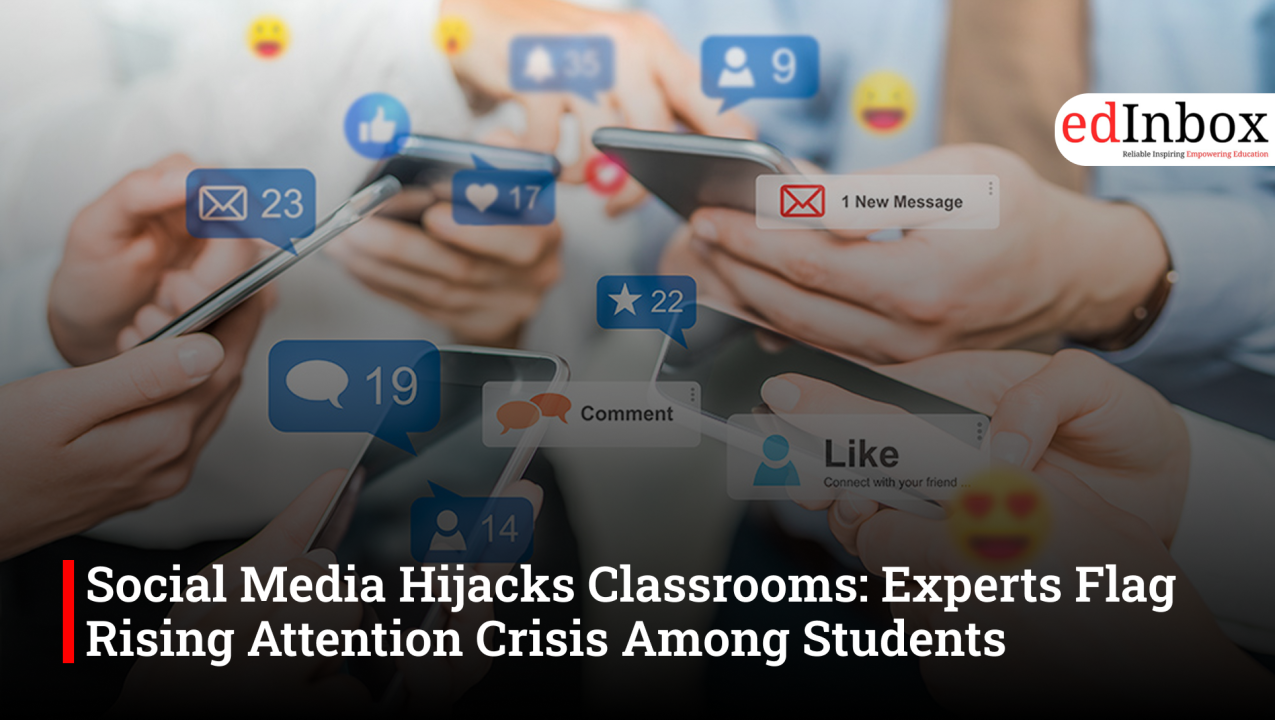
Social Media Hijacks Classrooms: Experts Flag Rising Attention Crisis Among Students
Typography
- Smaller Small Medium Big Bigger
- Default Helvetica Segoe Georgia Times
- Reading Mode