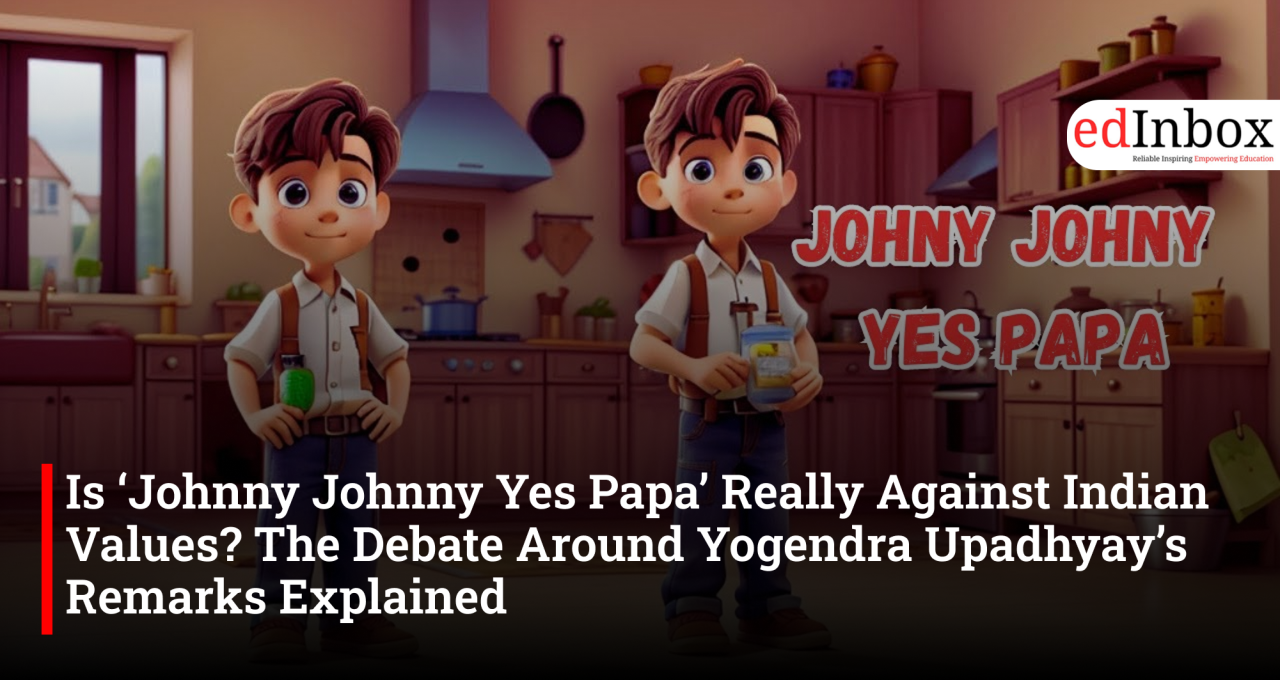
Most Indians have grown up hearing Johnny Johnny Yes Papa without thinking twice about it. It was simply a nursery rhyme children repeated in classrooms, school functions, and at home. The same goes for Rain Rain Go Away. Harmless, familiar, forgettable. That changed after Uttar Pradesh Higher Education and Science & Technology Minister Yogendra Upadhyay criticised both rhymes publicly.
According to the minister, Johnny Johnny Yes Papa encourages children to lie, while Rain Rain Go Away promotes selfish thinking by treating rain as a problem rather than something valuable for farmers and society.
Within hours, clips of his remarks spread across social media. Some people mocked the statement. Others defended it. Soon, the conversation moved beyond nursery rhymes and into something larger, what children should actually learn from school education.
Why the Remarks Connected with So Many People
Part of the reason this story exploded online is simple: almost everyone recognises these rhymes. People reacted emotionally because the songs are tied to childhood memories. For many, criticising them felt unnecessary or exaggerated. Critics argued that nursery rhymes are not moral textbooks and were never meant to be taken literally.
But others felt the minister raised a valid point. Children absorb ideas constantly from cartoons, stories, advertisements, and school material. Even simple rhymes shape language, behaviour, and emotional understanding at an early age. That is why some educators believe educational content should be looked at more carefully instead of being dismissed as “just for fun”.
This Debate Is Really About Education and Culture
The controversy has triggered a much wider discussion already happening in India. Questions around value-based education, Indian culture in classrooms, moral learning, and school curriculum have become more visible over the last few years.
Many parents today want schools to focus not only on marks and English fluency, but also on discipline, empathy, social responsibility, and cultural awareness. That is why a comment around two nursery rhymes suddenly became politically and socially relevant.
The minister also clarified that his criticism was not directed at the English language itself, but at the messaging inside certain educational content. Which seems fair and justified. India needs to think about these subtle things that shape a child.
Are People Overthinking Nursery Rhymes?
Probably. But that does not make the discussion meaningless. Most children will not grow up dishonest because of Johnny Johnny Yes Papa. At the same time, it is not unreasonable to ask what kind of values early education should reinforce.
That balance is where the real debate sits. School education has crossed the line of only making people literate. Parents and policymakers increasingly expect schools to shape behaviour, thinking, and emotional intelligence too. Once education begins carrying that responsibility, even nursery rhymes become open to scrutiny. And that’s exactly what has happened.
Why This Story Became Bigger Than a Viral Comment
In another country, the statement may have disappeared after one news cycle. In India, it touched several sensitive areas at once:
- education,
- culture,
- politics,
- parenting,
- and identity.
That combination almost always drives public debate. The controversy also reflects how education itself is changing. People are no longer only asking: “What should children study?” They are also asking: “What should children grow up believing?”
Why This Debate Matters
The argument over Johnny Johnny Yes Papa may sound trivial at first. But the reaction to it shows how deeply people care about education and culture, especially when children are involved.
Some will see Yogendra Upadhyay’s remarks as unnecessary moral policing. Others will see them as a reminder that education quietly shapes values long before students enter adulthood. Either way, the debate has turned into something more significant than a random meme online. People are not asking about what the society should normalise for the next generation.
Is ‘Johnny Johnny Yes Papa’ Really Against Indian Values? The Debate Around Yogendra Upadhyay’s Remarks Explained
Typography
- Smaller Small Medium Big Bigger
- Default Helvetica Segoe Georgia Times
- Reading Mode